
Troubled Margins: Academic Constraints and our Horizons of Liberation
Ghiwa Sayegh is an anarcha-queer writer, independent publisher, and archivist. They are the founding editor of Kohl: a Journal for Body and Gender Research and the co-founder of Intersectional Knowledge Publishers. They have an MA in gender studies from Université Paris 8 Vincennes – Saint-Denis. They are passionate about queer theory, transnational circulations, global economies, and imagined or unknown histories. Their influences are Audre Lorde and Sara Ahmed.
failure_of_humanitarianism.jpg
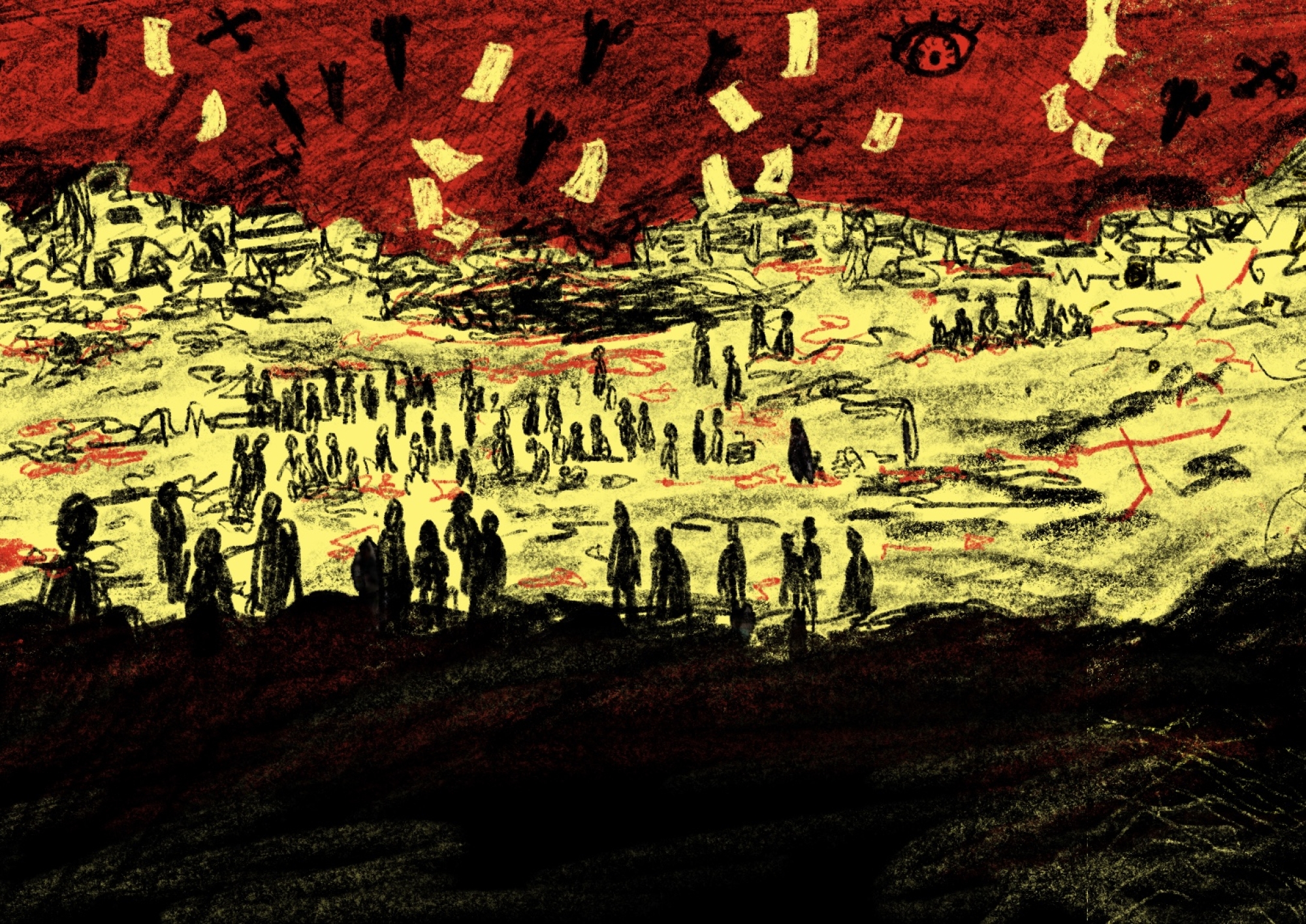
Myra El Mir
* The authors equally contributed to the conception and writing of this article. The names are listed in alphabetical order.
Academia against Liberation
We write this text from intersecting and intertwined locations, drawing on Palestinianness as a symbol of resistance to the colonialism that extends from Yemen to Lebanon, Sudan, and Palestine. As Palestinian academics in the diaspora grappling with ongoing forced displacement, we bind ourselves to a region we hope resembles us. But we are often met with rejection when we refuse to remain silent, to grow accustomed to, or to normalize, oppression. So we look for pockets of resistance that understand or resonate with our plight, whether in the space of a classroom or between the lines of an article. Our reality is distorted by deliberate and institutionalized ignorance; at times, sadness and helplessness take over. At other times, our anger is ignited by a colleague’s comment or by the banal indifference of those who live the luxurious or imagined lives they have created for themselves.
We are writing out of necessity, borne of the existential alienation we have to contend with. We live and work in different contexts; yet, our shared state of alienation is punctuated by the same fear: amidst the constant shifts in the political, social, and institutional landscape in our region, how to keep making sense of our place as political beings? This article is the result of a two-hour conversation. If mourning and a lost balance were the starting point, the thoughts we shared with each other (and now with you) are spontaneous, and free from the fear of judgment.
The context we are navigating and trying to understand today is that of the raging imperial war on our region and the ongoing genocide in Palestine and Lebanon. We find ourselves obligated to question our role and position as academics from this region, who write about and for it. We put our position within academic institutions under microscopic scrutiny. We are being exterminated and our geographies are being erased; we cannot allow research and academia to be removed from this reality, and we, as researchers, cannot allow our work to be metaphorical. This moment compels us to expose the institutional complicity that is required of its workers and seeps into the very function of knowledge. It also compels us to ask: are we neutral “mediators” in the service of neo-colonialism, or are we part of a movement that is resisting erasure?
This question raises a structural – and troubling – dilemma regarding the very essence of academic existence. There exists a sharp tension between the academic constraints that turn knowledge into an instrument of institutional domestication, and the horizons of liberation that researchers are expected to pursue as an act of resistance. Academic liberation cannot be limited to slogans of free speech; it has to be intertwined with the material conditions of daily life. How, then, can academics claim liberation while we remain bound to an elitist, comfortable way of life, and to rigid texts that are lacking in popular spirit? Our existential dependence on institutions distorts the act of liberation and reduces it to a mere temporary respite, before we inevitably return to the confines of screens and safe walls.
This constraint is even more complex with the erosion of the sense of security that has historically characterized the academic career path. Job stability has been replaced by policies of casualization, precarious employment, and short-term contracts that undermine the researcher’s dignity. Clear paths to tenure have shifted into navigating a project-based system that relies on grant applications. Such institutional humiliation forces academics to chase funding, the conditions of which are contingent upon donors’ agenda rather than the pursuit of truth. What happens, then, when the professor becomes a temporary employee scrambling for their next contract? How do we carve out a genuine horizon of liberation away from the institution’s dominance and what we are naming moving margins? In the era of academic collapse, this is our most pressing ethical and epistemological challenge; and creating alternative spaces is a necessity for survival, not intellectual luxury.
On the Structural Impossibility of Anxiety
Through this text, we engage with the fabric of anxiety within academic and institutional spaces in the Arabic-speaking region. Anxiety is structural; it is a strategy of control that governs our existence. As academics who teach, research, and write, we face vague, unclear, and incomprehensible boundaries: there are no clear standards or fixed red lines defining what we can say, teach, or write. The institutional strategy allows spaces to engage with certain issues, provided that they do not lead to any real disruption of the status quo.
Hence, the institution transforms political action into a mere outlet that does not address the roots of the issue, but ensures its continuity instead, by absorbing anger and channeling it in ways that do not disrupt its own structures. What we call the perpetually moving margins are at the heart of this structure. Their deliberate ambiguity keeps us academics in constant negotiation with boundaries we do not fully understand, and that can shift at a moment’s notice depending on geopolitical fluctuations. An institution that claims to embrace Arab nationalism, liberation, or even a critical ideology may suddenly find itself rewriting resistance as a threat under pressure from state “security” conditions and policies. Instability is structural violence: with the increasing reliance on temporary contracts and the neoliberalization of the university, academics are at the mercy of institutional volatility. Compounded with ambiguous evaluation criteria, intellectually distinguished individuals may be denied tenure simply because their critical thinking poses a threat to the required model of loyalty at a given moment.
In the same vein, this structure troubles identity and uses it to manipulate boundaries, making them even more blurred. As educators, we work with many students from diverse backgrounds and of mixed or hybrid identities. Instead of celebrating diversity and critically engaging with identities as part of the fabric of the region, they are instead invoked to isolate them from their ecosystem. In the West, we have observed with great concern how they are, at best, treated as a civilizational mission, or portrayed as ideal victims who must be rescued from the backwardness and barbarity of their own societies – in contrast with the image of the violent “other.” This feigned innocence is a dividing tactic adopted by Christian Zionism, colonialism, and the “whitening” that follows internalized self-contempt and self-hatred. It aims to erect barriers between our kin from within the same society, and pushes minorities toward seeking refuge in white privilege and false neutrality. Dual citizenship is also used as a tactic of class maneuvering, with Western identity positioning itself as a shield of safety and privilege. On the other hand, it is quick to disavow those same citizens in favor of political posturing, without ever being bound to real commitment.
In a lecture hall that abounds with socioeconomic privilege, the scarce diversity becomes a source of polarization. It is from within this space that we question our role as educators. Should we mitigate polarization by facilitating, taking a step back, and instructing when necessary? Or should we instead use this polarization to open up spaces for critical discourse? The violence of shifting margins resides precisely in that it prevents us from experimenting and improving our pedagogical methods towards learning, and reality becomes limited to the rigid bubble of representation in privileged classrooms. True diversity, including marginalized, migrant, and refugee groups in diaspora settings, should fuel critique and deconstruct racism, nationalism, and privilege. In elite environments, we find ourselves using an authoritative tone instead, as students are detached from reality because of ignorance perpetuated by parents and society alike, to avoid losing any privilege.
Privilege Limits Awareness
Fueled by the institutional structure of academia, frictions also occur from within our own circles. As we are witnessing the ongoing erasure of our own people, we find it extremely difficult to tolerate certain remarks from allied colleagues. We have to overextend ourselves to see the good intentions in others. Navigating the “war” imposed by our geopolitical reality, as Palestinian women, is not a craft mastered by everyone. Yet, it is precisely these expressions of sympathy, which still perceive our mastery of this craft as an inevitability, that make the burden of this reality even heavier to carry. With their weight, they cast doubt on the ideas, stances, and responsibilities we had been led to believe were a shared intellectual movement for liberation.
When the experience of war becomes transnational, we must turn our attention to our collective role in confronting the aggressions that are portrayed as our inevitable fate. Therefore, we must do the groundwork to treat what we know about war as a shared common ground. Bearing witness to war and then assuming the role of experts are heavy burdens, yet we as Palestinians are in a position to share the tools we have developed or inherited over the course of seventy-eight years in confronting the justifications for colonial terror. The elite have normalized the exceptionalism of the Palestinian experience with violence, as if that violence belongs to a qualitative rationale. According to this logic, Palestinians are sacrificed to the global colonial system, with people hiding behind implicit slogans: “kill them if you wish, as long as we remain safe and unscathed.” Expressions of sympathy and support often leave us feeling let down, if not humiliated. Thus, casual comments, such as “we don’t know how to deal with this situation” or “war shouldn’t happen here,” become moral justifications for inaction that undermine the possibility of building new educational environments where our resistance to this global system is not an exception.
The distance between their recent experience of war and ours sanitizes the complexity of Palestinian life, shaped by decades of colonial violence. It is the very essence of the Palestinian cause, and what it symbolizes: the struggle of a people resisting colonialism in all its forms. Not all Palestinians share the same experience: some have to live with the settlement apparatus and know that war is also in the time spent waiting at checkpoints; others disguise their words for fear of persecution in the colonial state; others still fight death in Gaza every day. As for Palestinians in the diaspora like us, the distance flattens our experience, and we feel that we have been robbed of our ability to speak. How can we talk about our diaspora, when we have experienced the meaning of life as death suspended? When survival requires we get used to grief and loss? In the absence of this complexity, our existence is swallowed by everyone else’s right to protection, and to feeling anger, sadness, fear, confusion… and we become the void.
A Parallel Reality: Ignorance and Evading Accountability
When we question those around us about their stance on the war, we are in fact probing into the problem of modern collective amnesia – a form of abandonment without which we might have predicted the sirens of war and the raids in Arab skies. During our discussion, we realized that collective amnesia affects us too, and the generational gap between the two of us uncovers how the false notion that some of our countries are “unfamiliar with the struggle” plays out. Do we really forget? And how can we forget the nights made sleepless by our fear of a “nuclear attack”? The books in our parents’ library – about World War III and the Day of Judgment, now gathering dust, bear witness to the long history of the struggle. It is the very same struggle we are living through now; even if we turn a blind eye, it will catch up with us. How has the loss of memory led our surroundings to believe that their relationship with violence is a recent phenomenon?
It’s become apparent to us that the political upheavals of recent decades have given rise to a social fabric that has a turbulent relationship with time. The torturers in prisons across Palestine have capitalized on this deliberate ignorance, and successfully marketed it as a lucrative commodity. Wealthy families trade in this currency; they rush to protect their children from reality, not only by withholding information but also by preventing them from engaging in politics for fear of losing them. Yes, losing them, to a prison that resembles a death camp, or to a dark cell, or even to martyrdom. For the cries of joy do nothing to quiet the grief that weighs heavily on the martyrs’ families.
These political shifts manifest in our environment, transforming our cities – in both their building and destruction – into machines that reproduce the tools enabling ignorance. Families’ fears for their children translated into residential complexes with impenetrable walls, where residents isolate themselves from their surroundings, trading their language, history, and miserable existence for a sterile, truth-deprived reality. Those inside the walls are safe from the truth, and those outside are so consumed by it that they have come to doubt it. There lie the dilapidated sidewalks and streets, where the bodies who cannot afford to live within walls crowd together, with their distorted history, dark reality, and miserable education.
But the city and the home are not the only sites where reality becomes sanitized. The very circulation of ideas cannot find a way out of this conundrum, and this turbulent relationship, which becomes the only relationship, colonizes even our political imaginary. Our discussion came to the conclusion that ignorance has become so rampant that when visual media distort the facts, they serve as a reference for creating parallel realities. For one of these parallel realities, the genocide in Gaza has come to a halt, never mind that more than two hundred thousand martyrs have perished in the Zionist massacre of our peoples across the Mediterranean. We haven’t even begun to fathom the harm this massacre is inflicting upon us, even if we are led to believe that we are removed from it. Then there was this Ramadan series about the genocide in Gaza; it attracted a wide audience who were invested in the heroes’ stories. The series was criticized for its content, timing, and quality, and yet some counter-argued that “it is true that the series is fictionalized, but it is necessary to raise awareness about genocide, and it could even qualify as an archive.” What awareness and what archive? It is as if we are being taught again the meaning of these terms, so that, like everything else, they become open to interpretation. Visual media allows the morality of its consumers to hide behind the faces of its heroes, where they wash away their own guilt of (not) bearing witness through passive watching. Despite all we have collectively witnessed, we are once again disappointed in that we do not share a common ground when speaking of injustice or violence. We find ourselves going in circles when we try to find, in those around us, echoes of what we see and feel. This disappointment is precious; we lean into it because it refuses to give up on memory, and what we consider to be the bare minimum of what collective struggle can do.
In this context, we are brought to question the declining commitment of our political communities that have become accommodating towards low standards of collective consciousness. In another time – just not the present time, expressing such inclinations or giving in to any form of Zionist narrative would have caused a scandal. How can we not consider the argument of archiving, honoring victims, and raising awareness about an ongoing genocide to be an excuse that ultimately serves to whitewash Zionist crimes committed by the Israeli occupation and its allies? How can we not criticize the absence of a deep political and academic framework regarding the modes of knowledge production that shape public consciousness? This subtle ignorance, in which parallel realities become the primary reference for understanding life, is nothing but a separation of reality from the real suffering of real people. Public discourse is shifting towards this imagined reality rather than towards the actual violence being experienced. This shift then seeps into the general public’s consciousness, and becomes one of the pillars of what is known as compassion fatigue. Those whose lives do not depend on knowing the details of the genocide, whose families and loved one are not affected by it, and whose very existence has not been shaped by it, can decide to stop watching the news, stop listening to survivors’ testimonies, stop counting the bodies of dead children, and stop hearing the cries of the survivors amongst them who have lost parents, homes, and limbs. When watching such series, they may feel a sense of satisfaction: immersing themselves in a simplified, fake reality confirms their own innocence, and may even evoke feelings of pity and sadness – but it is never conducive to the anger that fuels genuine solidarity and accountability.
Erasure is the consequence of the loss of collective memory, and it manifests itself in our classrooms. Let us remind ourselves, if we can ever forget, that we are trapped in the web of a colonial occupation that not only haunts us geographically, but also consumes our recent memory to accelerate time itself: a year of renewed violence erases the year that preceded it. It is as if the transmission of hope from one generation to the next also passes through the delays of exhausting checkpoints that veer us away from our path to liberation. How is it that the January Revolution is absent from the narratives of Egyptian students aged 20 to 25? Why have the repercussions of Sudan’s secession from the South in 2010 faded away, failing to shape the consciousness of Sudan’s children? As for the well-off Palestinian youth in Lebanon who live outside the camps, they do not understand what pushes them to change their accent, nor do they know much about the Sabra and Shatila massacre. While the events of Black September shaped the political consciousness of Jordanians, they barely understand the regional dimensions of the war. This erasure is maintained through intergenerational ignorance, where memory – specifically major regional transformations such as the Arab Spring – is treated as a distant, irrelevant, or non-existent history. It allows a privileged class to enforce a reality stripped of politics, truth, and ultimately, roots. Social silence towards non-mainstream violence, prioritizes the comfort of the privileged at the expense of acknowledging the lives of the marginalized. This equation reinforces the erasure of historical consciousness, as significant political events are obliterated from collective memory and detached from the reality of the region.
Fantastical or Imagined Violence and the Parameters of Solidarity
Difference does not only reside in generational gaps. The colonial acceleration of time doesn’t follow a linear path – at least not as we have come to understand it in our region. The scope of violence is a measure of time, so that even a few years’ difference between two people can feel like an eternity. Similarly, different generations may sometimes feel they have lived through the same events. Perhaps it is the inability to define the violence we experience – its repercussions and how to deal with it – that distorts the very nature of empathy in our society and deprives us of a shared political consciousness. How can we talk about violence, and can we even resolve it without the necessity of dismantling the Zionist entity?
There is a hierarchy of who is deemed worthy of grief and loss. In this hierarchy, only extreme violence – or unprecedented manifestations of violence, as exemplified by the mutilated or dismembered bodies of Palestinians in Gaza since October 2023 – is granted social, political, or even academic attention. This selective and conditional recognition creates a spatio-temporal distance that erases the structural violence occurring daily in our streets and neighborhoods, particularly against marginalized groups. Gendered and racial violence in geographical proximity – as is the case in Lebanon or Iran – is normalized by portraying these localities as inherently prone to violence, thereby excluding them from the imperative of solidarity.
International donors, NGOs, and Western philanthropists focus particularly on those who do not live inside the bubbles and walls of privilege. Abandoned by the state, they are treated as surplus or as a problem, and portrayed either as victims, savages, or criminals who must always be managed and tamed. This couldn’t be farther from reality. They are praised as “resilient,” capable of coping with any disaster, loss, or deprivation. But calling them resilient implies they would never deserve a dignified life. It is enough for them to survive within predefined parameters that preserve the saviors’ paycheck and absolve the state of its duties. And despite efforts to keep them ignorant, their political consciousness is sharp. Yet, they are expected to feign ignorance, play the role of the victim, and be voiceless in order to be worthy of the crumbs of charity thrown at them in the name of humanity.
What shapes solidarity is a deep divide. Students from elite backgrounds are detached, their privileges dependent upon a deliberate ignorance perpetuated by their parents and society. In contrast, students on scholarships stand out as the most critical thinkers, as their awareness stems from a genuine engagement with reality rather than intellectual comfort.
This contrast deconstructs and explains the concept of conditional solidarity. Without a deep political foundation, “woke” students view the Palestinian cause through an abstract lens of compassion, and Palestinians as people being bombed. On the other hand, students who have a closer relationship to suffering have a fundamental connection to reality. The paradox of shared religious, spiritual, or cultural references, such as the concept of martyrdom, offers them a kind of solace despite their differences. While this paradox momentarily breaks down elitist barriers and creates a space for emotional connection, it does not necessarily succeed in forging sustainable political bonds. As a result, disconnect and distance remain, dictated by the majority’s class position and avoidance of active political engagement – whether intentional or due to systemic ignorance.
Affect against Erasure
Throughout our discussion, and although we have grown accustomed to blaming generational differences, we realized that systemic ignorance and distorted empathy are not necessarily linked to generational gaps. This never ceases to amaze us despite its obviousness. If anything, the time gap between violent events in the region is not significant; in terms of our experience of violence, it is the defining feature of the region, given the continued existence of the Zionist entity.
Ultimately, we find ourselves facing two impossible choices: either remaining in troubled margins, haunted by the anxiety of self-censorship and institutional oversight, or fleeing to the colonizer’s empire in search of false security. But we are fully aware that to turn to empire is to throw ourselves in the heart of what created these dilemmas in the first place. There is no true salvation there, only a shift from the shackles of anxiety to the shackles of submission, assimilation, and colonization.
Our determination to create spaces for knowledge – through conferences, research seminars, and professional gatherings – is not merely an organizational effort; it is an act of resistance against attempts to confine us to the role of the Palestinian researcher or the refugee, expected to be the sole guardian of memory and bearer of the cause. We refuse to allow our identities to be reduced to functional labels, or our human existence to be confined to roles dictated by institutions or stereotypes.
We seek to transform solidarity from a fleeting, performative gesture into a shared, fundamental responsibility. We realize that this burden is our destiny and our duty, but we refuse to bear it alone. Our call for others to engage with the margins is a call to share the burden of truth, and to reject research projects that reduce us to mere numbers in donors’ records. We seek alternative spaces for genuine academic freedom, free from institutional constraints. To transcend the frameworks of academic objectification, we need to build a structure of certainty that refuses to compromise on human harmony and space justice.