Against the Imperialism-Theocracy Binary: Toward a Feminist Reimagination of Iran’s Liberation
dima_nachawi_-_civil_society.png
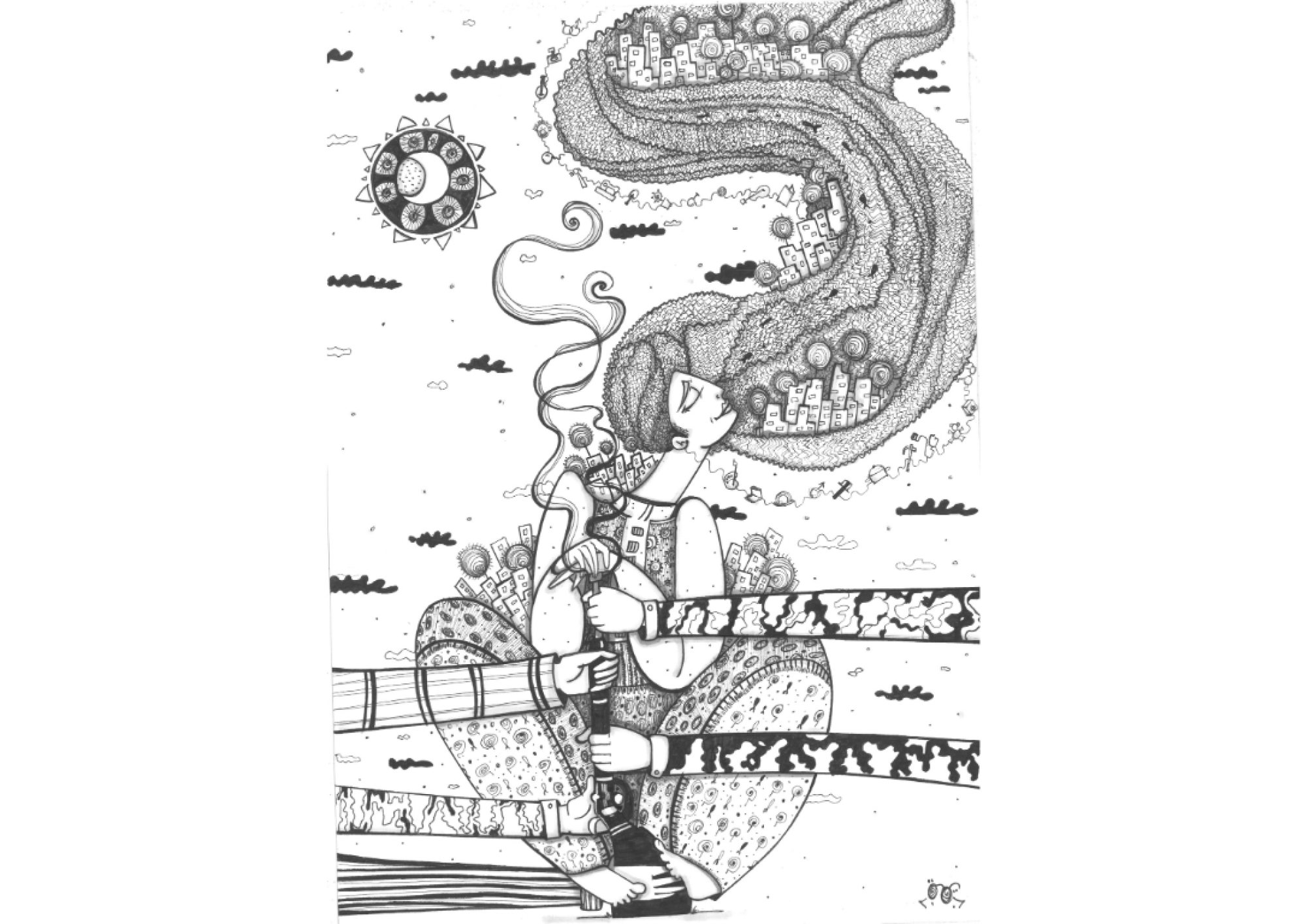
Civil Society - Dima Nachawi
(This illustration was a tribute to the civil society threatened by Jaysh Al-Islam in Ghouta)
On the morning of Saturday, February 28, 2026, nine-year-old Ariya and six-year-old Athena, along with over one hundred classmates and teachers, began their school week at the Shajareh Tayyebeh school complex in Minab, southern Iran. At 11:05 a.m., Ariya’s mother received a call from his teacher requesting that she come pick him up. Seven minutes later, the teacher’s phone went out of service. Hours later, Ariya’s father found his son’s shoes and uniform beneath the rubble of the school’s prayer room.
In a “double-tap” strike, a U.S. missile killed 168 students and teachers who had taken shelter in the prayer room after an initial missile hit the adjacent area. By the time Ariya’s afternoon math class would have begun, local residents counted up to six missiles hitting the school and its surroundings. Ariya’s father later recalled that day “smelled like collective blood” as he joined other desperate parents and rescuers in identifying the remains of their children and missing loved ones.
This account is drawn from a report by Iranian journalist and former political prisoner Negin Bagheri, published on her Instagram page a few days after the incident under limited internet access. It documents the killing of Ariya Bahadori, one of more than a hundred victims of the Minab school bombing.
Even in the early hours of the Israel-U.S. self-proclaimed “liberation mission” in Iran, the mask of imperialist aggression slipped: schoolchildren, mostly girls between seven and twelve, were among the first victims of the war. How could Israel’s “Roaring Lion” and the U.S.’s “Operation Epic Fury” claim to save women by killing women?
While this question may appear well-worn in 2026 – after Afghanistan, Iraq, Palestine, and Libya, this iteration of the Zionist-U.S. intervention in Iran demands renewed scrutiny. The unfolding war that rehearses once again a familiar imperial script under the guise of liberation in the region is taking shape on the heels of a massive, bloody uprising – the Dey Massacre that left Iranians mourning the violent killing of tens of thousands of protesters (Niktab Etaati 2026).
As Iranians are resisting the violence of daily foreign bombs and missiles, the repressive state of the Islamic Republic, through its anti-imperialist rhetoric, produces a paradoxical terrain for understanding resistance. This terrain is structured by a false binary in which opposition to imperialism and authoritarianism are framed as mutually exclusive. Does opposing war mean alignment with Iran’s oppressive regime? This paper takes up what remains incomprehensible within the dominant strand of Western and “Axis-of-Resistance” aligned anti-imperialist camps: the necessity for a feminist reimagining of liberation that refuses both patriarchal theocracy and imperial feminism.
Politics of Theocratic Authoritarianism
We stay at home most of the day. There is no internet. Satellite channels are heavily jammed. Until today we had no secure internet access at all. Today, after much effort, a VPN finally connected. […]
The city looks quiet. The air is unusually clean. It feels as if those responsible for pollution are busy with war and do not have time to burn fuel and darken the sky.
But the streets are full of armed officers. They patrol constantly on foot, on motorcycles, and in cars. Sometimes they move in long convoys. They shout and make noise.
When air raids begin, we simply listen to the sounds. We do not take shelter, because there is nowhere to go. We did not tape our windows either. There are no sirens before attacks. No warnings. No instructions.
We are certain these difficult conditions will continue until Nowruz. Still, we endure.
This war diary by an anonymous writer in Tehran was published in the first week of the war. By March 23, 2026, which marked the 24th day of the war, Iranians had endured 552 hours of a nationwide digital blackout imposed by the regime, rendering international connectivity inaccessible to the public “while authorities maintain a selective whitelist for global access.” Meanwhile, the regime’s primary telecommunications companies, Irancell and Hamrahe Aval, have exploited the crisis by selling exorbitantly priced international call packages that remain inaccessible to working and lower-middle-class families.
Amid this communication suffocation, the government continued to issue direct threats via text messages, warning the citizens that any activity deemed to be “aligned with the enemy will be harshly punished” (according to a text message received by an Iranian resident who wishes to remain unnamed). On a live program on National TV, Salar Velayatmadar, a senior commander of the Islamic Revolutionary Guard Corps, addressed parents: “If your son and daughter don’t listen to us, it’s not our fault. Anybody inside Iranian soil who lets a sound out of their throat that aligns with the enemy, their feet are in Tel Aviv, and their head is with Netanyahu, so the order to shoot them has been issued.”
As part of this politics of explicit intimidation and sanctioned violence, numerous military checkpoints run by the Basij volunteer armed forces appeared across the country to actively patrol and control the population during wartime. The intensification of fear and the militarization of everyday life as a state tactic of repression have remained in effect since the Dey uprising in January. Just days before Nowruz, the Persian New Year, three people, detained during that massacre, were publicly executed under ongoing Israeli-U.S. missile strikes.
There are no shelters, no sirens, no system of protection for Iranians as foreign bombs fall across the country. As the account mentioned above indicates, they simply wait in their homes, listening to explosions, uncertain whether the next strike will hit them. At the same time, the regime, in its words, showcases more than ever “Iran’s national authority and resistance to the enemies by defending its sovereignty” with missile strikes against U.S. bases in the region, the Persian Gulf countries, and Israel.
The regime’s resistance doctrine is evidently founded on the preservation of its geopolitical dominance, rather than the safety, protection, and welfare of the population. It waged forty-seven years of systemic repression against civil movements, student and labour networks, and feminist uprisings. This repression has sustained the theocratic empire, which systematically invests its human and natural resources in war machinery and coercive control, rather than in developing its productive capacities.
The lived struggles of Iran’s working and middle classes over nearly a century should be enough to dismantle the regime’s narrative that it is the sole anti‑capitalist force resisting U.S. imperialism in the so‑called Middle East – a myth still romanticized by segments of the neo-campist Left. In reality, the state’s anti‑imperialist doctrine operates as a form of “deformed anti‑imperialism, one that readily aligns itself with semi‑peripheral dictatorships,” producing an ostensibly radical internationalist politics that ultimately legitimizes and reproduces the very internal structures of oppression and exploitation it claims to oppose (Matin 2026). Meanwhile, the identity‑driven form of anti‑imperialism upheld by leftist campists “justifies repression, patriarchy, homophobia, and internal colonialism in the name of ‘resistance’” (Rostampour 2026). This campist posture easily renders the victims of Iran’s state violence as collateral damage within its geopolitical calculus, preventing the rebuilding of a popular, emancipatory leftist front (ibid.).
The regime’s manufactured narrative of “resistance,” draped in the familiar rhetoric of the Axis of Resistance shared with other regional allies, has convinced segments of non‑Iranians that the Islamic Republic is the only serious force confronting Israel’s military expansion and its Zionist colonial project in the region, and is therefore a political formation to be defended through any means necessary. This follows the logic of “the enemy of my enemy is my friend,” a rationale that also appears, in reverse, among parts of the Iranian diaspora who endorse the Zionist-imperialist military aggression on Iran because they cast the regime as their primary enemy and Israel as the only actor confronting it. What this geopolitical theatre of “resistance” obscures is the simple fact that the Iranian regime’s posture toward Israel cannot be understood as aligned with the emancipatory struggles of oppressed peoples. The state’s theocratic authoritarianism is fundamentally – and violently – antithetical to any project of liberation, just as the deployment of so‑called “freedom bombs” by Israeli and U.S. forces is irreconcilable with any emancipatory language.
For nearly half a century, the regime’s slogan, “Revolution for the Oppressed,” has, in practice, been replaced by a neoliberal order that privileges an oligarchic ruling class. On one hand, this system has entrenched corruption and exclusionary welfare; on the other, it has systematized the economic deprivation of ordinary Iranians. Conditioned by intensifying U.S.-imposed sanctions, Iran’s political economy has been severed over decades, further widening class inequalities throughout the 2000s. As a result, working-class women, particularly those who “rely exclusively on various forms of informal, low-wage, and fragmented work for social reproduction and daily survival,” are amongst the most precarious “classes of labour” (Abdi 2026). These classed and gendered disparities have been intensified by the neoliberal, authoritarian, and patriarchal policy regime that structures labour conditions and constrains women’s capacities to sustain everyday life (ibid.).
Whether in its legal framework that institutionalizes gender discrimination or in its violent suppression of feminist movements, the regime never concealed its patriarchal and repressive nature. The imprisonment, torture, and execution of dissidents reveal a system in which control over women, gender-diverse, and politicized bodies is central to its authority. The 2022 “Woman, Life, Freedom” (Jin, Jîyan, Azadî) uprising is a profound challenge to this structure; it is part of an insurgent lineage that not only long confronted the authoritarian state but also interrogated the deeply embedded culture of patriarchal norms within Iranian society itself. The regime’s brutal crackdown on this movement offers unequivocal evidence of a political order that sustains itself through the systemic regulation of women’s bodies, gender-based violence, and the repression of fundamental rights.
Politics of Imperial Feminism
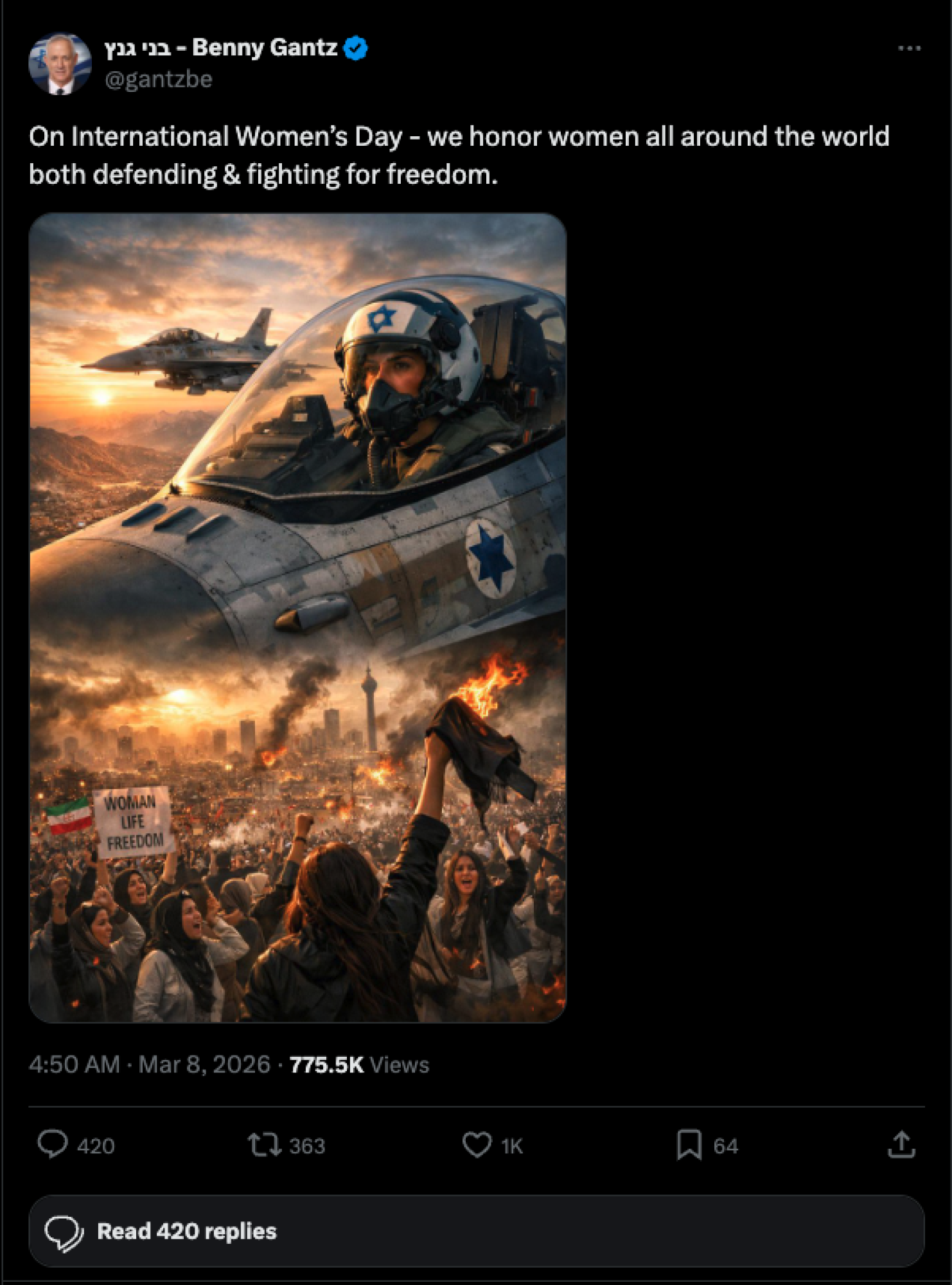
This is what former Israeli Minister of Defence, Benny Gantz, posted on his X social media account in celebration of International Women’s Day in 2026, amidst the Zionist-U.S. war on Iran. It shows what appears to be an AI-generated image of an Israeli female fighter jet pilot flying over Tehran’s sky, while Iranian women on the ground protest, holding up their burned scarves and “Woman, Life, Freedom” signs. In June 2025, during Israel’s twelve-day war, Netanyahu addressed the Iranian people by referring to them as descendants of Cyrus the Great and invoked the slogan “Woman, Life, Freedom” in both English and Farsi, assuring that this war was being waged for their liberation from Iran’s “evil and repressive regime.”
Nothing reveals the apparatus of Zionist-imperial feminism more clearly than this image and these words; they crystallize the instrumentalization and co-option of women’s struggles for freedom in the service of expansionist militarism, as enacted by a genocidal settler-colonial state. The global far-right rhetoric frames imperial military intervention as both inevitable and emancipatory for women’s liberation, and appeals directly to monarchist and reactionary factions within the Iranian diaspora, who have long advocated for regime change by any means necessary. The invocation of Cyrus the Great is not incidental; it echoes a long-standing discourse within the diaspora that mobilizes proximity to whiteness and the glorification of Persia’s imperial past as strategies for belonging and inclusion in the West (Malek 2025:266). Since the Dey Massacre, this faction has further consolidated and amplified its ideological position by adopting the Trumpian slogan MIGA (Make Iran Great Again), alongside the slogan “Man, Homeland, Prosperity” (Mard, Mihan, Abadi) as its vision of liberation – one that is not struggled for from within, but imagined as bestowed through Zionist-imperialist intervention by figures such as Trump and Netanyahu.
Other imperialist actors have performed similar renditions of this Zionist feminist script, staging them as projects of democratic salvation in the Global South. Among the most cited and critically examined by decolonial and anti-colonial scholars is the U.S. “saving mission” of burqa-clad Afghan women from the Taliban in 2001 (Ahmed 2013; Abu-Lughod 2013). Laura Bush’s 2001 propagandist radio address framed the War on Terror as a “fight for the rights and dignity of women.” This overt staging of a white woman’s voice to authorize war in the name of saving brown women’s bodies barely conceals the underlying mechanisms of imperial feminism. From its opening act, it was fraught, grounded in assumptions of Western superiority, and the imperial production of Muslim women as docile subjects stripped of agency and in need of rescue (Abu-Lughod 2013). What was scripted as a humanitarian rescue unfolded instead into the creation of a failed state marked by prolonged violence: mass killings, sexual violence, displacement, forced migration, and the systemic erosion of women’s lives and rights. The U.S. brought this performance of women-saving to a close in 2021 with the fall of Kabul, leaving the stage to a reinstated regime of gender apartheid under Taliban rule.
Like its precedents, the ongoing wars in Iran, Lebanon, and Palestine are wars on Woman, Life, and Freedom – on women’s bodies, on the conditions of life, and on the very possibility of liberation. They entail not only the destruction of life, land, and future, but also the systematic intensification of women’s visible and invisible burdens: the extraction of emotional labour, the violent rupture of social reproduction, and the deepening entrenchment of both domestic and state violence. The displacement of one quarter of all women and girls in Lebanon due to Israeli military aggression since March 2, 2026, alongside the fact that women and children constitute 70% of those deliberately targeted and killed in Gaza since the beginning of the genocide on October 7, 2023, lay bare the gendered architecture of Zionist-imperialist warfare. In the present moment, when missiles shape the contours of everyday life in the region, the political horizon of liberation recedes, eclipsed by the immediacy of survival and the fog of explosions. War, by nature, is anti-feminist: it reproduces and hardens the very structures of domination that feminist struggles seek to dismantle and reimagine.
Politics of Refusal
Over a century ago, amidst World War I, the Marxist thinker and revolutionary theorist Rosa Luxemburg foresaw that all future wars would be imperial wars, serving the accumulation of capital and the struggle for world dominion (Luxemburg 1918).
The geopolitical chessboard of the ongoing Israeli-U.S. military aggression on Iran, Lebanon, Palestine, and Syria is not difficult to discern. Every move is directed toward geopolitical dominance, land theft, the destruction of civilization, and the very erasure of life and freedom. As Luxemburg warned in 1918, political rupture gives way to moral collapse following the dismantling of internationalism in favour of national warfare. In the face of present Zionist-U.S. imperial greed, no nation is immune – only their time has not yet arrived.
While the face of the external aggression in the region could not be more unveiled, the machinery of war in Iran has another face – one that is less visible, more difficult to read. It forcibly imposes a damaging choice between alignment with imperial power and the defence of authoritarian rule. This false binary lays bare the violently narrowed imagination of geopolitics, where people are reduced to chess pieces, presumed to have no agency, to be positioned and played by external powers.
The feminist struggle for freedom resists both tyranny and empire. Genuine aspiration for liberation is imagined on a different terrain – one that is collective, self-determined, and disentangled from intersecting systems of domination, whether imperial, patriarchal, Zionist, or authoritarian. Transnational feminists reject the imposed choice between murderers. They reject the hierarchy among regimes of dominance, grounding their politics instead in the emancipation of the oppressed, whose struggles predate state and geopolitical orders. They refuse the framing that dictates which lives are more “grievable” than others (Butler 2009). They mourn all the precious lives cut short by imperial greed or tyranny’s oppression: the schoolgirls of Minab, the thousands of women murdered in the Dey Massacre, those who sacrificed their lives for “Woman, Life, Freedom.”
This aspirational liberation is inseparable from broader struggles for freedom that reject binary thinking and forced alignments. In the present moment marked by war and genocide, when imperial powers scorch the earth, a politics of refusal may be the only form of commitment that remains faithful to people’s struggles and capable of opening space for new political imaginaries. Long practiced within queer and trans liberation movements in Palestine and Lebanon (Maikey and Darwich 2026), it is a politics that simultaneously rejects colonialism, state violence, and militarism, while refusing the choices that demand the erasure or silencing of certain bodies.
A politics of refusal does not offer a neat or stable position; at times, it might seem to fail to provide the “shared grammar” needed to hold contradictions together. Yet it remains the only politics that refuses to subordinate marginalized bodies to prioritized geopolitical projects, insisting instead that liberation cannot come at the expense of the most vulnerable.
Abdi, Asma. “Gender, Crises of Social Reproduction, and Iran’s Neoliberal Policy Regime.” Jadaliyya, February 24, 2026. https://www.jadaliyya.com/Details/47194/Gender,-Crises-of-Social-Reproduction,-and-Iran%E2%80%99s-Neoliberal-Policy-Regime
Abu-Lughod, Lila. Do Muslim Women Need Saving? Cambridge, MA: Harvard University Press, 2013.
Ahmed, Akbar. The Thistle and the Drone: How America’s War on Terror Became a Global War on Tribal Islam. Washington, DC: Brookings Institution Press, 2013.
Al-Halabi, Madlin. “The Women of Gaza during the Current Genocide: Women, War and Resistance.” Institute for Palestine Studies, 2024. https://www.palestine-studies.org/en/node/1655116
Butler, Judith. Frames of War: When Is Life Grievable? London: Verso, 2009.
Luxemburg, Rosa. The Junius Pamphlet. 1918. Marxists Internet Archive. Accessed March 31, 2026.
Maikey, Haneen, and Lynn Darwish. “The Long Refusal: Queer Decolonial Praxis in a Time of War and Genocide.” Jeem, April 27, 2026. https://jeem.me/en/authority/1450
Malek, Amy. Culture Beyond Country: Strategies of Inclusion in the Global Iranian Diaspora. New York: New York University Press, 2025.
Matin, Kamran. “The Iran War and the Contradictions of Anti‑Imperialism.” The Amargi, May 14, 2024. https://www.theamargi.com/posts/the-iran-war-and-the-contradictions-of-anti-imperialism
Niktab Etaati, Saeedeh. “The Dey Uprising: Iran at a Volatile Interregnum.” Histoire Engagée, February 24, 2026. https://histoireengagee.ca/?p=13775
Rostampour, Somayeh. “For an End to Campism: The Iran War and the Anti‑Imperialist Washing of the Islamic Republic.” Tempest, May 2026. https://tempestmag.org/2026/05/for-an-end-to-campism-the-iran-war-and-the-anti-imperialist-washing-of-the-islamic-republic/