
Temporal Constellations: Movement and Revolution in You Must Believe in Spring
dabke_website.jpg
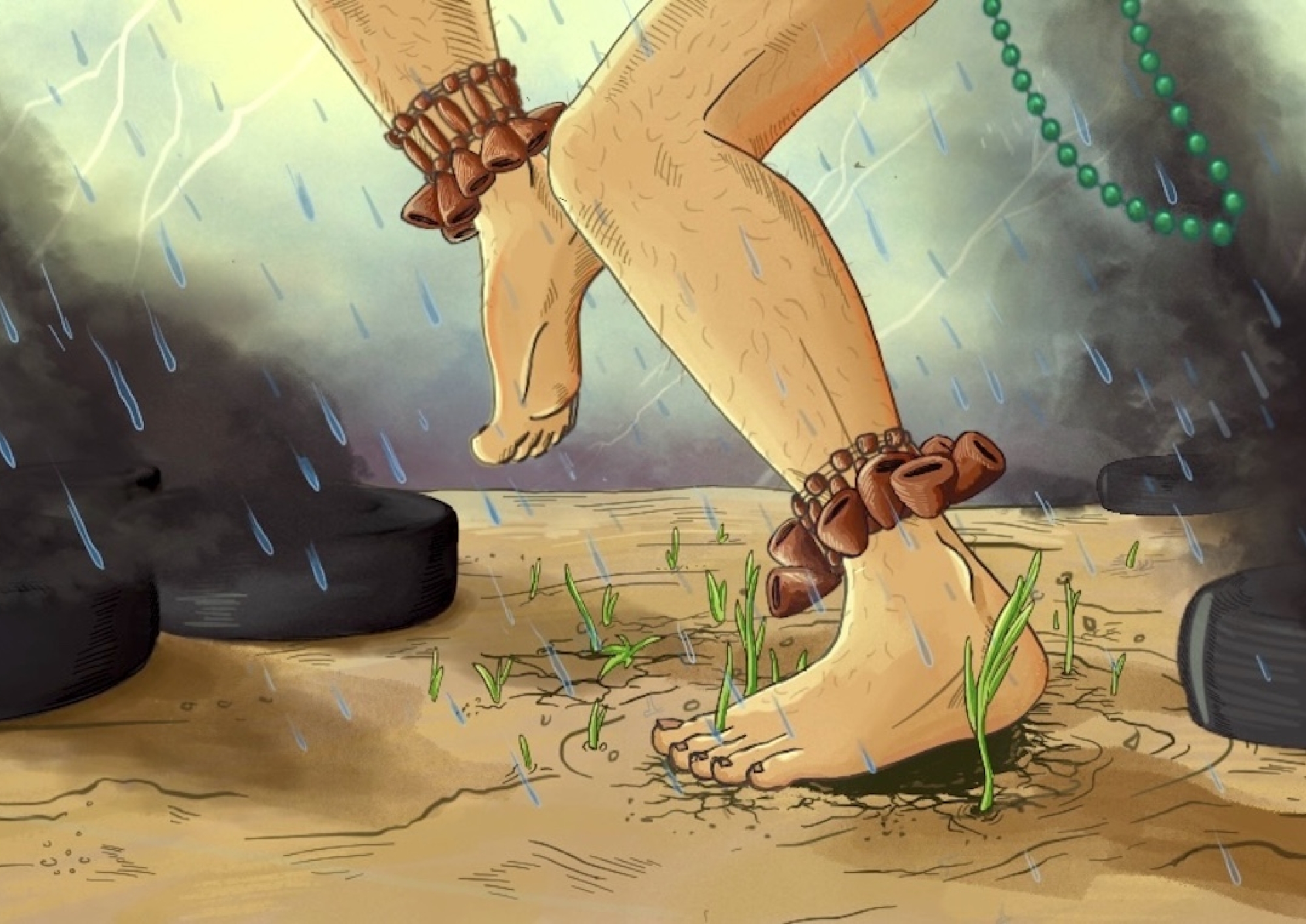
Sarah Al-Sarraj - Dabke
First, I want to acknowledge the Boonwurrung people as the rightful owners and sovereign people of this land and pay respect to First Nations people present today. As we struggle against Zionist settler colonialism, we work in the lineage of the long struggle for liberation against the settler occupation of [so-called Australia] too. First Nations have been in this fight for centuries and today we humbly contribute a small part to this immense legacy.
– A black-clad activist, Boonwurrung Country, 2024.1
This essay began over two years ago in a library. I was buried in Mohamed Tonsy’s novel You Must Believe in Spring and was reading works of José Esteban Muñoz and other theorists interested in queer temporalities. I emerged with an image: that of the temporal constellation. The novel presented moments unfolding in time, not as a sequential chain of events but, rather, an array of interrelated locations. The past flashes up unexpectedly in the present, bringing with it resources, affects, and ideas. The future is a constant horizon, glimmering with potential for a life outside the constraints of the present. The here-and-now is the terrain of struggle. I parked the essay, expecting it to remain a forgotten file on my computer, and left the image to idle. A year on, busied among pockets of the global movement in solidarity with Palestine, I began to see the image resonate more and more with the organising I was involved in. I re-read the novel with a mind freshly attuned to political praxis and adapted the piece to weave in reflections on resistance in my neck of the woods and beyond.
Straight time unsettled
Straight time is the hegemonic conceptualisation of time as linear, sequential, and excluding anything outside the here-and-now. The future becomes but a reproduction of the present.2 For Walter Benjamin, this idea of time naturalises the normative social order. We are propelled through a “homogeneous, empty time” in the name of progress, the limitless, straight, and inevitable march of human history.3 Relations of power are continually re-produced, like the “beads of a rosary.”4 Linear time obliterates or devours past antagonisms that pushed against this march. In doing so, it hides the violence, exploitation, and resistance that conditions power in the present. The discursive defence of Zionism shows us how this works. When assessing the Israeli Occupation Force’s eliminatory campaign, state leaders across the world defer to so-called Israel’s “right to defend itself” and limit any criticism to military conduct.5 The right retrospectively naturalises the order established following conquest in 1948, and sees it instead as the product of the morally and legally valid acts of a sovereign authority, and not, for example, a genocidal occupation. Liberal critics of Israel still only focus their critiques on its actions in the West Bank and Gaza, the territories occupied following the 1967 Six-Day War, implicitly legitimising the occupation and displacement that facilitated the State of Israel coming into being in 1948.6 This position glosses over the fact that the events in Gaza today are a structural continuation of the Nakba that predates but intensified in 1948.7 In the words of Mahmoud Darwish, “the Nakba is not a memory; it is a continuous uprooting.”8 Invoking the right to self-defence, therefore, repudiates structural realities and obfuscates the historical conditions and relations of power that gave rise to so-called Israel’s sovereign status. The coloniser’s view devours past resistance, and we are left to imagine that the present is an inevitable consequence of progress.
If the future is limited to “normative reproduction” in “straight time,” José Esteban Muñoz suggests that queering this temporal paradigm involves denaturalising its linearity. Muñoz also suggests we peer into and extract from the wayside of history that which is “no-longer-conscious,” and experiment with affects, aesthetics, relations, and desires that reject heteronormative prescriptions.9 Utopia is not a complete ideal to work toward but rather a critique of the present and an anticipation of what is “not-yet-conscious.”10 Finding the aesthetic and social potentialities hinted to in the present, queerness, therefore, strives for another future; for utopia. It sees time as a constellation, not a sequence, and queerness as a “horizon,” rather than existing in the restrictive bounds of straight time.11 Apprehending the kernels of liberatory potential in the past, then, can potentially provide the tools and topography for struggles in the present.
The past flashes up
The overlapping and intersecting timelines in You Must Believe in Spring step out of the logic of straight time. The novel speculates on what might have been while rooting its story in historical events. Like Ronak Kapadia, I see artistic productions as a “radical cultural archive” which can “articulate social visions and political imaginaries” that are distinct and against dominant social relations.12 A queer calculus refers to a hermeneutic approach with the potential to uncover those intimate knowledges which are subordinated and obscured by dominant discourses of (in)security, terrorism, or war.13 In particular, diasporic literature constitutes what Kapadia calls an “insurgent aesthetic,” which makes legible the affective, sensorial, and imaginative aspects of political moments.14 This produces knowledges that are sensitive to the corporeal experiences of those marginalised by empire, conflict, and carcerality. This framework allows for a more expansive notion of theory beyond the confines of the academic ivory tower. Situating Tonsy’s work of speculative fiction alongside the works of other queer theorists as well as social movements points to resonances, clarifications, and affective depth in the claims each makes about the world we yearn for.
The primary plot of You Must Believe in Spring is set two decades after the Egyptian Revolution of 2011. Hosni Mubarak was deposed, but the military co-opted the movement and has held onto power ever since. The Egypt of the 2030s is a dystopian military dictatorship in the depths of ecological collapse, intense social surveillance, and brutal repression. Shahed, the narrator and protagonist, is the son and grandson of revolutionaries. He was an athlete representing the armed forces, and a junior member of the Sufi order. He was initially ambivalent when reacting to dynamics in his world. Though his peers and seniors at the Sufi institute quietly resisted military rule, Shahed voluntarily wore an army eagle pin to remain inconspicuous.15 However, his Teita (grandmother) was a doctor in the field hospitals of Tahrir Square, and it is through flashbacks to times when she was alive that Shahed builds resolve. Knowledge of actions like Teita’s was the “no-longer-conscious” in post-(counter)revolutionary society,16 and Shahed progressively pulls these stories back into the present, activating in him a revolutionary consciousness that rejects the straight time that characterises military rule. During a clandestine crossing of the Nile during curfew, Shahed reflects:
Mama and Teita glimpsed the paradise that I still long for. They saw the best and worst of the country. Teita couldn’t live with the loss of paradise, while Mama traded her history for a paradise in Europe. Grief of that kind has a price. Part of me hopes that I never find anything so heinous that I have to look away, because to witness is to be powerful, to witness is to expose, to witness is to imagine an end to cruelties endured and the possibility of leaving suffering behind. It’s a way of saying, “The past has passed, and it doesn’t have to come to pass again.”17
Glimpsing paradise, or apprehending the revolutionary moment and experiencing the ecstasy of its potential, is a generative event. Memories are, according to Christopher Castiglia and Christopher Reed, not “retrievals of an archived past” but rather they imaginatively “craft a world that stands as a counterreality to the lacking or painful present.”18 As such, Shahed recovers the moment as the foundation from which he can say no in the present. This refusal gestures towards the possibility of another kind of future, without the suffering that constitutes the present, and activates his role in labouring towards it. Temporal experiments like this produce the past and future, each with a certain semiotic fluidity, in a constellation with the present. The here-and-now is the terrain for struggle, but the armature for the fight is derived from knowledge of or speculations about the past. If the protest camps at Tahrir Square were heterotopic, in that they enacted real, critical relations with other sites at that moment,19 Shahed’s relation to this camp represents how it has functionally disrupted the logic of straight time. He is able to recover knowledge of insurgent moments in the past, even though they are repressed by the straight time of the sovereign order, and mobilise them to enunciate defiance. This, according to Michel Foucault, is a sign of the heterotopia beginning to “function at full capacity.”20 When passing an army barracks, riddled with bullet holes as scars from a more insurrectional moment, Shahed is surprised to think that placing a finger in one such hole would allow him to feel “the essence of a hidden place, a time when people were not scared of firing guns at these buildings and were close enough to do so.”21 The practice he plays with crystallises in this moment:
I think again of the Bedouin conception of the past and the future as happening elsewhere, time being a geographic location, not an hour, so travellers are equally likely to find themselves in the past as their destination.22
Knowing time in this way brings those liberatory sites onto the horizon, if still too far to see anything but a blur.
Today’s movement in solidarity with Palestine is replete with instances that push against the logics of straight time. The epigraph to this piece, known in so-called Australia as an Acknowledgement of Country, came from a briefing delivered to a group of around one hundred people who were about to storm a major port called Webb Dock in Narrm (Melbourne) and begin a community picket to prevent the loading and unloading of a cargo ship. The ship in question was operated by Zim, so-called Israel’s national shipping line, and a long-time target of the Boycott, Divest, and Sanctions campaign.23 The action responded to a renewed call from Palestinian trade unions to target so-called Israel’s supply chains.24 Acknowledgements of Country in so-called Australia are a common way of showing awareness or respect for First Nations’ Country in a range of settings such as sports events, ceremonies, public talks, and television programs. The well-intended practice can, at times, be routinised and lack meaningful political commitments; a means for a non-Indigenous speaker to distance themselves from violence they perceive to be historical and not contemporary. As such, they are susceptible to paradoxically strengthen settler innocence, minimising accountability for colonisation, or erasing First Nations’ resistance.25 This instance, however, suggested quite a different orientation. It reads against the grain of settler colonial myth-making to identify First Nations’ resistance as central to this moment. Against the eliminatory logic and nature of the settler colony,26 the acknowledgement reactivated movements that are “no-longer-conscious” in the perspective of hegemonic time: from the Frontier Wars to the Intifadas. These are movements that enunciated radical critiques of the existing order; experimented with tactics, strategies, and organisational structures to deal with their situation; and carried affects, sensibilities and aesthetics that inform a vision of utopia. Much like the memories of Teita for Shahed, knowledge of other moments in the constellation (that is, other sites in the struggle against settler colonialism) helps to ground the subjectivity and guide the strategies of those in the movement today.
Bequeathing a dream
Militarism, carcerality, and war shatter linear progress. Maya Mikdashi and Jasbir K. Puar describe the ways biopolitical techniques alter bodies in contexts of permanent war and colonisation, destabilising Western queer theory’s taken-for-granted focus on sexual or gendered injuries. Instead, they invite a broader understanding of queerness in light of the many and varied ways bodies are harmed and altered in the context of permanent war.27 Permanent war prevents one from “moving forward.” Buildings are demolished and rebuilt, just to be demolished and rebuilt once again. Dr. Samah Jabr from Palestine’s Ministry of Health criticises the eurocentrism of PTSD diagnoses because they pathologise an individual’s reaction to social suffering: chronic and repetitive exposure to structural violence undermine any therapeutic intervention that presumes the traumatic stimulus to be in the past.28 Tonsy himself was forced into early retirement from racing triathlons after permanently losing eighteen percent of his lung capacity from the effects of tear gas in the protests in Egypt.29
Shahed’s journey culminates in the decision to perform a self-immolation in protest of military rule, bringing necropolitical resistance into focus for queer life on and in the margins. Necropolitics, or the “forms of subjugation of life to the power of death,” mark the contours of sovereign power.30 Bodies are instrumentalised in the economy of violence. The multitude is alienated not just from their labour, but from their land and also their bodies. Surveillance, settlements, displacement, destruction of infrastructure, militarisation of public space, and the fracturing of urban space into enclaves all fortify this process of alienation.31 Simultaneously, fictional or mythical narratives are projected onto the Other to justify the sovereign status.32 The multitude is literally and metaphorically bulldozed into reductive and anonymised political categories: violent terrorist, helpless victim, desperate refugee. The martyr refuses this corporeal instrumentalisation and instead re-appropriates their own body in service of an anticipated future, one that has transcended the necropolitical domination that characterises the here-and-now.33 Shahed is sensitive to the ways self-immolation negates sovereign power in terms derived from the necropolitical assemblage itself:
I never set out to die. If I had seen a way to deviate from this course and follow a different line to freedom – freedom in life – then I would have taken it. But there’s no way to topple this military government and live free, no flaw in the system that can be exploited to dismantle it. The state has no flaws; it functions perfectly to serve the people it was built to serve.34
The “universe in the bottle” of petrol that Shahed planned to douse himself with points to the limitless potentialities that might succeed this moment of negation of necropower.35 Although Shahed’s plan ultimately failed – the bottle of petrol slipped from his grasp before he had a chance to use it – the intention and narration make clear his shifted consciousness. It is not so easy to reduce the meaning of such actions to some Freudian death drive, because the death is reconciled in the pursuit and love for life of those left behind. In other words, he embraces death as a way of insisting on life. His simultaneous orientation to the past, present, and future reveals how insurgent affects might be activated in the process of becoming.
Much like Shahed in the face of death, writer and academic Refaat Alareer bequeathed a dream of a free country. Displaced since 19 October when his family’s home was bombed in Tel al-Hawa, Gaza City, he stayed in northern Gaza and broadcasted first-hand accounts from the area.36 Five weeks before his martyrdom in December 2023, Alareer shared his 2011 poem “If I Must Die” on X.37 The poem is an instruction and a hope for those who survive. “You,” the narrator speaks directly to the reader, must “tell my story” and “sell my things” to make a kite. When it flies high above Gaza, the “long tail” of this kite transmits love and hope across time, from those killed by the occupation to the survivors and their descendants. Hence, the trace of one’s existence remains long after their biological death. The “cloth and some strings” that embody this trace develop into a “tale:” the cumulative story of loss and love, hope and resistance. “If I Must Die” is a refusal for this tale to fall by the wayside of history. Against the devouring effect of straight time, the poem demands that knowledge of the past animate struggles out of the present. Following the poem’s instruction would mean to defend the tale’s legacy, recall the grief and love of moments like ours, and invoke them in our political choices to come.
Alareer’s poem made waves. He became the namesake of liberated zones, encampments, buildings, and libraries in Oregon, Brisbane, Liverpool, New York, Oxford, Berlin, Los Angeles, Utrecht, and Milan, just to name a few.38 Organisers assemble the traces Alareer left with us into a politically potent narrative: universities enable genocide. It is a practice of “counter-iconography” which, according to Sophie Chamas and Sabiha Allouche, questions “which political deaths should serve as the means for producing the values to which the nation should commit itself.”39 By memorialising Alareer, the student intifada surfaces contradictions in the university’s role in society. It enunciates clear defiance to the trend of reducing students to customers or agents of a system embroiled in global economies of violence. Instead, it reifies the principles that Alareer embodied, a commitment to resistance perhaps being the most pertinent and fortifying for the student movement. In an interview, he said, “I am an academic. Probably the toughest thing I have at home is an expo marker. But if the Israelis invade, if they charge at us, open door to door to massacre us, I am going to use that marker to throw it at the Israeli soldiers. Even if that is the last thing that I would be able to do.”40 Shahed’s resolve mirrors Alareer’s. Each contains an instruction and a wish: to activate the insurrection which can wrench the moment of liberation from the not-yet-conscious into the present.
Let the dust devils dance with the remnants of my body for eternity, so those who come after me will smell my ashes on a wind carried far from the city, traces I’ve left behind of my minor rebellion, and when they breathe the dry desert air, they will know that I died free by my own hand, believing in freedom and bequeathing to them a dream of a free country.41
The values are clear, and the instruction must be irresistible.
Temporal experimentation and an orientation to life are fundamental if these political deaths are to build up strength in the resistance to Zionism. Apprehending the past, as Tonsy described, can generate critical and insurgent orientations that eschew the logics of straight time. Cracks form in the systems of domination once their temporal organising logics are overcome. This leads to opportunities for fugitivity, insurgency, solidarity, and movement. Queer theory clarifies how utopian potentialities build on traces of liberation that exist across the temporal constellation. It is sensitive to how an ontology of the present, replete with desires, hopes, rage, and belief in better futures, can destabilise the taken for granted or hegemonic. This kind of politics evinces the varied, sensuous, material, and symbolic modalities of resistance that are possible and desirable in the struggle for a freer life. One’s embrace of death, of martyrdom, generates potent political narratives. They are the narratives that motivate and give feeling to the struggle, while it is the experiments in social forms that sustain and fortify it.
- 1. This comment, along with much of the data that informed this piece, was noted by the author on-site, in real time.
- 2. Muñoz, 2009:22.
- 3. Benjamin, 2007:260–61.
- 4. Benjamin, 263.
- 5. https://www.whitehouse.gov/briefing-room/speeches-remarks/2024/03/08/remarks-by-president-biden-in-state-of-the-union-address-3/; https://www.gov.uk/government/speeches/the-uk-supports-israels-right-to-defend-itself-against-hamas-but-israel-must-be-targeted-in-achieving-that-goal-uk-statement-at-the-un-security-cou; https://news.sky.com/story/rishi-sunak-says-uk-shocked-by-bloodshed-but-stands-by-israels-right-to-defend-itself-as-gaza-war-reaches-six-month-mark-13109858
- 6. https://www.aljazeera.com/news/2023/11/17/does-israel-have-the-right-to-self-defence-in-gaza
- 7. Imseis, 2024. https://www.youtube.com/watch?v=aHh0ech78Kc
- 8. https://www.newarab.com/opinion/his-deathbed-letter-mahmoud-darwish
- 9. Muñoz, 28.
- 10. Muñoz, 99.
- 11. Muñoz, 32.
- 12. Kapadia, 2019:16.
- 13. Kapadia, 10.
- 14. Kapadia, 43.
- 15. Tonsy, 2022:45.
- 16. Muñoz, 31.
- 17. Tonsy, 66–67.
- 18. Castiglia and Reed, 2012:11–12.
- 19. Pérez Navarro, 2020:168.
- 20. Foucault, 1986:26.
- 21. Tonsy, 191.
- 22. Tonsy, 190.
- 23. https://www.youtube.com/watch?v=RwyPKPULdZw; https://electronicintifada.net/blogs/ali-abunimah/campaign-forces-israels-zim-halt-shipments-tunisia
- 24. https://x.com/WorkersinPales1/status/1713908923848130880
- 25. Dreyfus and Hellwig, 2023:607.
- 26. Wolfe, 2006:387–409.
- 27. Mikdashi and Puar, 2016:220.
- 28. Kalia, 2023.
- 29. Qureshi, 2021.
- 30. Mbembe, 2003:39.
- 31. Mbembe, 28.
- 32. Mbembe, 27.
- 33. Mbembe, 37.
- 34. Tonsy, 191.
- 35. Tonsy, 201.
- 36. Alareer, 2023. https://electronicintifada.net/content/israels-claims-terrorist-activity-childrens-hospital-were-lies/41226
- 37. https://x.com/itranslate123/status/1719701312990830934
- 38. https://solidaritynews.org/2024/05/16/uo-students-chain-themselves-to-johnson-hall-in-solidarity-with-gaza-rename-it-alareer-hall/; https://x.com/manukoreri/status/1790966128279490902; https://x.com/redyellowparrot/status/1788579670151090609; https://x.com/NationalSJP/status/1791861928706380287; https://x.com/bookllyfr/status/1788910044655780275; https://x.com/OnlinePalEng/status/1793314038513844454; https://x.com/OnlinePalEng/status/1783793915973210366; https://x.com/sahatenglish/status/1791913688699478316; https://x.com/redstarryplough/status/1790414246347440287
- 39. Chamas and Allouche, 2022:240.
- 40. https://www.youtube.com/watch?v=W96N5eMOuzc
- 41. Tonsy, 191.
Abunimah, Ali. “Campaign Forces Israel’s Zim to Halt Shipments to Tunisia.” Electronic Intifada, August 20, 2018. https://electronicintifada.net/blogs/ali-abunimah/campaign-forces-israels-zim-halt-shipments-tunisia
Alareer, Refaat. “If I Must Die.” X: @itranslate123, November 1, 2023. https://x.com/itranslate123/status/1719701312990830934
Alareer, Refaat. “Israel’s Claims of ‘Terrorist Activity’ in a Children’s Hospital Were Lies.” Electronic Intifada, November 19, 2023. https://electronicintifada.net/content/israels-claims-terrorist-activity-childrens-hospital-were-lies/41226
AROC Bay Area. “We Blocked the Boat – Oakland 2014-2021.” YouTube, August 21, 2014. https://www.youtube.com/watch?v=RwyPKPULdZw
Benjamin, Walter. “Theses on the Philosophy of History.” In Illuminations: Essays and Reflections, edited by Hannah Arendt. New York: Schocken Books, 2007, 253–64.
Castiglia, Christopher, and Christopher Reed. If Memory Serves: Gay Men, AIDS, and the Promise of the Queer Past. Minneapolis: University of Minnesota Press, 2012.
Chamas, Sophie, and Sabiha Allouche. “Mourning Sarah Hegazi: Grief and the Cultivation of Queer Arabness.” Women’s Studies Quarterly 50, no. 3 & 4 (2022): 230–49.
Darwish, Mahmoud. “On His Deathbed: A Letter by Mahmoud Dawish.” The New Arab, August 10, 2017. https://www.newarab.com/opinion/his-deathbed-letter-mahmoud-darwish
Dreyfus, Shoshana, and Anne F. J. Hellwig. “Meaningful Rituals: A Linguistic Analysis of Acknowledgements of Country.” Journal of Australian Studies 47, no. 3 (2023): 590–610. https://doi.org/10.1080/14443058.2023.2236618
Foucault, Michel. “Of Other Spaces.” Diacritics 16, no. 1 (1986): 22–27.
Islam Channel. “Gaza Academic Refaat Alareer Tells Podcast: ‘We Are Helpless… We Have Nothing to Lose’.” YouTube, October 10, 2023. https://www.youtube.com/watch?v=W96N5eMOuzc
UN Palestinian Rights Committee. “‘The Nakba Is a Structure, Not an Event. Its Authors Openly Admit Its Aim’ Explains Dr Ardi Imseis.” YouTube, May 22, 2024. https://www.youtube.com/watch?v=aHh0ech78Kc
Kalia, Saumya. “Understanding Palestine’s colonial, intergenerational trauma from a mental health perspective” [Interview with Samah Jabr]. The Hindu, November 16, 2023. https://www.thehindu.com/sci-tech/health/understanding-palestines-colonial-intergenerational-trauma-from-a-mental-health-perspective/article67537380.ece
Kapadia, Ronak K. Insurgent Aesthetics: Security and the Queer Life of the Forever War. Durham: Duke University Press, 2019.
Mbembe, Achille. “Necropolitics.” Translated by Libby Meintjes. Public Culture 15, no. 1 (2003): 11–40.
Mikdashi, Maya, and Jasbir K. Puar. “Queer Theory and Permanent War.” GLQ: A Journal of Lesbian and Gay Studies 22, no. 2 (2016): 215–22.
Muñoz, José Esteban. Cruising Utopia: The Then and There of Queer Futurity. New York: New York University Press, 2009.
O-G, Matthew. “UO Students Chain Themselves to Johnson Hall in Solidarity with Gaza, Rename It Alareer Hall.” Solidarity News, May 16, 2024. https://solidaritynews.org/2024/05/16/uo-students-chain-themselves-to-johnson-hall-in-solidarity-with-gaza-rename-it-alareer-hall/
Pérez Navarro, Pablo. “The Performative Power of Queer Assemblies.” Krisis: Journal for Contemporary Philosophy 40, no. 1 (2020): 165–79.
Qureshi, Arusa. “Mohamed Tonsy: Connecting Ceramics and Literature through Imagined Futures.” Craft Scotland, November 25, 2021. https://www.craftscotland.org/journal/article/mohamed-tonsy-connecting-ceramics-and-literature
Tonsy, Mohamed. You Must Believe in Spring. London: Hajar Press, 2022.
Wolfe, Patrick. “Settler Colonialism and the Elimination of the Native.” Journal of Genocide Research 8, no. 4 (2006): 387–409. https://doi.org/10.1080/14623520601056240
Workers in Palestine. “An Urgent Call from Palestinian Trade Unions: End All Complicity, Stop Arming Israel.” X: @workersinpales1, October 16, 2023. https://x.com/WorkersinPales1/status/1713908923848130880