
For my mother to rest, the world has to end
seed_website.png
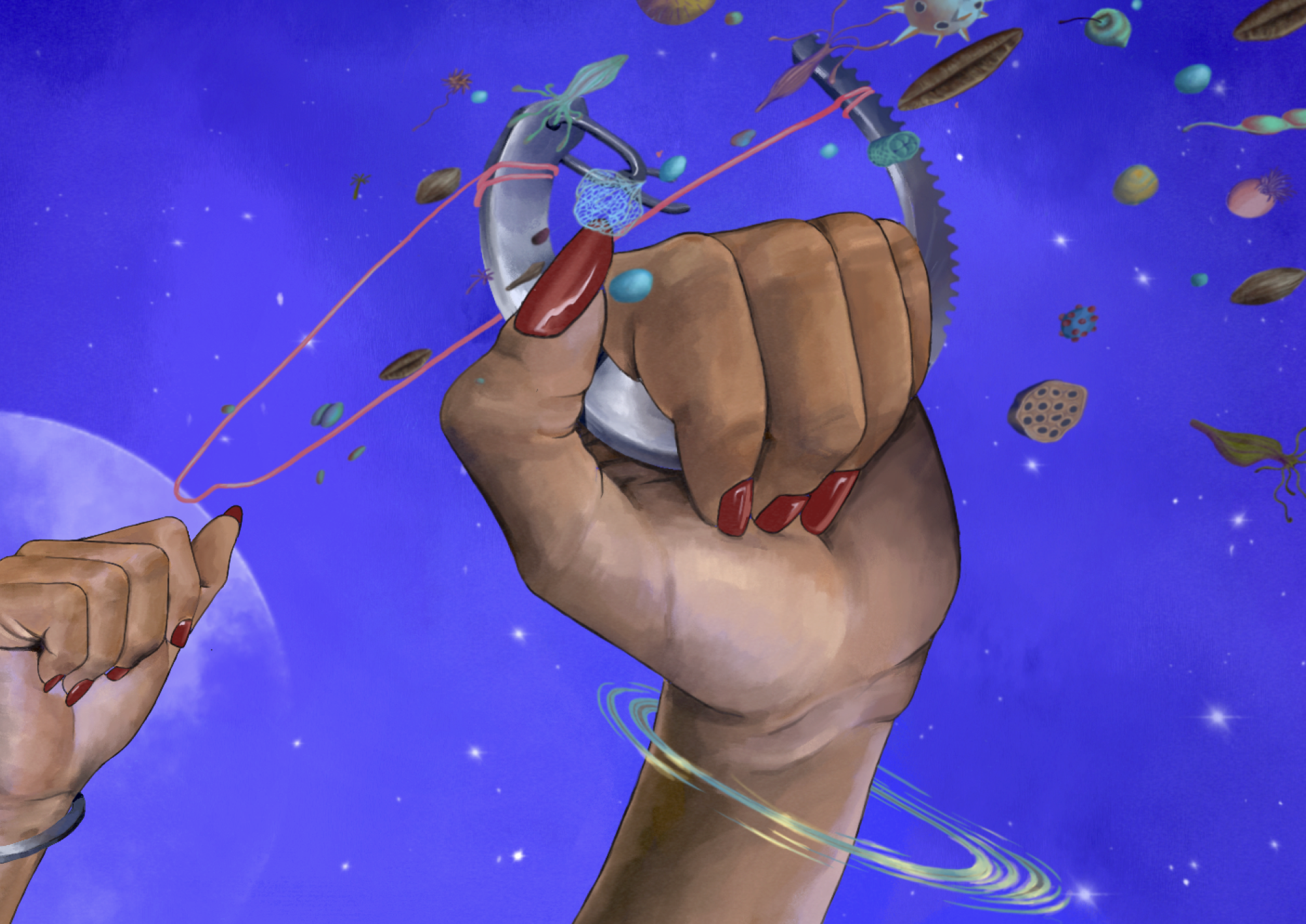
Sarah Al-Sarraj - Seed
I remember when I was younger, when we used to spend our summers in the South of Lebanon, my father would always take us on small drives around our village. He would drive up to a gas station in Bint Jbeil, and then turn around to make his way back. Every time without fail, that was the furthest point we’d reach before we would head back. At least that was what I imagined to be true at the time. I used to think that we had reached the end of the world. I would even often ask my father to take me to the end of the world. And if I wanted, I could get out of the car and walk towards it. Somehow it made complete sense to me that once we’d reached that end, the end of the world, we could simply turn round and begin again.
***
As though the idea of home conjures the evening,
as though the idea of salt gathers the dinner table.
– Bassam Hajjar1
When I try to imagine the future, I end up tracing the corners of my room. A small and vast space that gently holds my world together. For long amounts of time, the entire world exists as my room. It is within four walls, often within the four edges of my bed, that the world happens to me and I happen in it. Sometimes I change where my bed sits, and I change the world. Sometimes I leave my bed, and the world ends.
I cannot know for sure why such a task sends me back to my room. I suspect that it’s precisely from the location of my room, the location of my constant return, that the future is not some imagined later time, but something that has already happened. It is in my room, in the warmth of my home, that I remember the future rather than imagine it.
And so when I try to remember the future, I am filled with an urge to return home, and a hope for everyone to return home.
***
Not pain
but its place after it has ceased,
continues to hurt.
It hurts
in as much as it fades.
– Bassam Hajjar2
I used to be haunted by the future as something that is yet to happen. It’s a naive, futile speculation. It reduces the future to contingencies of causes and effects: if this happens, then this happens, then this happens,... etc. In Economics, when you come to analyse a causal relationship, you must say: ceteris paribus (if all else is held constant). So for example, you would say: I cannot return home because home is far. Ceteris paribus, if home is no longer far, I can return home. But that is rarely ever true – rarely is anything ever constant, rarely can you return home.
To me, home is a memory. It’s the memory of my mother hanging from the branches of an olive tree, of her having coffee in bed. The memory of my father and I sitting together watching the morning fog dissipate, of us picking hawthorns and figs. The memory of my siblings and I getting ready for school in the morning, and then studying together around the kitchen table when we came back. The memory of staying up late to speak to the neighborhood boys from the balcony when everyone else is asleep, of being afraid of getting caught. The memory of falling in love, of being in love. The memory of the touch of a hand, the curve of a hip, the pull of a gaze. The memory of a scent, of a whisper, of a secret I no longer have to keep. The memory of a memory, of something that has never happened, of something that has maybe happened.
And for this I can never return home, but if I tug on the threads of memory long enough, I can see a future – I can see a road that leads me there.
***
But I am tired,
for the burden lies in my heart,
not along the road ahead.
- Bassam Hajjar3
Most of the time, despite the joy of tracing my way back home, I’m far too tired to remember. What happens when we’re too tired to intervene in the world, let alone in the future? What happens when exhaustion removes us from the world, stops us from leaping into another?
I don’t mean the kind of tiredness that you can anaesthetise. I mean an exhaustion that is both an effect of the extractive nature of the world and an extraction in itself. One that sends us to our beds and tells us this is the world. One that hollows rest until it becomes one with it. What do we do when rest has become in itself tiring? What happens when exhaustion is so deeply visceral that no amount of rest, albeit if we can afford to rest, can scratch its surface? How. then, can the exhausted dream of the end of the world, remember a future?
I cannot speak or write or speculate about this without thinking of my mother, whose exhaustion I learnt before my own. I have often indelicately asked my mother to rest. Sometimes even aggressively. But how can she? She cannot rest until the world makes it possible for her to. For my mother to rest, rest has to be possible. For my mother to rest, the world has to end.