
What are Queer (Non)Futures? Notes on Theory and Praxis
seed_website.png
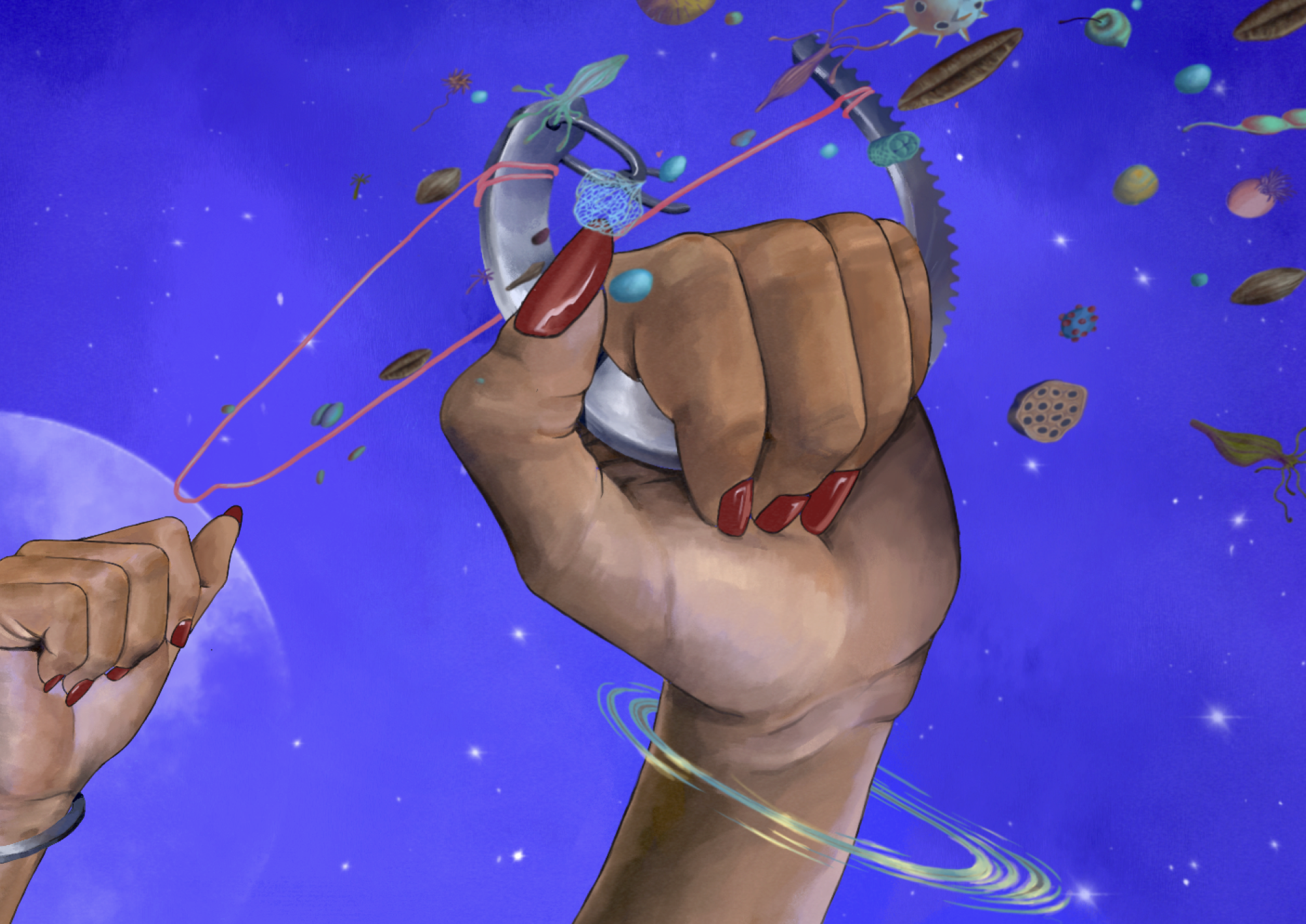
Sarah Al-Sarraj - Seed
We do not write alone. The not-alone as a state of existence is about space as much as it is about time. In togetherness, there is something that goes beyond physicality; and yet, we experience it firsthand as tangible, even as we sit in online circles, dig into an immaterial archive, or speculate and speak worlds into being. There are so many histories that sustain us, and so many worlds to invoke, that we could say that we do not write in the present. In fact, we rarely, if ever, do so.
I do not write alone. I am in perpetual conversations with “ghost,” a multitude of inner voices and encounters;1 my ancestors who escaped a genocide of another epoch, and who with their bodies fought the gendered capitalism of post-colonial states; those who have been committed to speculative, anti-colonial queer futures that might never materialize; the ephemeral circles of comradery we find ourselves in and that bring a sense of purpose back into focus; you, the reader, who perhaps have found in Kohl a place of political respite and clarity.
Most importantly, in this editorial, my words are woven by three years of thinking about queer (non)futures at the end of times, alongside a growing “Circle’s Conspiracy of Writers” (many of whom are authors in this issue), our Palestinian comrades, and a tightly-knit editorial team that has been a lifeline amidst the atrocities we cannot unsee.
Ghost: I love you, my comrades and my people, who have no choice but to draw their poetry from the future.
This issue of Kohl started as a writing circle held in early 2023, on what we at the time called “Queer Futures.” We were so numerous – no less than forty authors! – that we had to split the circle in two; each circle met bimonthly for a period of about three months, with the hope of turning both spaces into a tangible publication by the end of that very year. We followed the same methodology we had previously employed, in Beirut in 2019 for the “Queer Feminisms” issue,2 then online during multiple COVID lockdowns for the issue on “Counter-Archives.”3 We all arrive into the space with a personal project of writing; we sit in a circle and allow the discussion to unsettle us and make us uncomfortable. We are not simply carried by it; the path is traced by a collective drive. A personal writing project, therefore, is not limited to being a “part” of a publication, but is in direct conversation with all the others, like organs in a living, pulsating ecosystem. Eventually, the group’s meanders inform the prompts of the collective writing exercises. Fragments of the collective writings we assembled in the circles sometimes appear in this editorial as “ghost.”
Ghost: I don’t have the strength to dream about tomorrow.
Then the genocide on Gaza intensified as of October 2023. Instead of a publication, we ended up meeting in circles again, in early 2024, because any notion of future, no matter how queer, was unbearable at the time. We did not know what to do with an issue titled “Queer Futures” when no future seemed imaginable. If anything, speaking of a future, any future, when our Palestinian comrades were being annihilated, was offensive, as it seemed complicit with the colonial genocidal entity and their enforced idea of futurity. So we put the whole issue on a shelf.
Ghost: There is a deep sense of horror and confinement when engaging with futurity today. How to think about building a future when the present is unbearable and you just need it to stop? The unimaginability of the present we live in now, is the product of futures that blood/money-thirsty oppressors have planned. You know and remember that you had tried and those before you have also tried to interfere with those plans, and perhaps that’s how and why you are still here!
There is a naivety to queer futurity. As queer anti-colonial and anti-capitalist folx, we have spoken of futurity as if it was our own to dream into being, forgetting at times the magnitude and pace of accelerationist, genocidal futures. Futurity was their project to begin with, and despite centuries of resistance, it continues to colonize the here and now. The mechanism itself has not changed; it follows cycles that at times become impossible to ignore, and it is in these moments that we come to the realization that linear temporality is theirs, and that it vampirizes our already limited resources and capacity for action.
Ghost: The future keeps rolling towards us, rolling over these interruptions, these moments of outcry, the many “emergency demos” we held when another hospital got bombed. When did we stop with those “emergency demos”? Every week we gather for a sit-in, an action, a demo, but we don’t speak of emergencies anymore, even though (or perhaps because?) any minute, any second that passes screams absolute urgency.
Queer theory of a dominant genealogy – one that emerges elsewhere, from the very heart of empire – has for decades debated the (re)productiveness of futurity, wanting us to believe that futures and non-futures are two different projects. The former would be animated by radical imagination, whilst the latter urgently calls for the death of any social fabric as we know it.4 This debate has taken so much space, as is usual with theory that travels from the west, that as anti-colonial queer thinkers who theorize from other genealogies, we have felt compelled (myself included) to position ourselves in this debate, at times at the detriment of our very own knowledge. But if we are to heed the teachings of anti-colonial resistance from Palestine today, then we understand that non-futures and futures are not so much of a binary. If anything, they are a continuum of anti-colonial thought and praxis, where we must rely on an ethics of ephemerality – our own, and that of the worlds we wish into being – and of letting systems of power go, without ever giving up on the land and the pockets of life and resistance it contains. For it is the all-encompassing endlessness of colonialism and capitalism that makes them so murderous. It is a systemic scope that not only will we never be able to match, but that we should never strive to match. We can then define queer (non)futures, not as power-grabbing or land-grabbing, but as perpetually dislodging the centers of biopower so that our ecosystems, ancestral and communal, might survive. In a lot of ways, queer (non)futures are what makes the material conditions for any anti-capitalist, anti-colonial future possible.
Ghost: What is the work of queer futurity when understood in relation to the colonial longue durée of inescapability; an inescapability that is not the same as inevitability (which is often the source of apathy, nihilism – and even binary constructions of hope and despair), but rather an experience of time as induced and reproduced by the tools and technologies of coloniality itself?
We returned to the publication of this issue in the summer of 2025, and renamed it “Queer (Non)Futures” instead of “Queer Futures.” Despite the change in framework, some of the authors still chose to withdraw their pieces, often because they could not reconcile what they had written before the intensification of the genocide with today’s atrocities. Most, however, revisited them or rewrote them entirely. Numerous authors from outside the writing circle spontaneously sent us their writings – this year was the year we received the most submissions, despite not having a call out – turning this issue into our largest yet. We did not know what to make of that, given the ongoing genocide in Gaza and the expansion of the colonial war to the region. But it sprung us into action. We asked ourselves, why now? What changed? What conditions have made the publication of an issue on futurity not only possible, but desirable?
Ghost: If not hope, then not hope, but revolt, one more time, at least, one more time – revolt.
On the level of discourse, queer (non)futures are not abstract theory, but anti-colonial praxis. The colonial project murders in mass so that an anti-colonial otherwise is annihilated. In contrast, if we look at any iteration of anti-colonial resistance, in Palestine and across contexts/histories, people literally die so that an anti-colonial otherwise might live on. In other words, “death and the beyond become the anti-imperial outpost from which we speak, think and live otherworldly – the last outpost from which we ‘write ourselves into existence,’ so to speak.”5
When confronted with so much destruction, I can see why any conceptualization of a queer (non)futurity might be considered politically naïve. But I am tired (as are many others) of being lectured by western-centric queers, ecologists, and anti-imperialists, for whom destruction is an apocalyptic tomorrow they have now predicted with a doomed certainty in art and literature – except it is already happening elsewhere, as we speak; it had been happening for decades and centuries before sci-fi, experimental art, and queer theory caught up on it. And now they have come to lecture us, as have their colonial predecessors, with the same holier-than-thou attitude, from within the same institutions of knowledge and extraction, demanding our reciprocal solidarity as they scoff at the battles we choose to fight and how we fight them.
Ghost: What would be the institution’s complicity statement?
What would be the institution’s ongoing colonialism statement?
What would be the institution’s non-non-discrimination statement?
Perhaps we have to be naïve in order to make queer (non)futures plausible. Perhaps naivety is one of the very few tools in our political arsenal that has not yet been co-opted by the Master’s house.6 Perhaps we are naïve because we have worlds to fight for.
Radical imagination is often caricatured as not only naïve, but as being divorced from the material conditions of life “on the ground.” This accusation is but a mere projection of colonial fantasies and how they themselves operate in the realm of fiction.7 If radical imagination accounts for non-futures, then it is anchored in making do and the day-to-day practices of life and resistance.
Ghost: I do believe in our practices of resistance, and I don’t feel they are futile, or at least, I am not afraid of their futility.
As we labor towards a shift in colonial time, as we organize to shake the foundations of power as we know it, we employ it necessarily and almost intuitively. Obstructing colonial and capitalist systems is radical imagination. Wanting the genocide to stop at any cost is radical imagination. Returning to return for Palestinians, and what it could mean today, is radical imagination. Queering return, which Sarona Abuaker wrote about in 2020 and which has echoed with many queer Palestinian writers in the past two years, is not about the destination but a possibility – one that cannot be given up.
Sarona: I push return forward not as a policy which must wait until a linear achievement of Palestinian sovereignty becomes a land form. It is not the end point – it is an ongoing departure. Queering return by re-positioning it as not only a physical dimension of physically returning to Palestine if that is what is chosen by Palestinians, but also occupying multiple times and spaces of practice for Palestinian-ness occupies those very things.8
Radical imagination, then, encapsulates the potentiality of queer (non)futures, which this issue attempts to theorize. It “queers time” to “queer roots,” speaks of “liminal intimacies” and “spatial dis/orientations,” before accounting for “hauntings and crossings,” and what making anticolonial archives can look like. By laying out the twenty-three pieces under these sections, we have traced a possible path, but it is by no means the only one. The issue can also be read in reverse, departing from Akanksha Mehta’s “We Reject A Colonial Imperial Liberal Feminism” and arriving at “What Does the Future Look Like?” by Sarah Al-Sarraj, our illustrator. A different direction would still hold, because queer (non)futures are precisely about detaching ourselves from specific, one-way readings, even becoming lost in the process.
If the multidirectional reading of the issue represents its architecture, then its infrastructure has often had to work under and against the devastating atrocities of the past three years. In a lot of ways, the making of the issue has inadvertently employed a methodology of queer (non)futures. During that time, we created pockets of comradery; we deserted publishing in the face of incommensurable grief; we prioritized a different form of organizing against the zionist genocide; we let funders go; we came back to discourse; we found each other again, and others found us along the way. It is no secret that Kohl was defunded en masse over the past two years, which meant that we could no longer afford to pay our team members’ wages. Just as I was grappling with what it meant to publish a journal like Kohl alone, I was joined by Sabiha Allouche at the beginning of 2025, then Jo Hemlatha in the summer, who donated their time, labor, and thought, so that Kohl outlives the complicit, neo-colonial redistribution of resources. It was extremely challenging to go back to an issue that had been shelved, and Jo was instrumental in getting in touch with authors again and providing us with the structure and driving force we needed to move towards a different direction. Later in the summer, albeit temporarily, Sabah Ayoub returned as Arabic editor, and so did Maya Zebdawi and Presica Chaar, who took on the translation of the issue in full. We have joked amongst the team that goodbyes have become a recurring tradition at Kohl. But perhaps that is the point, that has always been the point: we make do with what we have, we go with disorientations, and we wait for a return – seldom an otherwise, almost certainly futile, but always a reunion of sorts. Always within our grasp.
- 1. https://kohljournal.press/fuck-fucking-lines
- 2. https://kohljournal.press/issue-6-3
- 3. https://kohljournal.press/issue-7-1
- 4. This debate often cites Lee Edelman’s No Future (2004) and José Esteban Muñoz’ Cruising Utopia (2009), but keeps coming up in many western-centric queer academic conversations and conferences.
- 5. https://genderit.org/feminist-talk/what-method-under-annihilation-notes-queerness-death-and-data
- 6. In reference to Audre Lorde’s “the Master’s tools will never dismantle the Master’s house.”
- 7. https://kohljournal.press/between-facts-fiction
- 8. https://kohljournal.press/suture-fragmentations