
Between Depression and Mania: How to Heal by Reclaiming Our Bodies?
Coming from a background in science and audiovisual production, Presica Chaar has worked across Lebanon, Iraq, and Turkey in project and grant management, supporting feminist, media, and grassroots groups in complex political and social contexts. Her engagement with civil society has been less about career than about inquiry – a sustained questioning of how structures shape meaning, collaboration, and fatigue. Within that trajectory, she has contributed to research, coordination, and project and strategy design, gradually moving away from iNGO frameworks to work more closely with small collectives and grassroots initiatives concerned with gender, media, and accountability. Her current interests move between film, photography, and critical writing, and through dialectics explore how image and language can hold space for contradiction, fragmentation, and care. Having long navigated the NGO industrial complex and its alienation, she now studies cinema and explores a multidisciplinary visual practice. Presica continues to work between languages and disciplines as a photographer, photojournalist, translator, and writer, seeking forms of collaboration and expression beyond institutional structures.
palace_higher_hill.jpg
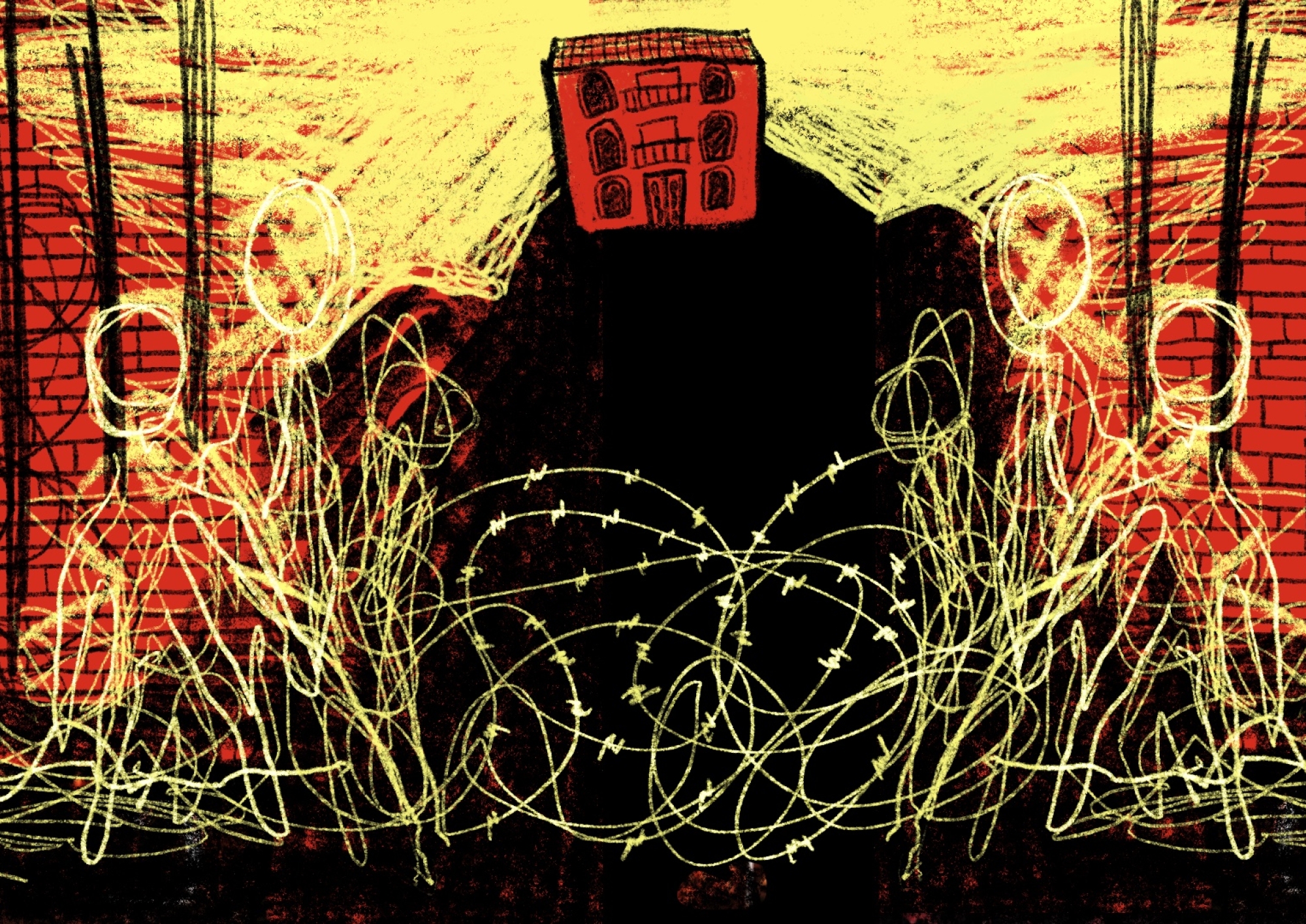
Myra El Mir
“You’ve gained weight!” “You’ve lost weight!” The first is said with a disappointed voice, while the second’s delivery is filled with joy and excitement. My friends constantly try to reach out to me and encourage me to go out. They call several times, but I fail to pick up the phone, as if my body is betraying me in moments of depression. I become someone else in moments of mania; I dance in the streets, run, work, and laugh a lot. During those times, I often hear the phrase “you do not look like someone who has depression.” But my body also betrays me in moments of mania: I become more active and sleepless. Between the two episodes come the insomnia, anxiety, and overthinking.
Seven years ago, I was diagnosed with bipolar disorder. I suspect that I had developed it before but had delayed seeing a psychiatrist. It is difficult to make the decision to consult one in our societies, especially with the stigmas around mental health and its use as an insult. I bet that I had avoided visiting a psychiatrist because I was affected by how people view those who go to therapists and psychiatrists. Perhaps that was because I refused the idea that I was ill, because no one believed I was, or because of the high cost of treatment. I do not really know the reason behind delaying that visit, but I know that I only went after things became unbearable.
My illness can be summed up as a fluctuation between a state of depression, with episodes of intense sadness, crying, and suicidal thoughts, shifting into a state of mania, with episodes of happiness, enthusiasm, and work. The two episodes are at opposite ends of each other. I do not know why the medical industry calls them “episodes,” but I got used to naming them that way. My life moves between depression and mania with no balance, and so do my emotional, mental, and physical swings. I have never known any sense of stability in my life, even with medication. My body keeps betraying me, and my mind goes up and down like a seesaw. Sometimes, I understand it; many times, I do not know myself.
People do not realise the battles a person may fight with their body every day and every minute. They keep looking at it and describing it whichever way they want without any consideration for what this body has gone through to appear this resilient, or how bodies, in all their differences, with their visible and hidden scars, with their weight gain and loss, with the circles under their eyes, with all of it, are beautiful. Women are always required to be beautiful, thin, of average height, and to smile at everyone. It is acceptable for them to cry from pain in their rooms and to curl up and contain the pain inside their bodies, as long as they smile and allow society and its system to invade their bodies and decide whether they deserve treatment, how they deserve it, and under what conditions.
That gaze toward my body always pushed me toward suicidal thoughts. I wondered why I kept gaining weight, and why it is a side effect of the medication, to the point that I once imagined jumping off the top of the highest building in Amman, during an otherwise beautiful family trip while in a depressive episode, because I hated my body. This hatred was an extension of the thoughts of others, their gazes, and their perceptions of me.
And perhaps among the devastations of mental illness is the external bubble we live in. Some people around me believed that I was being dramatic when speaking about the illness and its effects because I have friends and a warm family, and the ability to travel and work. Others see my life as a dream for people who do not have such privileges, because how can someone like me with all this comfort suffer? This suffering grew and intensified with the relentless news and the harsh reality we live in our Arab region.
Psychological Pressures and Institutional Neglect in Jordan
Mental illness in our Arab societies remains a mark of shame; patients avoid admitting their illnesses or disclosing that they receive treatment. The phrase “mentally ill” is used by some as an insult, even a slur. In Jordan – as in many Arabic-speaking countries – people are still afraid of visiting a psychiatrist, and some believe that prescribed medications are simply pain numbing drugs. Meanwhile, the consultation fees of psychiatrists in the private sector can reach 70 dollars per visit. Those with medical insurance receive almost free psychological treatment in the public sector, but only after having to wait for over 5 hours during each appointment. If they’re lucky enough, they might even get a good doctor.
As for women, they are accused of being “dramatic” or “moody” if they cry often or speak negatively about their condition, and it is difficult for people to imagine that this could be due to their mental health as well as their need to understand what has happened to them and how it happened. If they do consider seeking treatment, the first thing said to them is “how will you get married later?” or “what will people say?”
Yet, treatment centres themselves may not be qualified to provide care or to receive women at all. In 2020, the programme “Nabad Al Balad” on the Jordanian channel Roya broadcast an investigative report1 documenting violations inside the National Centre, popularly known as “Al-Fuheis Hospital.” This centre is the only governmental institution2 in Jordan specialised in treating mental and psychological illnesses. It contains several departments, including the judicial ward that receives patients referred from the courts, the “Karama” ward for psychological rehabilitation, and a ward for rehabilitating people with addiction.
Some investigations3 documented harsh conditions in the judicial ward, such as overcrowded rooms, with 8 to 10 residents in each room, leading to a lack of privacy and a deterioration in patients’ mental health. Some rooms also lack proper ventilation, which negatively affects the patients’ health. Cases of physical and psychological abuse against patients in the hospital were documented as well, including dragging women patients across the floor in front of nurses and under their supervision. Despite the media uproar that followed the publication of those investigations, the hospital continues to operate and receive patients, who are subjected to a chain of violations under the cloak of medical guardianship over patients – assessing their condition, claiming to understand it – and of social guardianship, with claims that these people are “unaware” or “crazy.”
In Jordan, the mental health field faces multiple challenges in which social factors linked to stigma around mental disorders intertwine with the healthcare sector shortage of specialised staff and financial resources. This affects the quality of the services provided as well as the absence of community awareness about mental health conditions and how to deal with them. Economic and social pressures – such as high unemployment rates, especially among youth – have also elevated levels of stress, anxiety, and depression. Data issued by the National Centre for Forensic Medicine,4 affiliated with the Jordanian Ministry of Health, shows a rise in suicide cases in 2024; Jordan recorded 166 suicide deaths, including 16 children under the age of 18.
One of the most prominent difficulties Jordanians face is the severe shortage of specialised staff. According to the “National Action Plan for Mental Health and Addiction” (2022–2026),5 the number of psychiatrists in the country is around 92, which is less than one doctor per 100,000 people, while the number of psychiatric nurses does not exceed 13 nurses – about 0.13 per 100,000 people. This shortage of human resources negatively affects the healthcare system’s ability to meet increasing needs. Limited insurance coverage for psychological treatments also increases the difficulty of accessing services. The Ministry of Health operates 56 mental health clinics across Jordan in addition to the National Centre for Mental Health, yet health insurance does not cover mental illnesses, except through a few expensive global insurance companies.
With unemployment in Jordan reaching 41.7 percent in 2024,6 the lack of job opportunities, rising economic pressures, and increasing prices,7 the figures related to the spread of depression, anxiety, and other mental illnesses are to be expected. Estimates indicate that about 46.1 percent of the labour force works outside the formal economy, meaning that a wide segment of workers – especially in agriculture, construction, and domestic labour – lack legal or social protection. On another front, the gap between the outputs of the educational system and the needs of the labour market continues to widen, while graduates pour into already saturated fields. As for the minimum wage, it has remained fixed at 290 Jordanian dinars (around 408 dollars) for three years, despite rising living costs.8 The national poverty line in Jordan is estimated at around 168 dinars per month (236 dollars) per individual, which means that the minimum wage does not meet the requirements of a dignified life and does not align with Jordan’s international obligations regarding workers’ rights.
In addition to the burdens of the escalating living crisis, the crisis of freedoms and the suffocation of political life in Jordan intensify pressures. Most recently, this included waves of arrests carried out by Jordanian authorities following demonstrations in support of Gaza,9 the suppression of peaceful protests protected by the constitution,10 and restrictions on freedom of expression and opinion. The Euro Mediterranean Human Rights Monitor issued a policy paper in 2023 calling on the Jordanian authorities to lift restrictions on freedom of expression, including legal provisions used to undermine these freedoms.11 The paper pointed to fluctuating levels of freedom of expression in Jordan, ranging from limited tolerance of criticism to direct pressure on individuals and groups. Jordanian universities have also cracked down on their students following acts of solidarity with Gaza during the ongoing genocide. Overall, arrests extended beyond participation in demonstrations to include security summons related to chants or posts on the platform “X” (formerly Twitter). During that period, the public prosecutor charged most detainees with “unlawful gathering” and “disturbing public comfort.”
These pressures further intensify when the person targeted is a woman. Her participation in demonstrations, raising her voice in chants or discussions, and even her leaving the house, become “shameful.”
All of these factors, among others, have contributed to an increase in psychological pressures on people in Jordan. They are subsequently treated as mental health disorders within a system that imposes its ways of “healing” on you – even when these methods do not align with you or your way of functioning, and even when “healing,” according to the medical industrial complex, ultimately means being alienated from your own body and taught not to trust it.
The Medical Institution and its Betrayal of Women
Despite the Jordanian Ministry of Health’s claims of expanding mental health services and increasing community awareness around them, financial expenditure still appears to be used as a pretext to ignore gender-based differences in diagnosis and treatment. Disorders such as depression, anxiety, and bipolar disorder lead, from the state’s perspective, to loss of productivity, worker absenteeism, rising healthcare costs, and the draining of public resources. Accordingly, they are considered a major financial burden on the economy. Official priorities remain focused on reducing costs and supporting economic growth at the expense of providing comprehensive treatment that accounts for the particular needs of women’s bodies, which have long been neglected within the patriarchal medical system. Treatments offered often rely on prescribing sedatives rather than effective psychological interventions. This economically driven logic does not address the gaps in knowledge regarding women’s health, nor does it acknowledge the persistent discrimination against their bodies in medical research and studies. As long as lives are measured in numbers, women will continue to receive inappropriate treatment. This necessitates a fundamental re-evaluation of a system that treats women as an economic unit rather than human beings deserving of genuine care.
All of this leads us to speak about the medical system itself, its origins, and its treatment of women’s bodies. Since the nineteenth century, medicine has functioned as a tool of power through which the state and colonial thought subjugate bodies. The resistance of enslaved people, such as attempts to escape, was classified as a “mental disorder,”12 and coercive medical experiments were performed on Black and Indigenous peoples under the pretext of “serving science,” justified by claims that they possessed higher pain thresholds or smaller brains. Michel Foucault argues that modern medicine does not merely treat bodies but subjects them through discourse and techniques, transforming hospitals and clinics into spaces of discipline.13 In this context, philosopher Michela Marzano explains that the “acceptable” body today is that which is fully disciplined and controlled, reflecting the power relations that shape contemporary healthcare.14 Women remain at the centre of this struggle, as bodies subjected to surveillance and forced medicalisation from the study of “endometriosis” to the modern discourse around beauty and cosmetics.
What is Healing?
When I told the doctor that I was in pain from taking the medication or that I was sleeping too much, he expressed surprise, because the dose I was taking was low, and he perceived me as “too sensitive” to this kind of medication. Doctors’ dismissal of the medication’s side effects often reflects how they practice the power of knowledge and epistemic superiority over patients, as if they own their bodies and as if they alone know their states and ailments. The body is not “healed” unless the doctor declares it healed, even if the patient continues to suffer.
And so, when I ask myself: what is healing? I find that the answer is bigger than my ability to define. Healing is not simply an individual journey between me and my body; it is a complex relationship with a state, a healthcare system, a society, and a culture that make recovery difficult before even initiating it.
Can people struggling with their mental health in Jordan heal when the medical system is not even prepared to receive them? How do we heal in a country that considers psychological treatment a luxury, and that turns access to a psychiatrist into an economic act rather than a basic right? How do we heal amid suffocating unemployment and crushing living pressures, within a political system that restricts freedoms and warns people that expressing their feelings may lead to their interrogation or arrest?
I confront my illness in a country that asks for our silence, that teaches women in particular to hide inside their bodies, and convinces us that psychological pain is not “real” so long as it cannot be seen. At every doctor’s visit, I feel that medical authority is as harsh as political authority: both want to define my body on my behalf, and both want to decide whether I am “fit” or “ill.” I have learned that healing is not a return to “normality” as defined by the medical industry or as imposed by society. Healing, for me, is understanding my body and accepting that illness is a part of me, and that living with it is not a failure. Therefore, in my view, healing does not happen unless we feel able to live with illnesses or adapt to them without centring others’ judgments. It does not happen unless we can understand our bodies, how they react to their surroundings, and how they can recover. Or perhaps does it happen through the psychological support we receive from our surroundings and close circles.
And why must we even heal from illnesses as long as we are able to live with them? Why did the medical industrial complex convince us that the “myth” of healing exists? As people with mental illnesses, we know that this option is not available, that the illness has taken root in our bodies, flowed through our minds, and shaped our personalities until we no longer recognise ourselves.
Healing is defined not merely as the disappearance of symptoms, but as a process of personal change aimed at improving health and well-being, in which the individual lives a self-driven life and seeks to achieve their full potential. According to the medical industry, this includes four main pillars: hope, empowerment, autonomy, and social integration within the community. So would medicine call accepting to live with an illness and embracing those pillars, healing? Can healing happen in the mind even if the body is in shambles? What if we are able to move forward without a track-record of tangible indicators in daily life, such as the ability to perform ordinary activities effectively, regain confidence, and form supportive social relationships? Who said that we must restore social connections to be well? Are relationships proof of improvement even when they are, in most cases, the very reason for relapses?
Why must we achieve “healing” if we are agents of our own lives, if we are able to wake in the morning without thinking of death? Is it because the medical industry has decided that this is what recovery and “exiting illness” look like? Wouldn’t disavowing myself from my illness limit my freedom from all those constraints and stigmas? The only liberation here is directed toward myself and my body; no matter how much illness weakens it, it knows and reaches for me.
With these reflections in mind, I have come to openly speak with my friends and those around me about the psychological experience in all its complexity. I encourage them to acknowledge what they go through without fear or shame. I share with them what I have learned about my body, my feelings, and my boundaries, not as an expert, but as a person trying to recover through understanding, experience, confrontation, and listening to herself at times when it feels almost impossible.
Perhaps it is enough that we live, that we breathe, that we rise every morning despite it all. Perhaps it is enough that there are moments during which we believe our bodies instead of subjugating them. And perhaps, as I have discovered, illness is the only place where I possess my freedom in full – the freedom to fully be myself – away from societal constraints, state rule, and its standardised medical industrial complex.
- 1. https://www.youtube.com/watch?v=lhRLYq0YUyg
- 2. https://petra.gov.jo/Include/InnerPage.jsp?ID=127199&lang=ar&name=news&utm
- 3. https://arij.net/investigations/mental-health-jordan/en/
- 4. https://www.khaberni.com/news/702637-%D8%A7%D8%B1%D8%AA%D9%81%D8%A7%D8%B9-%D8%B9%D8%AF%D8%AF-%D8%AD%D8%A7%D9%84%D8%A7%D8%AA-%D8%A7%D9%84%D8%A7%D9%86%D8%AA%D8%AD%D8%A7%D8%B1-%D9%81%D9%8A-%D8%A7%D9%84%D8%A7%D8%B1%D8%AF%D9%86-%D8%A7%D9%84%D8%B9%D8%A7%D9%85-%D8%A7%D9%84%D9%85%D8%A7%D8%B6%D9%8A
- 5. https://www.moh.gov.jo/ebv4.0/root_storage/en/eb_list_page/national_mhsu_action_plan_2022-2026_%28english%29_%282%29-0.pdf
- 6. https://www.cia.gov/the-world-factbook/field/youth-unemployment-rate-ages-15-24/country-comparison/
- 7. https://www.almamlakatv.com/news/167819-%D8%A7%D9%84%D8%A8%D9%86%D9%83-%D8%A7%D9%84%D8%AF%D9%88%D9%84%D9%8A-%D8%A7%D8%B1%D8%AA%D9%81%D8%A7%D8%B9-%D8%A3%D8%B3%D8%B9%D8%A7%D8%B1-%D8%A7%D9%84%D8%A3%D8%BA%D8%B0%D9%8A%D8%A9-%D9%81%D9%8A-%D8%A7%D9%84%D8%A3%D8%B1%D8%AF%D9%86-%D8%A8%D9%86%D8%B3%D8%A8%D8%A9-18-%D9%84%D9%84%D8%B1%D8%A8%D8%B9-%D8%A7%D9%84%D8%A3%D9%88%D9%84-%D9%85%D9%86-2025
- 8. https://ammannet.net/%D8%A3%D8%AE%D8%A8%D8%A7%D8%B1/%D8%A7%D9%84%D8%A3%D8%B1%D8%AF%D9%86-35-%D9%85%D9%86-%D8%A7%D9%84%D8%B3%D9%83%D8%A7%D9%86-%D9%8A%D8%B9%D9%8A%D8%B4%D9%88%D9%86-%D8%AA%D8%AD%D8%AA-%D8%AE%D8%B7-%D8%A7%D9%84%D9%81%D9%82%D8%B1
- 9. https://arabi21.com/story/1672985/%D8%A7%D8%B9%D8%AA%D9%82%D8%A7%D9%84-%D9%86%D8%A7%D8%B4%D8%B7%D9%8A%D9%86-%D9%81%D9%8A-%D8%A7%D9%84%D8%A3%D8%B1%D8%AF%D9%86-%D8%B9%D9%82%D8%A8-%D9%85%D8%B4%D8%A7%D8%B1%D9%83%D8%AA%D9%87%D9%85%D8%A7-%D9%81%D9%8A-%D8%AA%D8%B8%D8%A7%D9%87%D8%B1%D8%A9-%D9%85%D8%A4%D9%8A%D8%AF%D8%A9-%D9%84%D8%BA%D8%B2%D8%A9-%D8%B4%D8%A7%D9%87%D8%AF
- 10. https://www.amnesty.org/ar/latest/news/2024/04/jordan-stop-cracking-down-on-pro-gaza-protests-and-release-those-charged-for-exercising-their-freedoms-of-assembly-and-expression/
- 11. https://euromedmonitor.org/en/article/5613/Jordan:-Official-policies-and-laws-legitimise-censorship,-violate-free-expression
- 12. https://www.pbs.org/wgbh/aia/part4/4h3106t.html
- 13. https://democraticac.de/?p=92168
- 14. https://alantologia.com/blogs/70843/