
Carrying What We Fight Against: How Oppression Shapes Us
seed_website.png
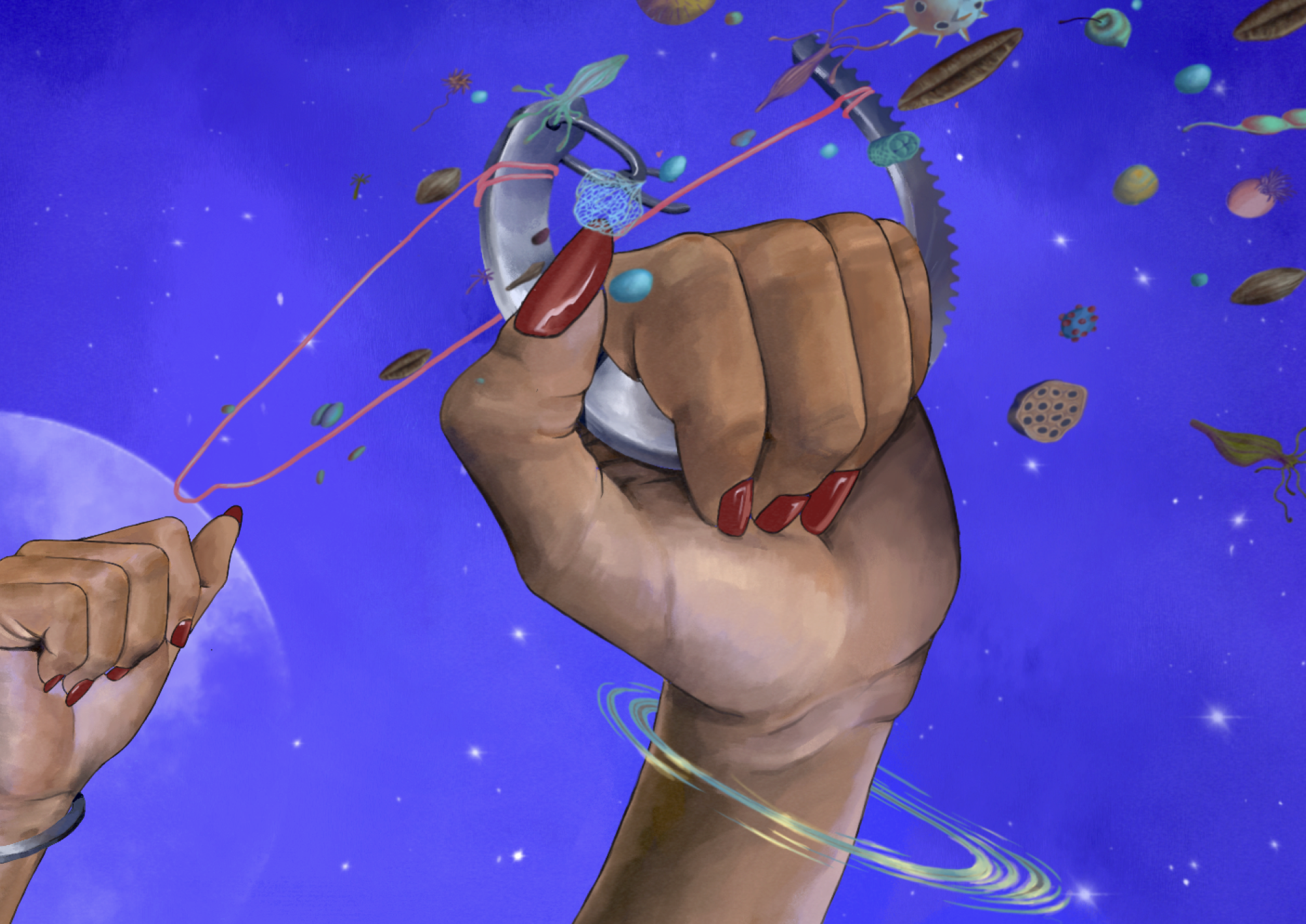
Sarah Al-Sarraj - Seed
Mirroring Oppression: Navigating Harm in Our Communities
In our rush to fix the world, many of us tend to neglect the pain we carry. We may even convince ourselves that rejecting the pain will make it disappear. We direct our anger outward, focusing mainly on changing the world around us. When we can’t, our frustration deepens, leaving us feeling powerless and reactive. Our unmetabolized pain doesn’t just sit quietly; it reverberates through our bodies, our relationships, and our movements, shaping how we see and respond to the world. Without tending to it, our pain can eclipse our clarity, narrowing our choices and feeding cycles of harm, even in spaces meant for healing and liberation.
I devoted years to understanding power-over dynamics,1 studying and analysing the ways oppressive systems shape how we relate to one another. Because I could map and name the dynamics of domination and oppression, regardless of their proximity to me, I believed I couldn’t possibly contribute to them. I often intellectualized my way out of feeling, in order to be taken seriously, to prove that I was worthy of safety, care, and dignity. I would do so, not just to avoid having my feelings reduced to mere personal hurts, but to give them weight, to make them undeniable. By framing my pain as just an outcome of structural injustice, detached from me, I hoped to protect it from being ignored – as if understanding the mechanics and roots of harm could somehow shield me from feeling the pain.
By prioritizing analysis over relationship, and control over trust, I was becoming more rigid. In their book Joyful Militancy, carla bergman and Nick Montgomery write, “When analysis becomes a trait, rather than a collective and curious process, it stagnates” (2017:179). In the same way, I was trapped in my own politics and analysis, unintentionally upholding the colonial binary that sees rational thinking as superior to the wisdom of the body and the power of connection. Of course, I didn’t arrive at the way I dealt with pain on my own; the mind-body split is a dominant framework in Anglo-European thought, visible in all aspects of life – from western medicine and psychology to education and even social justice movements. This binary devalues internal processes, emotions, and embodied knowledge, framing them as secondary or even irrelevant in the fight for systemic change. It also views the self as an isolated individual rather than being inherently woven into the well-being of all others.
In their book Tending Grief, Camille Sapara Barton reminds us that this approach, which they trace back to Cartesian dualism, creates a sense that “the mind is the essence of who we are as humans and that our bodies have no inherent wisdom or meaning other than being a vehicle for the mind” (2024:58). As a result, we learn to intellectualize deep injustices while silencing the embodied signals that are desperately trying to alert us to harm and exploitation.
In my persistent efforts to find the roots of this split and disconnection, I kept arriving at my deepest wounds. Trauma, derived from the Greek word for wound, is not just a physical rupture but a deep fracture that extends to our relationships with ourselves, others, and the world. Gabor Maté (2022) explains that trauma is not what happens to someone, but rather what happens within someone. He believes that just as a cut divides the skin, trauma disrupts the threads of connection that hold us together. This creates the very conditions that oppressive systems rely on to maintain control.
Trauma is particularly prevalent in marginalized communities, where systemic harm and intergenerational struggles make it even more difficult for trust and connection to take root. Without adequate access to stable income, housing, mental health support, time, or space to process the pain, many of us carry it into our relational and movement spaces, often without realizing the weight it places on our interactions. When unprocessed, trauma tends to seep into the cracks of our differences, influencing how we perceive one another and how we carry and express our pain. It can manifest as cycles of accusation and projection, where open wounds drive defensiveness and mistrust. These dynamics disrupt our allyship and camaraderie, fracturing the very connections we need to build resilient movements rooted in care.
In the years I was involved in Berlin-based anti-colonial movement spaces and worked with German grassroot organizations, including refugee support networks, or anti-racism collectives, I often witnessed this painful paradox. Many of us with a deep understanding of systemic oppression mirrored those patterns and struggled to navigate conflicts without replicating harm. I’ve seen, and participated in, many conflicts among my queer racialised siblings where someone was hurt, but instead of naming the hurt and expressing what needed to be changed, individuals were villainized and labeled as racist, transphobic, or ableist. These accusations weren’t always rooted in the actual dynamics of harm, but sometimes they would be weaponized to secure the moral high ground, positioning oneself as the victim and, therefore, the most deserving of empathy and care. Like many others, I felt stuck in this cycle; I wondered if there was a way to name harm and transform without getting caught in the rigidity of identity politics and treating each other as disposable.
Pain, Power and Protection: Who Has the Right to Resist
Police, prisons, and other punitive institutions that are deeply rooted in racial capitalism and colonialism constantly reinforce a rigid binary of good versus evil. Many of us have grown up in systems where punishment is the default way to enforce “moral order.” This framework sees harmful behavior as a moral failing of the individual rather than a product of systemic conditions, and therefore dehumanizes the person by casting them as inherently bad.
Within a system built on punishment, it’s not surprising that we feel uneasy when harm is named. We may even feel more at ease around active abuse than with someone who has a keen awareness of power dynamics and a sharp eye for recognizing harm. The behaviour of the former can be easier to rationalize or excuse, while the “killjoy”2 poses a discomforting challenge, bringing attention to the things people would rather ignore. Mia Mingus (2019) argues that this dynamic sometimes even extends inward, as many of us have an abusive relationship with ourselves. And sometimes, abusive or harmful behaviours can even feel safe simply because they are familiar.
In my friend groups and feminist social circles, I witnessed how complicity was often justified under the guise of being sociable and “nice.” People who avoid conflict were often perceived as kind, agreeable, and non-threatening. Their reluctance to challenge the status quo made them seem easy to get along with. On the other hand, those who spoke up about harm were labeled difficult or disruptive, and on many occasions dismissed or isolated.
When acts of systemic violence are normalized by patriarchy, white supremacy, cis-hetero normativity and ableism, the perpetrators tend to receive more empathy and leniency than the survivors. Yet, for example, when a survivor of sexual violence expresses anger, rage, or distress, the dominant reaction is often condemnation, victim-blaming, and dissmissal. This disparity is not accidental: as Elsa Dorlin (2022) argues, the right to self‑defense and the legitimacy of violent response have historically been granted to those who already belong to the class of the “defensible subject,” while marginalized and racialized people are disarmed, discredited, or punished for asserting their own survival. For example, Black teenagers can be killed for simply being perceived as “threatening,” while their killers are protected by the state as acting in self-defense.
What Dorlin teaches us is that one of the deepest forms of injustice lies in who is permitted to defend themselves and whose self‑defense is recognized as legitimate. I did not always have the words to name this, but I could still feel this deeply in my body. I witnessed how power grants legitimacy and empathy, while its absence strips people of their humanity and I did not want to be a part of the culture that thrived on the absence of tension on the surface while masking violence. I never saw myself as exempt from harm and making mistakes. I know that I, too, have been racist, transphobic, ableist, and complicit in patriarchy, even as I am directly affected by these systems. However, I did not realize that these patterns were so deeply internalised that they could manifest in ways I might not even recognize. For example, I was quick to call out how others perpetuated supremacy in its many forms, yet I failed to see how I positioned myself as morally superior in the process.
In trying not to be complicit and repeat the very patterns I spoke out against, I became a relentless detective, always on the lookout for patterns of dominance and oppression and pointing them out left and right, which granted me the title of “difficult.” This title served as a form of social control, a quiet mechanism that discredited my concerns and kept me in check. It seemed to me that it was easier for some people to pathologize my reactions than to confront the discomfort and pain that violence had left behind.
I couldn’t see a path, in which I wasn’t being a hypocrite, yet I also knew I couldn’t fight every battle. The constant vigilance was exhausting and isolating, leaving me stuck in a reactionary state. At the same time, what I paid attention to, as adrienne maree brown argues (2017), grew, and by focusing so much on harm and abuse, I gave it more power in my life and lost my connection with what I truly longed for.
Accountability Cannot be Forced
As an aspiring abolitionist, I firmly believed that making mistakes is an inevitable part of being human, and I saw accountability and community care as the only viable path forward. I understood that this process should center on honoring the needs and wishes of those harmed, while also addressing the systemic patterns that enabled the harm. To me, there was nothing more compassionate or transformative than giving those who caused harm the opportunity for reflection, repair, and growth. But, in the absence of networks of care and support, I didn’t know how to move forward except by demanding accountability from others – an approach that not only failed but deepened my despair and left me feeling absolutely hopeless.
As Mariame Kaba (2021) puts it, accountability is a process that is inherently self-reflexive and cannot be forced. She argues that transformative justice is about creating the conditions for individuals to recognize the harm they have caused, feel genuine remorse, and take steps to repair the harm. In Kaba’s vision, accountability is a continuous process of unlearning harmful behaviors and patterns, and cultivating a practice of radical honesty and humility. As such, accountability cannot be “given” by others.
But, how can we embrace accountability when we often see it as the admission of guilt? How can we see our own role in creating a fertile environment for harm when our relationship with shame is shaped by fear and avoidance? We are in desperate need of community care and restorative approaches that can foster environments safe enough to encourage self-reflection. But as far as I could see then, there was no culture of care, no container for holding pain collectively, and I was too hurt and disempowered to name or challenge this absence.
After publicly sharing my story of how I was sexually violated by someone within my close feminist circle, the community I once believed in crumbled before my eyes. Harm of this magnitude doesn’t just end with the violation itself; it continues living in all the different ways it’s questioned, denied, or shared by others as proof of a point I never agreed to make. I found myself displaying my wounds, desperately hoping for validation. When I realized this didn’t work, I began to overextend myself, hoping it would help me to be heard and held in the way I needed. I expected that by showing others how their words and (non)actions had hurt me, they would stop saying anything dismissive or hurtful. Yet, each time a friend unintentionally touched that wound, it reopened and bled all over that relationship. My trauma of being violated continued living in my nervous system, in my tissues, and it shaped my perceptions and reactions to the world around me.
In search of the validation and support I desperately longed for, and instead of asking for what I needed, I relied on theory to prove that what was done to me was objectively wrong. Today, I see why that felt like the only path available. I had lost trust and was always on an alert mode, while my friends became frustrated with me because they felt that believing my story was not enough. I genuinely believe that they didn’t know what else to do, despite their best intentions, because none of us truly understood what it meant to practice accountability and care without spiralling into internalised cycles of shame and blame.
True Transformation Begins with Us
It took years of sitting in terrifying, disorienting darkness, before I began to see things differently. Accountability, I realized, isn’t about imposing change through urgency or force. It means exploring our relationship with shame, checking if our actions align with our values, and taking responsibility for the impact of our (non)actions. It also requires us to remain open to receiving apologies with the same grace we offer them. It is about cultivating a shared commitment to repair, growth, and healing while recognizing each other’s inherent worth and refusing to treat anyone as disposable. As Esteban Kelly (2019) reminds us, accountability is agreeing that we are in community. It’s about preserving and honouring our interconnectedness while acknowledging that harm can happen and that we are all going to hurt each other at some point. It is a practice of mutual responsibility, where we hold each other with care and respect, especially when things get hard.
adrienne maree brown (2017) reminds us that transformation happens through small, intentional shifts in relationships, rather than through sweeping, top-down mandates. She argues that “complex systems and patterns arise out of a multiplicity of relatively simple interactions” (2017:13). I also never believed that liberation can be handed down through policy changes or dictated from the top. I understood that true transformation must be built from the ground up, through collective action. Yet, I came to realize that my approach sometimes mirrored the very hierarchies I opposed. I had been hoping for change from the outside to help heal the pain I carried inside. I needed someone else to take the blame for my pain in order for it to feel real, expecting others to heal me – a pattern that Lama Rod Owens refers to as “externalizing power” (2020). It’s not that the harm done to us isn’t real or significant; it’s that when our emotional well-being hinges solely on others’ actions, we give up our own power and agency. Reflecting on my role in the aftermath of being violated is not about excusing harm, but about disentangling my sense of self from the actions of others.
In other words, my liberation was as much about tending to my wounds and acknowledging patterns of oppression that I’ve internalised as it was about dismantling the oppressive system. This personal reckoning echoes what Alok Menon reminds us in one of their interviews: “There is an oppressive mentality within me that I have to liberate myself from, and that’s not to excuse bad faith actors, that’s not to say there are certain institutions and individuals that need to transform. But it is to say that we recognize that we are collectively responsible for them” (2024).
Care as Political Resistance
Internalized oppression not only manifests in how we relate to others but also as the internal voices that replicate external hierarchies: self-criticism that follows societal norms, perfectionism that echoes impossible capitalist standards, and self-erasure and making ourselves small that mimics historical silencing. These patterns are not abstract; they live in the body. My shoulders get tight under the weight of shame. My stomach clenches at the thought of rejection. My breath constrains itself when I feel like I’m not enough, mirroring the constrictions imposed by systemic oppression.
On the other hand, systems of control and domination benefit when we are alienated from our bodies, from our capacity to feel and respond to what’s happening within and around us. Disconnected bodies are easier to exploit and control. They tend to perpetuate the systems that thrive on exploitation, domination, and manipulation, making their work easier.
In a world where capitalism and colonialism have co-opted, appropriated, and commodified our need for healing and rest, many of us have internalized the idea that rest and healing are selfish luxuries, especially in a time when genocides and mass atrocities, in Palestine, Congo, Sudan, and beyond, are unfolding before our eyes in real time. But healing is not an individual pursuit of feeling better in times of despair. It is a collective process of reclaiming agency, resilience, and care. We can’t lock ourselves up and heal behind closed doors. On the contrary, I learned from the work of multiple movement leaders and mentors that as trauma happens in relationships, healing has to happen there too. It’s about acknowledging our pain and the systems that cause it, while also finding ways to rebuild ourselves and our communities. Healing allows us to show up as our most powerful, grounded selves to challenge injustice and oppression in all its forms and capacities. Practicing embodiment is a radical act in a world that tells you that feeling is wrong and numbing is necessary to function. Audre Lorde writes, “Caring for myself is not self-indulgence, it is self-preservation, and that is an act of political warfare” (1988:130).
Part of feeling the pain is recognizing how healing has been colonized and commodified under capitalism. It’s no secret that self-care and healing have turned into an entire industry. When there’s profit to be made from healing, we are bombarded with messages that tell us we need to spend money to feel better, whether it’s going to spas, cafes, retreats, or committing to extensive skin care routines. Yashna Maya Padamsee writes, “we do all of that ‘self-care’ to return to organizational cultures where we reproduce the systems we are trying to break” (2011). Self-care must function as both refuge and rebellion, an active and consistent interplay between tending to the self and nurturing the collective struggle. As Omotayo Jolaosho explains, “self-care is not just about the occasional retreat following or in anticipation of breakdown, it’s constructing spaces and communities of resistance – countersystems – where there is communion, solace, solstice, and rest, where we never run out of arms that are reaching out to hold us in recognition and warm embrace” (2019).
Many of us have been so disconnected from our feelings that we no longer know how to care for ourselves, let alone others. Our conception of self-care must then become one of communion between survival and resistance – an ongoing interaction between individual attunement and collective nurturance. Healing is not a destination; it’s a constant process of becoming, taking many forms under different conditions.
On an episode of Becoming the People podcast, Vivien Sansour, founder of the Palestine Heirloom Seed Library,3 gives us a beautiful account of how she sees being with aliveness under ongoing violence:
When I walk down the street (in the US), the more I see people and I engage with people who are still living in the delusion, I’m like, wow, I am still so alive and I feel zero sorrow for my people (in Palestine) in that way. Because I feel like we are alive and we still care even in the midst of all of this, you still see people caring for folks they don’t know in the street. And so I think we’re in a deeply transitional moment. (2024)
Healing is not about learning to endure oppression more gracefully; it’s about reclaiming our capacity to feel and our right to resistance.
Embracing Embodiment for Justice
We are in and of this world and we become what we practice, whether we do it intentionally or not. Built on this awareness, embodiment and somatics have become an increasingly popular set of practices for reconnecting to the body as a site of knowing and power. Many activists and movement leaders with long histories of organizing are now turning to healing justice, recognizing that sustaining our struggles for collective liberation also requires tending to our pain and building sustainable relationships. It’s important to remember that embodiment, somatics, and healing justice are not new discoveries; they have long histories that predate their popularized forms and fancy terminologies. Across many indigenous cultures, these ways of being have always existed as embodied relationships with land, spirit, and one another – practices that colonial systems sought to pathologize, erase or appropriate. When I began learning about somatics, many of the practices felt familiar. They reminded me of the ways my elders and kin would organically gather around food, music, and shared grief. We didn’t have terms to describe what we were doing, but it simply was in the ways we used touch, tears, and presence to show our love and support of one another.
Practicing collective care and accountability are vital forms of political resistance: cooking and sharing meals remind us of the power of care and togetherness; storytelling challenges systemic erasure by preserving collective memory; and creating spaces for collective rituals of grief allow us to process pain, honor loss, and restore our capacity to feel. The more we cultivate our ability to be with aliveness, the more we can make choices in support of what we love and care about.
While connection and openness are necessary for collective transformation, they can only root in the presence of safety and consent. What this means is that connection must include protection. In a capitalist society, rest is indeed resistance, but when violence is ongoing, healing cannot always occur through rest or introspection. Sometimes, survival may require numbness, dissociation, or rage. In such contexts, survival and resistance themselves become vital forms of care. As Palestinian psychiatrist and writer Dr. Samah Jabr reminds us, in the face of ongoing violence, what sustains you is “to be able to have critical thinking and to maintain your capacity to empathize” (2022). Her insight reframes healing as an ongoing act of resistance – preserving our ability to think critically, to feel deeply, and to remain human in the midst of dehumanizing conditions.
My journey taught me that we are not separate from the systems we seek to transform. Collective liberation begins in the spaces where we tend to our wounds, metabolize our grief, and relearn how to relate – to ourselves, to one another, and to the earth – with compassion and presence. It is to sit with the discomfort of acknowledging the ways we have internalized the systems we fight against and challenge the patterns of oppression that shape the world and live within us.
- 1. Power-over dynamics describe relationships and systems in which control, authority, or domination is exercised by one person or group over others.
- 2. The term killjoy, coined by Sarah Ahmed, refers to someone who disrupts social norms and calls out inequities like racism and sexism, even when it makes them unpopular.
- 3. https://viviensansour.com/Palestine-Heirloom
Barton, C. S. (2024). Tending Grief: Embodied Rituals for Holding Our Sorrow and Growing Cultures of Care in Community. North Atlantic Books.
bergman, c., and Montgomery, N. (2017). Joyful Militancy: Building Thriving Resistance in Toxic Times. AK Press.
brown, a. m. (2017). Emergent Strategy: Shaping Change, Changing Worlds. AK Press.
Dorlin, E. (2022). Self-Defense: A Philosophy of Violence. Verso Books.
Erotics of Liberation (2024, August) We can’t be abolitionist and conflict avoidant [zine]. Erotics of Liberation.
Haga, K. (2020). Healing Resistance: A Radically Different Response to Harm. Parallax Press.
Hemphill, P. (2024). What It Takes to Heal: How Transforming Ourselves Can Change the World. Penguin Random House.
Jolaosho, O. (2019, January 27). Why self-care is not enough. Medium. https://medium.com/@ojolao/why-self-care-is-not-enough-c3acf86e6add
Jabr, S. in Goldhill, O. (2022, July 21) Palestine’s head of mental health services says PTSD is a western concept. Quartz. https://qz.com/1521806/palestines-head-of-mental-health-services-says-ptsd-is-a-western-concept
Kaba, M. (2021). We Do This ’Til We Free Us: Abolitionist Organizing and Transforming Justice. Haymarket Books.
Kelly, E. (2019, April 27). What is Accountability? Panel discussion with Shannon Perez-Darby, Esteban Kelly, RJ Maccani, Mia Mingus, Sonya Shah, and Leah Todd. Building Accountable Communities: A National Gathering on Transforming Harm. Barnard College. https://youtu.be/LjRbj57vBvA?si=eBxClqDPi-6XFi_S
Lorde, A, (1988). A Burst of Light, Essays. Sheba Feminist Publishers.
Maté, G. & Maté, D. (2022). The Myth of Normal: Trauma, Illness, and Healing in a Toxic Culture. Penguin Random House.
Menon, A. (2024). The politics of trauma 2.0 [online program]. Interview with S. K. Haines. Unpublished course material.
Mingus, M. (2019, April 27). What is Accountability? Panel discussion with Shannon Perez-Darby, Esteban Kelly, RJ Maccani, Mia Mingus, Sonya Shah, and Leah Todd. Building Accountable Communities: A National Gathering on Transforming Harm. Barnard College. https://www.youtube.com/watch?v=LjRbj57vBvA
Owens, L.R (2020) Love and Rage: The Path of Liberation Through Anger. North Atlantic Books.
Padamsee, Y. M. (2011, June 19). Communities of Care, Organizations for Liberation. naya maya [blog]. https://nayamaya.wordpress.com/2011/06/19/communities-of-care-organizations-for-liberation/
Sansour, V. (2024, June 17) Tending the Seeds of Aliveness with Vivien Sansour. Becoming the People Podcast with Prentis Hemphill. https://podcasts.apple.com/de/podcast/tending-the-seeds-of-aliveness-with-vivien-sansour/id1519965068?i=1000659252925&l=en-GB&r=68