On Urbicide and Bombs that Fail: Reading Tehran as an Archive of Defiance
asma_abdi_cover.jpg
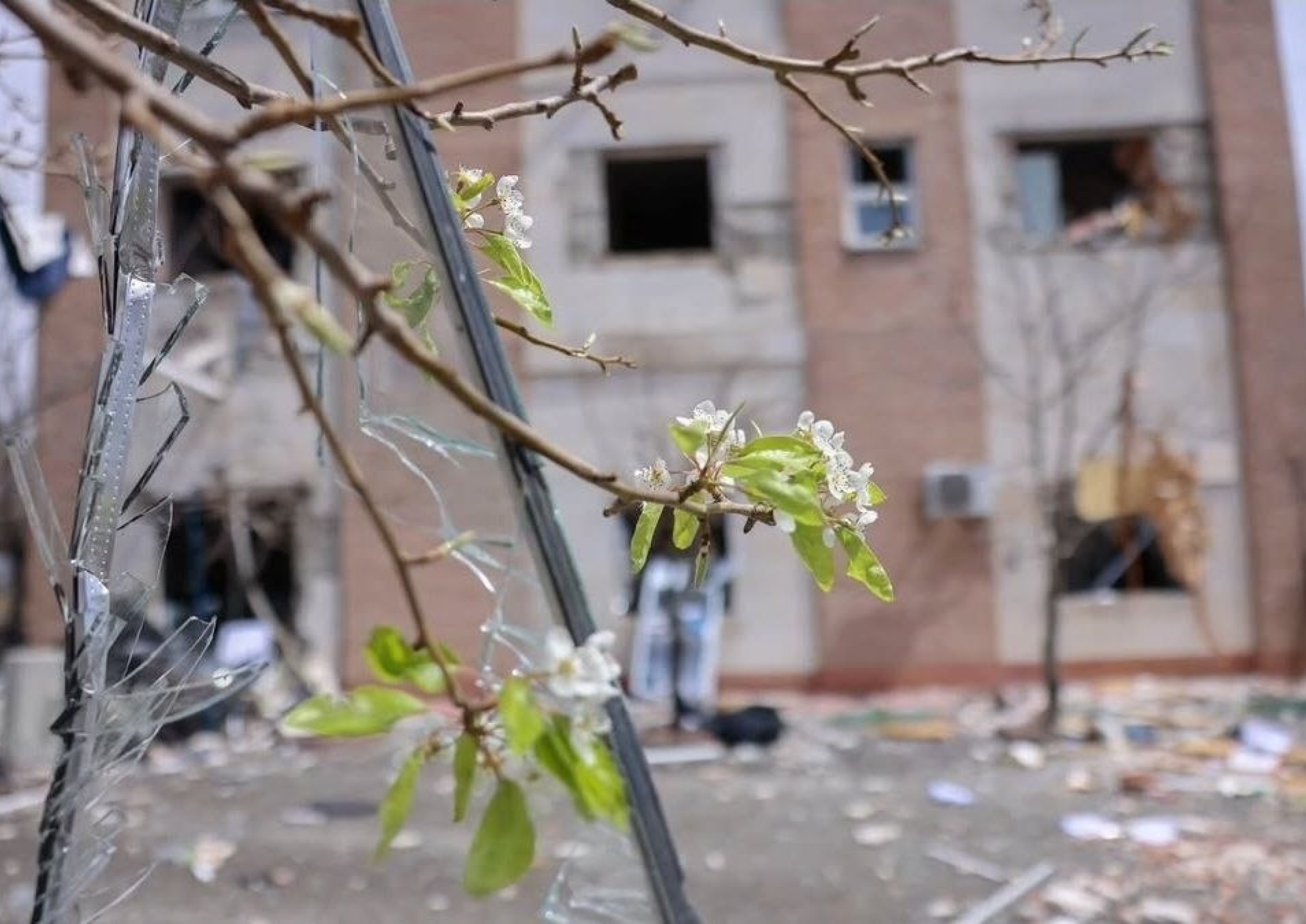
Photograph by Seyyed Vahid Hosseini, retrieved from his Instagram page. The photograph captures spring blossoms visible through shattered windows in the aftermath of the attacks on Shahid Beheshti University in Tehran, April 2026.
Over the past week,1 I have seen, on my phone screen, images of ruination from across the country. Over the past week, I have seen, with utter disbelief, places I had thought of as untouchable, turn into rubble. Over the past week, I have seen Freedom Square (Meydan-e Azadi) set on fire, Ferdowsi Square (Meydan-e Ferdowsi) turned into ruins, and Revolution Square (Meydan-e Enqelab) devastated. Over the past week, I have seen impossible images of Tehran – images unimaginable otherwise: rivers of flame as oil spread through the streets of Shahran after US and Israeli bombs struck an oil refinery, and thick, acidic, black rain falling on the streets of Tehran the next day.
These were the places in which I have once lived. These were the places in which I have once loved. These were the streets from which I once learned how to protest, how to resist. These were the streets where I first learned about the magic of collective power.
Memories pour down as I go through these images of ruination. I ask myself: who am I, who are we, without these buildings, these streets, these memories? Will memories simply disappear if the places where they were formed are gone overnight? What is erased, what is lost, when streets are bombed – “obliterated,” as Trump, that ever-smouldering, war-loving President of the United States puts it?
The Streets that Rise: Green Movement (2009)
I had marched in these streets in 2009 during the Green Movement with thousands of others, when I was a bachelor student at the University of Tehran – that magical place, where I fell in love for the first time; where we held our weekly poetry sessions; where I sat every day with comrades and friends, sometimes in the backyard of the Literature or Law Department, other times in the tall pine-tree2 gardens across the campus, speaking for hours about politics, poetry, philosophy, and art. I was in the final year of my bachelor’s degree when the Green Movement unfolded. I still remember that vivid moment – of rage, of disbelief, of horror – when we heard that Mahmoud Ahmadinejad, whom we had been campaigning against for months before the election, had been re-elected on 22 Khordad 1388 (June 12 of that year).
asma_abdi_image_1.png
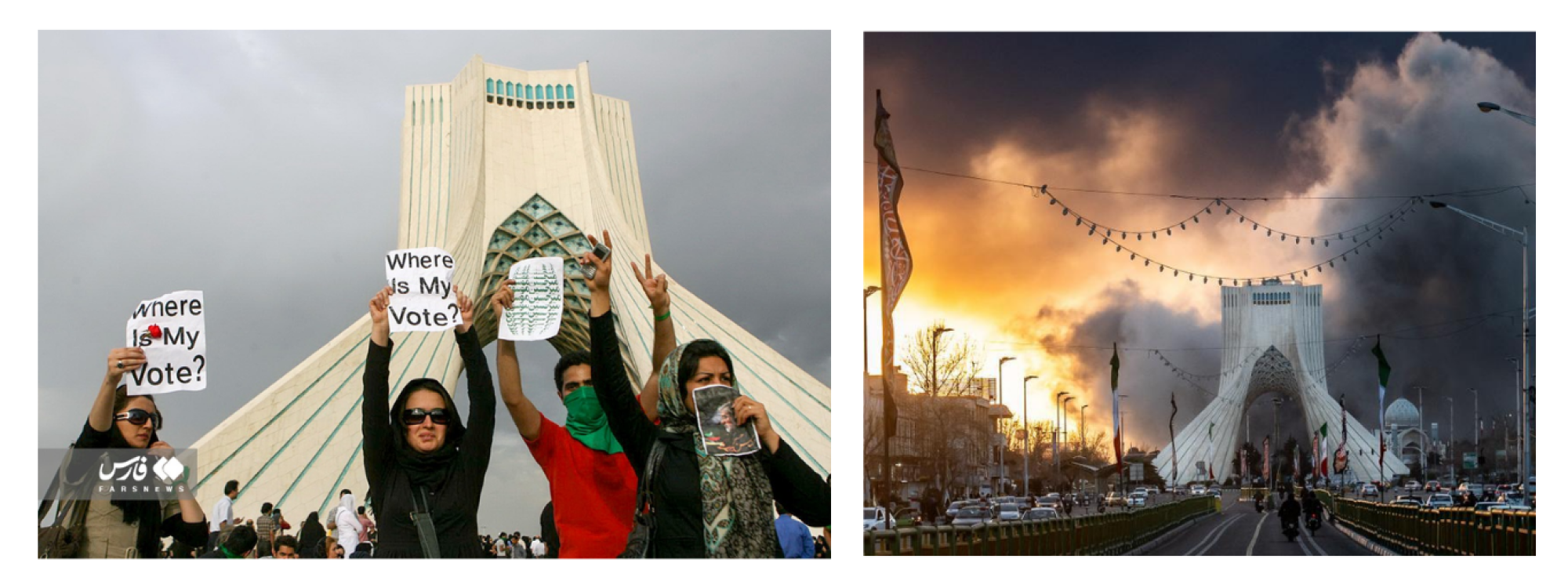
Left: Freedom (Azadi) Square on 15 June 2009, during the Green protests in Iran, when according to some sources, as many as half a million people took to the streets in protest against the disputed election results. This was described as the largest demonstrations in Iran since the 1979 Revolution. Wikimedia Commons, 2009.
Right: Freedom (Azadi) Square, on 3 March 2026, as smoke billows following a US-Israeli strike near the area. The Guardian, 2026.
Ahmadinejad,3 the to-be butcher of the Green Movement; the man who, during his first presidency gradually hollowed out our universities, arresting our professors and classmates; the man who introduced the morality police in the form that exists in Iran today into the streets and public spaces; the man who cracked down on many grassroots movements and sent many women activists of my generation into prison; the man who claimed to stand for the poor while presiding over the implementation of some of the most aggressive neoliberal policies of privatisation and budget cuts; the man who claimed to be “resisting” the United States by dismissing the severe impacts of some of the most “crippling”4 sanctions ever imposed on any country – sanctions, which as we now know, were borne most heavily by the poorest.5
The Streets that Refuse: The Girls of Revolution Street (2017-18)
It was from these streets that, later on – after I had migrated from the country – new protests erupted, new collectives formed, new political imaginaries took shape. It was from one of these streets that Vida Movahed climbed onto an utility box on 6 Day 1396 (12 December 2017), raising her headscarf on a stick in protest against the law of compulsory hijab. This became one of the most visible forms of defiance against obligatory hijab from within the streets of Iran. Before this, we had always challenged state-defined norms of what was considered “proper hijab” through quieter, everyday forms of resistance: wearing more colourful scarves instead of black, wearing them loosely to let more hair fall through, tucking them behind the ears so our colourful earrings remained visible. Inch by inch, we had pushed back the limits of the state’s authority over appearance in public space.
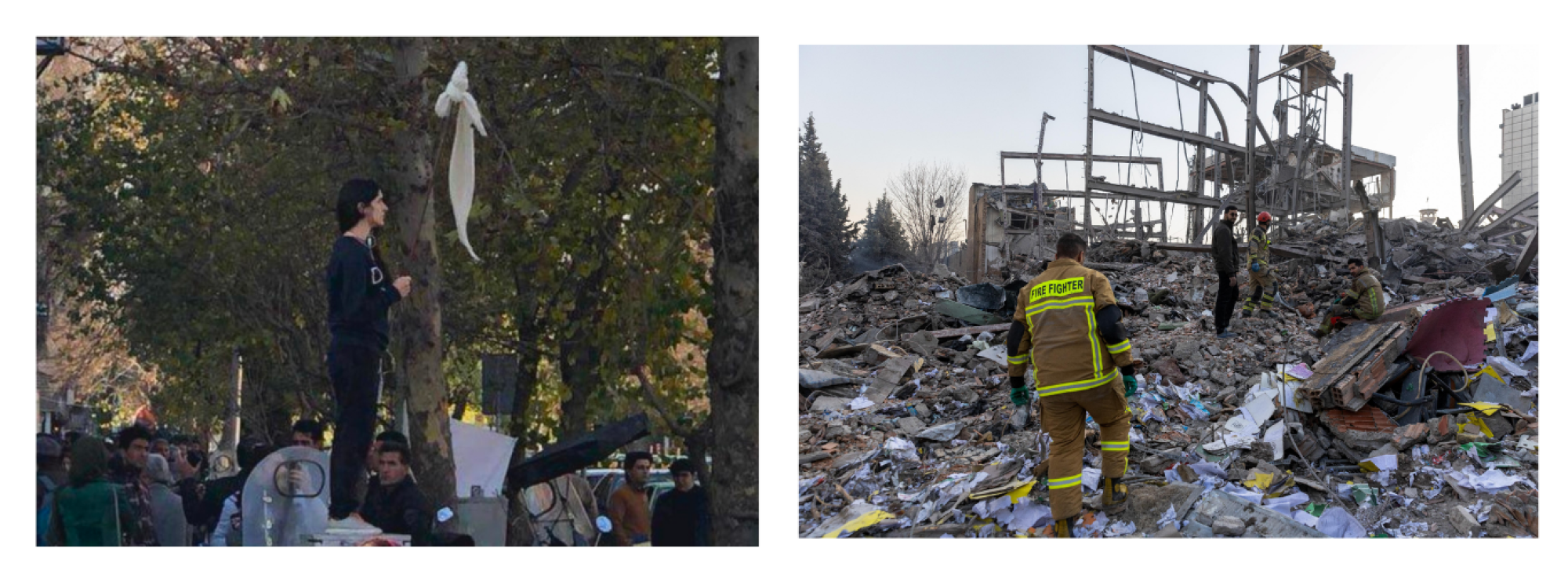
Yet, this felt different – like a rupture in the city’s more hidden and slow grammar of defiance; a silent revolution, a loud NO, arriving not in the hesitation of a loosened hijab that could be adjusted quickly when the morality police came into view, but in its complete absence. This was happening not on social media, where anonymity is possible; not on some quiet street corner where the body might briefly slip from the state’s gaze; not within the My Stealthy Freedom campaign.6 This was happening from within one of the busiest streets of Tehran, in the restless pulse of Revolution (Enqelab) Street, with nothing to shield but a headscarf raised like a white flag.
The “Girls of Revolution Street.” That was the name given to all the women who did the same as Vida. One by one, they climbed the city’s verticalities – sometimes on an utility box, other times on some street edges – turning the city into architectures of open refusal, even if for brief moments before the arrival of the police and their subsequent arrest. One by one, they raised their headscarves on sticks, defying the Iranian state’s widely despised and fiercely opposed gendered laws, and demanded authority over their own bodies. It is this same authority that is continuously negotiated and constrained, on the one hand by a state that has long relied on the regulation and policing of women’s bodies to sustain its self-defined “Islamic” identity, and on the other, by imperial formations that have repeatedly instrumentalised Iranian women’s struggles as moral cover for the justification of sanctions, war, and the redrawing of the regional maps.
asma_abdi_image_3.png
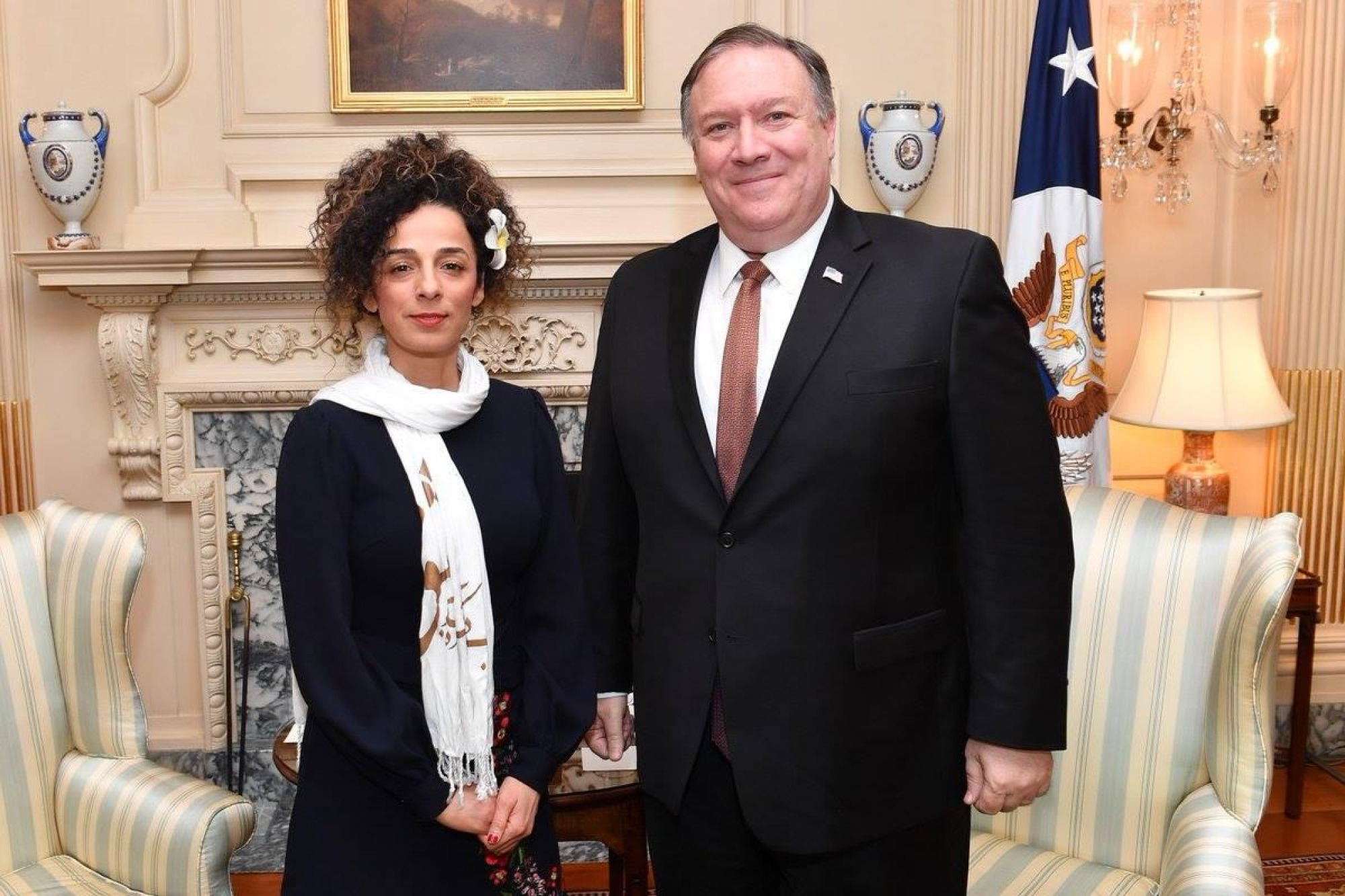
On 4 February 2019 in Washington, D.C., Masih Alinejad, founder of My Stealthy Freedom and advocate against compulsory hijab in Iran, meets then-US Secretary of State Mike Pompeo under President Donald Trump’s administration, a key architect of the “maximum pressure” sanctions policy on Iran. The encounter came to be seen as emblematic of the uneasy entanglement between women’s struggles in Iran and the geopolitics of sanctions and foreign intervention. Image source: Wikimedia Commons.

The Streets that Imagine: Woman, Life, Freedom: (2022-ongoing)
It was from within those same streets – and from the streets of other cities too, in Kurdistan, Baluchistan, and Ahvaz – that the Woman, Life, Freedom revolt erupted: a feminist revolution led by women, for life, for dignity, and for what protesters themselves referred to as an “ordinary life” (zendegi-e mamouli).
asma_abdi_image_4.png
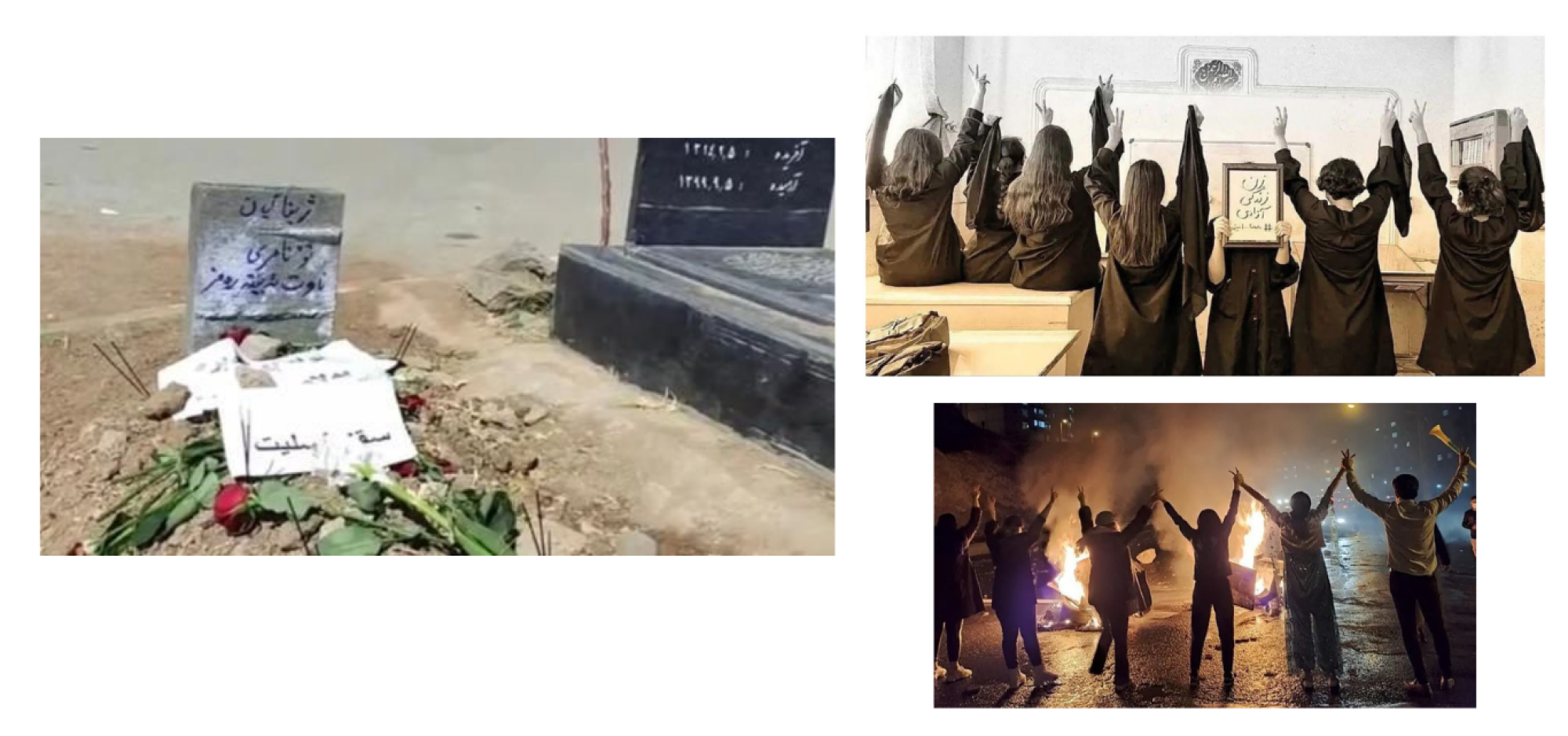
Left: This is the grave of Jina (Mahsa) Amini in Saqqez, whose death at the hands of the “Morality Police” in September 2022 sparked the Woman, Life, Freedom uprising in Iran. The widely circulated inscription on her tomb reads: “Jina, you do not die; your name becomes a symbol” (in Kurdish: Jina, canê tu namiri; navê te dibe sembol). At her funeral on 17 September 2022, women in Saqqez collectively removed their hijabs and chanted “Jin, Jiyan, Azadî” (Woman, Life, Freedom), a slogan rooted in Kurdish feminist resistance that was soon adopted across the country. The collective removal of the hijab by Kurdish women at the funeral marked a significant and transformative moment, not only because it initiated a visible wave of collective unveiling in public space, but also because it articulated the entanglement of gendered violence with the marginalisation of minoritized nations in Iran. Image source: BBC Persian, 2022.
Right above: Schoolgirls in Iran participated in Woman, Life, Freedom protests (2022), removing their hijabs and transforming classrooms and schoolyards into spaces of collective refusal. This marked one of the first major moments in Iran’s protest history in which schools became deeply involved in nationwide demonstrations. Image Source: Morning Star, 2023.
Right below: The image from a street in Tehran shows women removing their hijabs collectively, and burning them as a collective refusal of the Morality Police, compulsory hijab, and the broader system of gendered regulation in Iran. Image Source: BBC, 2022.
It was from one of the cafes along these streets that Donya Rad shared a photograph of herself and her friend during the Woman, Life, Freedom protests – an image that travelled fast across social media and beyond, leading to her arrest the next day. The image is simple and ordinary: two women sitting in ordinary clothes, without hijab, sharing breakfast in a cafe in Javadiyeh, a neighbourhood in the south of Tehran, often marked as traditional and more religious, where cafes and teahouses have often been coded as male, working-class spaces. Her caption reads: “while working, we took a short break to have breakfast.”
asma_abdi_image_5.png
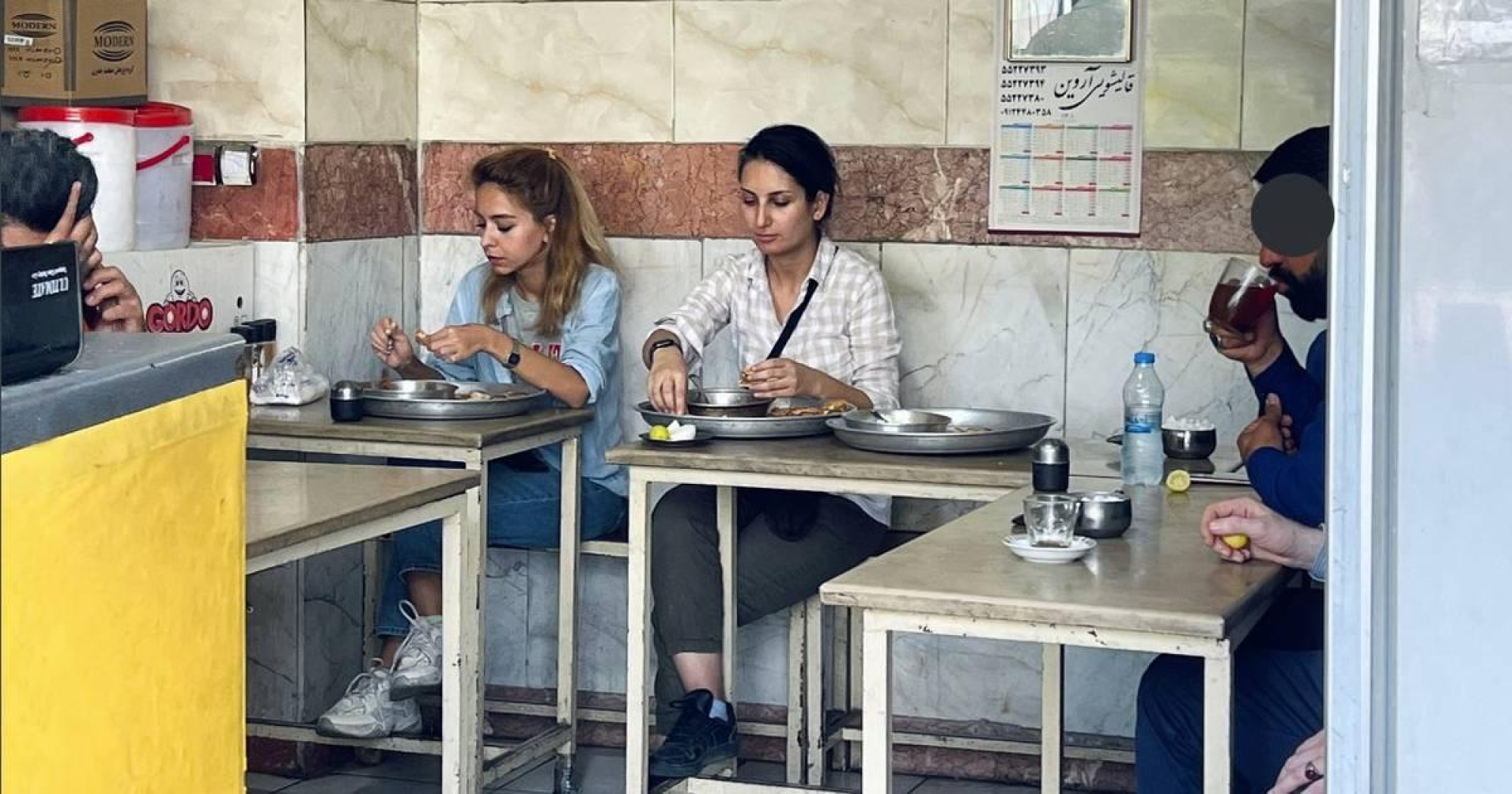
The image tweeted by Donya Rad which went viral during the early phases of the Woman, Life, Freedom protests in September 2022.
Simple, short, yet threatening the city’s many gendered and classed grammars of ordering – some imposed by the state, others sustained through social codes. The image, does more than just oppose the law of compulsory hijab: it claims ordinariness against state-imposed discourses of exception and criminality, in which women are either glorified as exalted mothers under whose feet heaven is said to lie, or reduced to the domestic, confined to the private sphere, and punished when they disrupt this gendered spatial ordering. Against this double edge of sanctification and confinement, the image instead announces the existence of the ordinary, the working-class woman. It lays bare the invisibilised gendered and classed labour regimes upon which the city and the state depend. Compulsory hijab, and wider discourses of motherhood and femininity, are thus revealed as mechanisms through which this ordinary, working-class woman is denied. Against such politics of invisibility, the image reworks the aesthetics of “the woman” in the city: feminising the often masculine imagery of the working-class subject, reclaiming the leisure and friendship as feminine otherwise. In all its ordinariness, the image is thus extraordinary, as the claim to ordinariness itself becomes the silent revolution – a revolution for “ordinary life.”
The Streets as Archive of Possibility and the Third Way
These were the streets that inspired political imaginaries powerful enough to cross borders, to ignite imaginations on a global scale. Images of women demanding a different gendered order. Images of women in defiance, capable of shaking the very foundations of the Iranian state, unsettling its carceral, capitalist, and patriarchal architectures. Images of women speaking for themselves, capable of disrupting the imperial war machinery that has long justified sanctions and war in the name of “protecting” women.
These were the streets from which Iranians have long strived to create a political possibility for imagining a third way: a way beyond the state’s bullets, a way beyond the imperialist bombs, a path of their own making.
A path increasingly foreclosed by the images of death capturing our memories, after each protest, after each act of defiance, after each bombing. Images of morgues filled with bodies sealed in black zippers. Mothers, fathers, and friends moving down the rows of the dead, opening black bag after black bag, searching for their children, their lovers, their friends. Images of the bodies dancing the death of their loved ones away, in grief, in despair, in defiance of death, in the writing of a poetry of impossibility.
asma_abdi_image_6.png
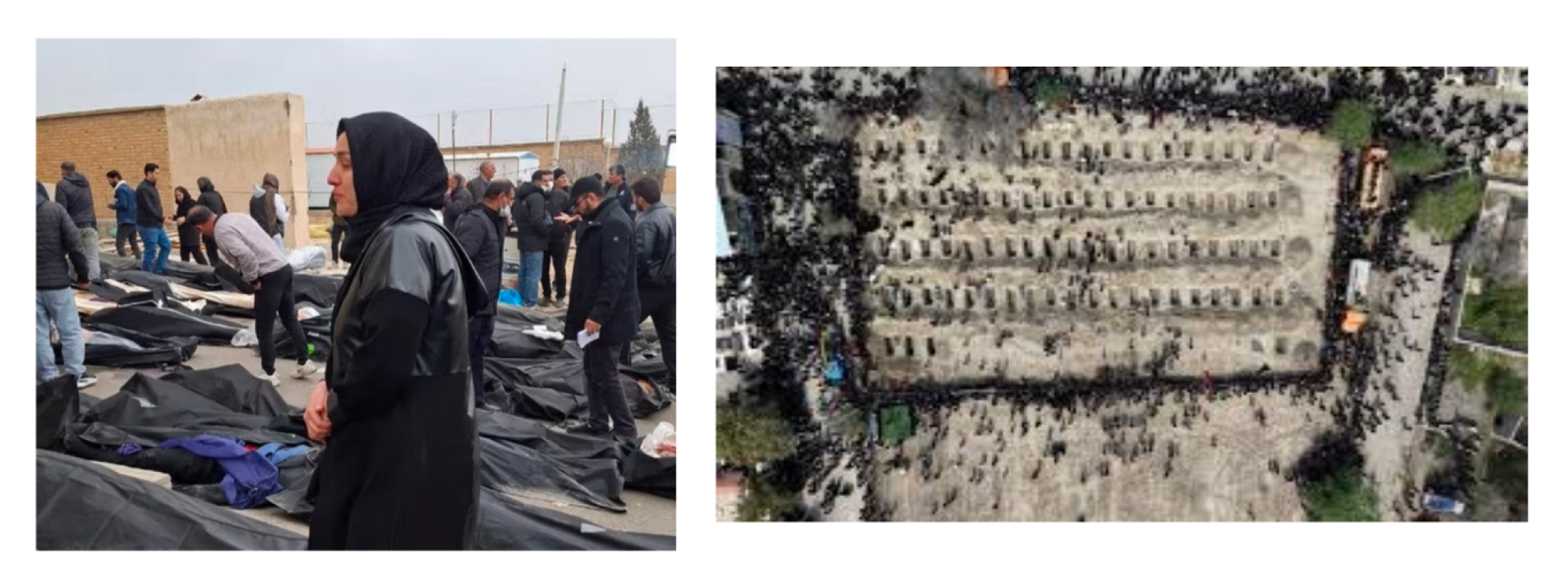
Left: A woman standing among rows of body bags after the January 2026 massacre, when thousands of protesters (exact figures remain contested) who had taken to the streets to protest political and economic conditions were killed by the Iranian state’s security forces. Image source: France24, 2026.
Right: The mass grave of the children of Minab school, killed in a US bombing on the first day of the 2026 war on Iran. Image source: Radio Farda, 2026.
A path increasingly foreclosed by the (im)possibility that bombs could be read as “help,” as “precise,” as “targeted.”
And now ruins, and now black rain pouring down of the skies, and now houses turned into rubble, the mass grave of the elementary school children of Minab capturing our memories, haunting us.
Ahhh, Tehran, a poetry of impossibility…
As I move through this archive of defiance, of grief, of ruination, of massacre, I think, how symbolic that Israeli and US bombs are attacking these streets, locations with such high symbolic capital – locations deeply connected to collective memory, political imagination, democratic potential, and revolutionary impulses that run deep through the veins of the country. Locations from which, for more than a century, student movements, women’s movements, and revolutionary futures have erupted.
This essay started as a short reflective post on my Facebook page in the immediate aftermath of the U.S.-Israeli attacks on these locations during the first week of the war. When I wrote the post on my Facebook, Alaa Abd El Fattah, the Egyptian activist and author of You Have Not Yet Been Defeated (2021), wrote in response: “Urbicide is a crime against humanity… against the memory of those who passed… against the possibility of those yet to be born… They hate our cities, for the city is witness to our unique paths through modernity. They hate our cities, for the city is the keeper of our struggles. They actually hate us for a kind of freedom that never made sense to them. Much of it lived despite our homegrown tortures because the city nurtured and hid us.”
Yes, urbicide is a crime against humanity. To bomb these streets is to attempt the erasure of defiance itself; to efface the memory of women who made it possible to think beyond the false binary of bullets or bombs. To bomb Tehran is to force ruination onto the city’s memory, to strip it of its past, its layers, its unfinished futures, its ongoing revolts – like forcing a period onto an unfolding sentence, an incomplete slogan.
Yet, these bombs fail. They fail to complete the imperial work of unmaking our cities, as what you seek to erase – to “obliterate” – does not reside in walls, but in bodies, in bones, in memories, in the rhythms of a pulse that quickens at the encounter with the name of our cities in the news.
Tehran, I carry you within me – standing, tall, proud like the flag Vida Movahed raised in Revolution Street.
Tehran, a city of defiance, always in the making.
- 1. This piece was written in the immediate aftermath of the outbreak of the 40-day war on Iran, launched by the United States and Israel on 28 February 2026. As such, the emotions it conveys and the facts it draws upon reflect what was known, experienced, and felt at that moment in time.
- 2. My memories are blurred, and I can no longer clearly recall what other trees were on campus, but my fascination with pine trees makes me remember them far more vividly.
- 3. For me, and for many in my generation in Iran whose coming of age and twenties coincided with the election of Mahmoud Ahmadinejad, his re-election in 2009 felt like one of the most horrific events of our time, especially given the widespread belief that the election was fraudulent. Ahmadinejad is also closely associated with significant shifts in Iran’s foreign policy, particularly regarding the nuclear program, as well as with the intensification of crackdowns on grassroots movements and the acceleration of neoliberal privatisation policies within the country. It can therefore be argued that his hardline legacy in both areas continues to shape Iran and the everyday lives of Iranians.
- 4. I am deliberately using the ableist and masculinist language of “crippling” here, as this is the term often employed in US discourse on sanctions against Iran. For a decolonial, affective reading of the term as it is used in relation to sanctions – and its masculinist, colonial, and able-bodied connotations, see Tafakori (2023).
- 5. During his presidency, Ahmadinejad frequently referred to UN Security Council resolutions on Iran’s nuclear programme and sanctions against Iran as “torn pieces of paper,” thereby dismissing them as irrelevant and of little consequence. For example, see: https://www.reuters.com/article/world/ahmadinejad-says-u-n-resolution-a-...
- 6. An online initiative against compulsory hijab in Iran, led by the US-based, US-funded Masih Alinejad, who has frequently linked the promise of women’s freedom in Iran to the idiom of geopolitics – calling for “international” intervention, sanctions, and war on Iran to “liberate” Iranian women.
Abd El-Fattah, Alaa (2021). You Have Not Yet Been Defeated. London: Fitzcarraldo Editions.
Tafakori, Sara (2023). “The Intimate Public as a Decolonial Lens: ‘Cripping’ Affect, Nationalism and Imperial Violence.” Review of International Studies, 49(4): 694–720.