
Shi'a-phobia, Past and Present
dima_nachawi.png
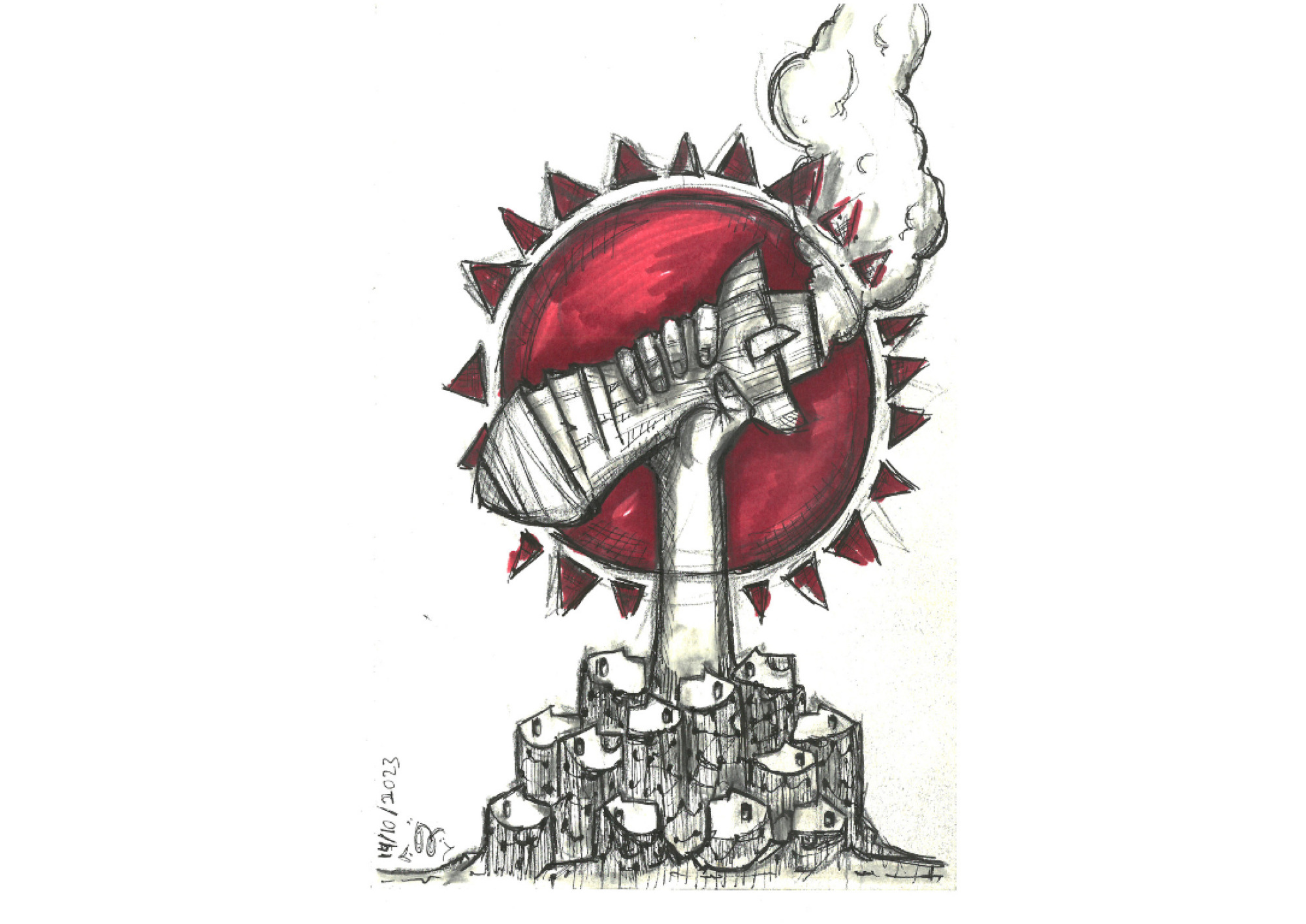
We Will Rise - Dima Nachawi
In mid-March 2026, in the midst of the US-Israeli imperial war on Iran and concomitant Israeli attack on Lebanon, the X social media platform erupted with panic about a plan to settle some of the one million Lebanese displaced by Israeli attacks from their homes in south Lebanon in the Karantina area of Beirut. At first glance, this could be interpreted as merely panic stemming from genuine fears that moving displaced people from the south – the vast majority of whom are Shi'i Lebanese – would act as a magnet for Israeli bombs. After all, this was the lesson learned over the past weeks as Israeli bombs dropped on buildings in Hazmieh, Dohat Aramoun, Bourj Hammoud, Bachoura, even on displaced people sleeping in tents in Ramlet al-Bayda. The Zionist state has made it quite clear that they view Lebanese civilians, especially Shi'i Lebanese civilians, as marked for death, and that sheltering displaced Shi'a is dangerous for those sheltering them as well. While the evacuation orders issued by the Israeli military never explicitly say “Shi'a,” the villages, towns and territories marked for evacuation are all areas where mostly Shi'a live. After livestream witnessing the Israeli military carry out atrocity after atrocity leading to genocide in Gaza for the past two and a half years and then reading leaflets that the military dropped on Beirut suggesting that Gaza could be Lebanon’s future, it is understandable that people are terrified. Yet, the violence with which some have responded to the displaced – ranging from refusing them housing to forcing them to move on – cannot be understood outside Lebanon’s particular context of sectarianism, and Shi'a-phobia specifically.
The X posts about Karantina did not only invoke imminent danger from falling bombs; some of them didn’t mention that fear at all. Instead, they invoked earlier moments in Lebanon’s history when Shi'i Muslims moved to Beirut and became a visible part of the city’s social fabric. “History has taught us that once the Shi'a settle, they’ll never leave [...] I beg those in power to take action now and prevent Dahieh 2.0.” read one post.1 An account that claims to be a news source called “Beirut Wire” described the plan as “a new Ouzai in the making.” These are examples of the more polite language used. Other posts used language I will not repeat here that can only be described as bigoted and dehumanizing. (The only reason I don’t use the term “racist” is because that requires more analysis; this is obviously sectarian but race in Lebanon is more complicated). This is Shi'a-phobia unmasked, expressed as the idea that Hizballah is “causing” the Israeli attack, and that therefore, all Shi'a are targets to be expelled from neighborhoods and even the nation. This Shi'a-phobia is fomented, though not initiated, by the Zionist attacks, as its multiple strands trace through Lebanon’s history, linked to class and religiosity on the one hand, and settler-colonialism and empire on the other.
Class and Religiosity
The marginalization of Shi'i Muslims in Lebanon dates to the mandate years. As the mandate borders were drawn, if the Shi'i villages in the south mattered, it was likely only insofar as they might disrupt French and elite Maronite efforts to carve out a Christian-majority enclave in the region. The few elite Shi'i families at the time were more urban and allied with the French. The Maronite villages located in the south created a problem for social engineering that required the inclusion of their Shi'i neighbors. Undercounted in the 1932 census and underrepresented in the sectarian government structure established by mandate elites, rural Shi'i Lebanese were ignored and unseen until the 1950s when infrastructure connecting hinterlands to urban centers and pressure to shift to cash crops pushed many to migrate to Beirut looking for work. They moved to the ring of suburbs around the capital, dubbed “the misery belt.” By the 1960s, Shi'i Lebanese were associated with poverty and service labor. Class and sect intertwined, as did classism and sectarianism. Population displacements during Lebanon’s civil war, primarily Shi'i Muslims leaving the eastern suburbs and Maronite Christians leaving the southern ones, solidified the southern suburbs of Beirut as a Shi'a-majority part of the city, now dubbed Dahiya. This history underlies the social media posts fearing that the displaced “will never leave.”
In the late 60s and 70s, Shi'i social movements began demanding greater collective rights within Lebanon’s sectarian system. Initial mobilization in the “Movement of the Deprived” morphed into a diverse, Islam-inflected social and political movement. Suddenly, those workers and service people – rural poor made urban working-class – were visible, organized, and making demands, challenging the hierarchy of sectarian status and their place on the lowest rung. Someone once told me that having one’s privilege challenged feels like being punched in the gut. When the deprived stood up as an explicitly Shi'a collective, that intertwined classism/sectarianism took the form of Shi'a-phobia.
Since those movements, both wealth and education among Shi'i Lebanese have increased significantly. One way to tell the sect’s story is as a story of collective class mobility. Poverty was not eliminated, but no longer could people point to the Shi'a as “the poorest of the poor” in Lebanon. Shi'a-phobia persisted. During the 1990s, when I was beginning my first ethnographic research project in Dahiya, friends and family in other parts of the city cautioned me about the area, drawing on stereotypes of “a Shi'i ghetto” and warning me about dirt and danger. A professor at the American University of Beirut (AUB) told me I didn’t need to go “that far,” that I could just interview the AUB janitors, “because of course they are all Shi'a.” Shi'i Muslims I interviewed drew on self-deprecating humor to pointedly note their awareness of the stereotypes other Lebanese hold about them, bringing the dehumanizing discourses into the open. Some even reclaimed the derogatory term mitwali,2 or shared stories of calling people out, because they thought that Shi'a have tails. Between my initial research and now, whether doing research interviews or hanging out with family and friends, the stereotypes have persisted. A Sunni marrying a Shi'a was a move down the social ladder, even if the latter’s family held more wealth. Massive wealth from emigration to West Africa and remittances in Shi'i communities was disparaged; their villas are described as “hideous” or “eyesores” as opposed to the equally massive villas in Christian villages built with remittances from the Sunni-governed Arab Gulf states. Shi'i Muslims with MDs and PhDs from AUB or institutions abroad complained of anti-Shi'a discrimination in hiring practices or promotions. Dahiya, which grew into a diverse, multi-class part of Beirut’s social fabric, was shunned by other Beirut residents except as a space to find bargains.
There is another piece to the class-sect nexus: religiosity. The Shi'i movement of the 70s had a palpable impact as piety moved into the public sphere. Take just the most obvious and tired example: within a couple decades, many Shi'i women chose to wear headscarves. What to them was an article of clothing linked to their faith, identity, and later, community norms, was viewed by some Lebanese as the alarming encroachment of Islam into an allegedly secular country. This view has had material impact: quite a few young Shi'i women have complained to me that their dress has blocked them from higher-paying employment outside Dahiya.
It’s possible to think about this as Islamophobia rather than Shi'a-phobia. Maronite Christian civilizational supremacy has been a discourse among a sector of the political elite since the mandate. For some Lebanese, Christianity provides a bridge to Europe and global whiteness – a bridge that allows Christian piety to count as secular, and that is threatened by visible Muslim piety like headscarves or not drinking alcohol. It also connects Lebanese Islamophobia to anti-Muslim racism in Europe and the United States. In my most recent research, I heard countless Islamophobic comments from Christian Lebanese linking appearance and lifestyle differences to being lower class and lower status – separate, again, from calculations of wealth. These comments were directed at both Shi'i and Sunni Muslims.
Yet, there is also something specifically Shi'a-phobic about these ideas that comes out in the intersection of religiosity with class stereotypes. Obviously, many Sunni women also wear headscarves, but in Beirut, especially among middle- and upper-class Sunnis, this has historically been more common among elders, where it is viewed, by Muslims and Christians alike, as a marker of age and respect. Even though over the past two decades, more younger Sunni women are choosing to wear headscarves as part of a Sunni piety movement, many urban Lebanese still assume that younger women in headscarves are Shi'a, or, if they are Sunni, are either rural or poor. This assumption is related to a sectarian hierarchy in which Sunni Muslims as a group have long held high status, both under the Ottoman Empire and as members of the mandate elite. To a certain extent, the privilege of status protects Sunni piety from disparagement. In addition, Shi'a-phobia is as common among Sunni as among Christian Lebanese. Beyond Lebanon-specific sectarian hierarchies, this connects to broader regional discourses that have amplified over the past two decades that pit the Shi'i-majority Republic of Iran against the Sunni-governed Arab Gulf states.
Thinking about Shi'a-phobia through class and religiosity lets us see the outcry over displaced Shi'a moving into Karantina as an outcry over the challenge their presence poses to the sectarian territorialization of most spaces in Lebanon since the civil war. Karantina is an area of the city heavy with meaning. Its name recalls its role as a space of quarantine in the 19th century, later becoming a space of refuge for Armenians fleeing genocide, Palestinian refugees from the Nakba, migrant workers, and Syrian war refugees. These groups that sought refuge in Karantina also faced intense xenophobia and discrimination, but not to the extent of the current anti-Shi'a (and earlier anti-Palestinian) sentiments. Its traumatic history includes the 1976 massacres of hundreds of mostly Palestinian refugees by Christian militias during the civil war, and, more recently, its devastation in the August 2020 explosion at the Port of Beirut.
This history also underlies the current panic. Calls upon officials to prevent “Dahieh 2.0” and invoking “Ouzai” hearken back to the initial migration of rural Shi'a to Beirut and the consolidation of the southern suburbs as a Shi'a-majority space during the civil war, as well as to Karantina’s layered history as a space of both refuge and violence. The language of these posts enforces the idea that each sect somehow “belongs” in its territory, and that borders that grew from wartime population transfer and real estate practices are material blocks to social mixing.3 They suggest that people moving in from areas of Lebanon where the Israeli military has issued evacuation orders – including the south and Dahiya – will infect or displace those living around them with their “foreign” social and religious practices, nevermind the fact that they are as Lebanese as anyone else and have been citizens for just as long. These fears also belie a realism, one their authors do not articulate explicitly: that this is likely not a temporary displacement, but a permanent one, related to the settler-colonial expansion of the Zionist state.
Colonial-Imperial “Divide and Conquer”
The Zionist state has been attacking Lebanon since 1948. Throughout, but especially during the major Israeli invasions of 1978 and 1982, and subsequent occupation of the south until May 2000, it was mainly Shi'i Lebanese who lost their homes, land, and livelihoods.4 Mired in and divided by civil war, and ill equipped to begin with, the Lebanese army could not defend the south. Inspired by the 1979 revolution in Iran and deeply connected to both the Shi'i social movement in Lebanon and the villages of the south, Hizballah was founded as a militia to fight against the Israeli invaders and their proxy Lebanese militias. By the end of the civil war in 1990, Hizballah’s Islamic Resistance had established itself as the leader of the multi-faceted armed resistance to Israeli encroachment. And during those years of occupation, as long as they stayed in their lane and no non-Shi'a areas of Lebanon were significantly impacted, that was not only acceptable, but often lauded by other Lebanese and even the state at times. They were doing the work of defense that the army could not do – defense that, if one pays attention to Zionist leaders’ words, has been and continues to be necessary to thwart Zionist ambitions to settle “Greater Israel” which extends at least to the Litani River and has been the consistent and explicit Zionist vision for over a century.5
After the Resistance successfully liberated the south in 2000, Lebanon began tense discussions about Hizballah’s armed wing. By now, Hizballah was also a post-civil war political party, and alongside its less popular and less organized ally Amal, was one of only two sect-based political parties representing Shi'i Lebanese in a system where the vast majority of political parties operate on sectarian interests. Not only was the party participating in the state, but after 2008, it was part of the largest political coalition in government. What should have been a political discussion about the role of the Lebanese army, and about how to effectively defend people and land in the south, as well as the state and its borders, from regular Israeli invasion and attack, instead took the shape of a sectarian debate laden with histories of neglect and trauma. The conditions of this debate were hampered by both the sectarian structure of the state and external imperial and colonial efforts to divide the region, pitting its communities and countries against one another in order to control and conquer. In this sense, the Shi'a-phobia that is expressed primarily as anti-Hizballah sentiment is also a symptom of both political sectarianism and the US and Israel’s imperial project for the region.
Creating divisions and giving those divisions teeth is one of the key modus operandi of the Zionist colonial project. We see it, for example, in the Israeli state’s categorizations of Palestinians as “Arab,” “Christian,” “Muslim,” “Druze,” and “Bedouin,” with differential benefits allowed to some over others, and in the Israeli state’s sectarian personal status legal system that is based on these constructed categories. Lebanon’s sectarian lines were drawn at the state’s inception by Maronite elites along with the French. All the Zionist movement had to do was wedge those lines into rifts. Indeed, the first wedge was forged prior to the Nakba, at least as early as 1946 with a treaty between the Zionist movement and the Maronite Patriarchate in Lebanon.
US involvement in imperial efforts to divide and conquer gained momentum after the 1979 revolution in Iran, when its initial popularity threatened for a moment to bring Sunni Muslims into the Shi'a anti-imperial fold. Divides were solidified by fueling the Iran-Iraq war. Later with the 2003 invasion of Iraq and the buildup of US military sites across the Arab Gulf states, the US empire demanded loyalty, ostensibly in return for protection from Iran, a Shi'i state with a diverse population that had not actually threatened any of its neighbors militarily. Notably, several of those Sunni-governed Gulf states have sizable and marginalized Shi'i populations. As the symbol of Shi'i power, Iran became the straw man escorting the US military into ever-extending corners of the region.
During the 2003 US invasion of Iraq, for the first time, various 24-hour news channels displayed maps with “Shi'a Crescent” written across them. By then, not incidentally well into the second intifada and the ripping open of the illusions of Oslo, the Sunni-majority states in the region were acquiescing to the imperial demand to normalize relations with the setter-colonial entity on Lebanon’s southern border. The “Shi'a Crescent” served as code for “those outside Palestine who won’t accept Israel and the Zionist project.” It marked out the axis of Resistance that continues today. It is no coincidence that the Sunni-Shi'a sectarian rift in Lebanese politics appeared soon after the assassination of Prime Minister Rafiq Hariri in 2005. Nor is it a coincidence that the 2006 war, the first war after their withdrawal in which the Israeli state attempted to eliminate Hizballah, took place at a time when regional sectarian divides had manifested in Lebanon as well.
During that 2006 war, the Israeli military deployed its “Dahiya doctrine,” which explicitly calls for the destruction of civilian infrastructure, thinking that if they reduced Dahiya and the south to rubble, the residents of those areas, mostly Shi'i Muslims, would abandon Hizballah and the Resistance. It had the opposite effect. But the Israeli destruction of infrastructure in other parts of Lebanon fueled sectarian tensions in the country.
As the internal political rift grew, anti-Shi'a commentary reached new heights. Its peaks correlated with moments when Hizballah made decisions or took actions that angered many Lebanese. These moments included the Hizballah and Amal sit-in in downtown Beirut that began at the end of 2006, the short-lived 2008 deployment of Hizballah fighters in the capital, Hizballah’s decision to fight in the Syrian civil war on the side of the regime, and the party’s participation in the suppression of the 2019 revolution in Lebanon and in a wave of multisectarian homophobic panic and incitement to violence in 2023. Many people experienced Hizballah’s actions as sectarian, and the party has used sectarianism and sectarian rhetoric – as has almost every Lebanese political party. This is also the period when Hizballah acted just like other Lebanese political parties in other ways: consolidating alliances with the elite, playing electoral politics, and supporting legislation that favors the middle and upper classes over the poor. I’m not suggesting that one shouldn’t criticize Hizballah or hate some of their actions. The problem is that expressions of that anger and hatred have not been limited to the political party.
Instead, over the past decades, Shi'a-phobia – language attacking an entire identity-based group – has grown explicit, strident, and again draws on classist imagery of dirt, ignorance, and pollution. The political-sectarian system of government in Lebanon makes it seem natural to associate sects with sectarian leadership. However, that association ignores not only political diversity within sects, but also differences of power between sectarian leaders and people who are living in a state and system where the only options for political representation are sectarian ones. While to a certain extent the sect-political party conflation takes place across Lebanese groups, other groups have not been vilified as Shi'a have when people disagree with the actions of parties that allegedly represent them. Maronite-phobia, for example, has not grown into a discourse in Lebanon worth commenting on in the wake of abhorrent actions or statements by the Lebanese Forces. The vilification of Shi'a Lebanese due to this conflation has been the most consistent and dangerous form of sectarianism in Lebanon, in part because it predates the emergence of a political party that is powerful enough to matter.
Fast forward to the past two and a half years of Israeli genocide in Gaza. During that genocide, political and economic pressure to normalize the settler-colony’s presence in the region continued, as did the theft of additional land in the West Bank, and later, Syria. It is again no coincidence that the only groups to do anything material to try to stop the genocide were in that “Shi'a crescent” (now including Ansar Allah in Yemen) and it is no coincidence that tactics, both brutal and manipulative, were used to suppress that resistance: the Israeli war on Lebanon in 2024, the US bombing of Yemen, the remaking of Syria where the tradeoff for the removal of a vicious dictator is rule by a US Islamist stooge and normalization with the settler-colony. It is plausible that, in February 2026, the Zionist state was ready to make what it imagined would be its final move on this resistance front. It is also plausible that it planned this war in an effort to establish Israel as uncontested fact in the region, and goaded the US to join its attack on Iran while simultaneously invading Lebanon for at least the tenth time since the Zionist militia attacks during the Nakba, depending on how one decides which attacks to count as invasions.6 This time (as in 2024), the Dahiya doctrine has been amplified into “the Gaza doctrine,” targeting civilians as well as civilian infrastructure. It is being deployed not to turn Shi'i Muslims against the resistance, but to turn other Lebanese against Shi'i Muslims, driving the sectarian wedge deeper. And as the resurgence of explicit Shi'a-phobia shows, it may well be working.
Shi'a-phobia Unleashed
Social media posts fearing that Shi'a “will never leave” “our” neighborhoods, refusals to rent housing to Shi'a, and efforts to expel them from certain areas tell us a great deal about who is included in the nation and who is being excluded from it. It should be obvious that directing anger at all Shi'a when one is angry at Hizballah is a problem. But it is also a problem to assume that any political group’s actions, including Hizballah’s, make them a proxy for an external state or even non-Lebanese. Suggesting that Iran is “occupying” Lebanon through their alliance with Hizballah ignores the fact that alliances outside Lebanon are a quintessential hallmark of Lebanese political parties, including Hizballah’s loudest detractors. It also ignores the long histories of other Lebanese groups allying with, and yes, also making decisions in conversation with, the United States and Israel. To call Hizballah “Iranian and not Lebanese” or a “proxy” for Iran is to begin the slide down a dangerous slope of deciding that some people do not belong inside the nation. Such claims also ignore the group’s decidedly Lebanese history: emerging in response to Israeli invasions and occupation, defending Lebanese territory against Zionist encroachment, and making decisions in the context of Lebanese sectarian politics. When those claims slip further, claiming that all Shi'a are somehow not Lebanese and not Arab, but Iranian, they rhetorically expel at least one third of the country’s citizens.
Of course, many – though certainly not all – Shi'i Muslims do support Hizballah and the Resistance. Why shouldn’t they, in a state where no one else, including the army, defends the south from invasion and where no other political party provides representation and support? Yet, supporting Hizballah does not erase a person’s civilian status or somehow make it acceptable to target that person for death. Nor does working for a bank or a television station associated with Hizballah, or voting for the party in an election. To assume that anyone who supports, works for, or is associated with Hizballah is an acceptable target of war is to call for genocide. To assume that anyone who is Shi'a might support Hizballah simply broadens the scope of the people marked for elimination in that genocide. And to assume that anyone who lives in a place the Israeli military has marked for evacuation is a legitimate target broadens it yet again, and accepts the terms set by the invading army.
We must remember that the current manifestation of Shi'a-phobia – the combination of the idea that Hizballah is “causing” Israel to bomb the country with the idea that all Shi'a serve as magnets for those bombs (and are therefore to be shunned, expelled, and avoided) – is at least in part the outcome of Zionist efforts to divide Lebanon from itself and turn the Lebanese against one another. After all, this is what the Zionist movement has sought to do in Lebanon from its inception, as it has sought to do in Palestine. Shi'a-phobia is a gift to those Zionists efforts.
Decades of Shi'a-phobia in the sectarian Lebanese register – with intertwined class-sect-religiosity bias and settler-colonial wedges – have combined with Gulf geopolitics and US-stoked fears of the Iranian enemy. The US imperial project has presented the Lebanese with a stark choice – as it has done to the Gulf states: you are either allied with us or with the “Shi'a crescent.” Shi'i Lebanese aren’t even given that choice, but are assumed, no matter what their political views and allegiances, to be allied with the latter. And let’s be clear, as the Gulf States are now learning, the US imperial project doesn’t care about Lebanon, and it’s not going to save the country when the settler-colony comes for our land.
It is possible to disagree with or even hate Hizballah’s decisions, actions, and statements without falling into the imperial rhetoric that marks the party, anyone associated with it, and by extension, all Shi'a, for death. It is possible to disagree with Hizballah without being Shi'a-phobic, without dehumanizing Shi'a, without denying them housing, and without discriminating against them. It is also possible to disagree with Hizballah’s stances and still acknowledge that they are currently the only group defending Lebanon from Zionist attack. Supporting the Resistance just because it is Hizballah is an equally problematic stance because it still hinges on sectarian identity politics. One can and should support the Resistance no matter what you think of Hizballah, because in the absence of a Lebanese army and state able to defend the country’s borders, it is the only thing currently standing against the murder and displacement of people and the theft of land from south Lebanon. It’s no longer a matter of predictive analysis based on historical Zionist statements to say that Israel is coming for the south in this war; Israeli politicians are saying so openly.
To fall into Shi'a-phobia is to play the colonial and imperial game, and to buy into the divisions that carve Lebanese from one another, as well as from Palestinians and Syrians (a whole other topic), instead of understanding that we are all of the region, that we are all impacted by the Zionist settler-colonial project and US imperial ambitions, and that the far more powerful strategy would be to unite against them. The alternative rests on the illogical idea that the south can be cleaved from the country and given up to settler-colonial encroachment, in return for an expectation that the rest of Lebanon will be left alone. This is illogical in part because settler-colonial states are by nature expansionist, so while today the line is drawn at the Litani River, it may well become the Zahrani, and then Saida, and then… From another angle, it is illogical because it assumes that Lebanon can sustain itself economically without the south’s key participation in agriculture and commerce, and its gas reserves off the Mediterranean. And it is illogical because why should one expect Lebanese from the south to give up their land and homes? Why should they either leave or stay and be murdered or agree to live under Israeli colonial occupation? How can one imagine asking them to sacrifice their homes for the nation while simultaneously writing them outside that nation?
The answer to this last question is precisely why there is so much rage against Hizballah, so much blame for the six rockets fired over the border after fifteen months of restraint in the face of regular Israeli violations of the ceasefire. So much rage against Hizballah – and by extension, all Shi'i Lebanese, that it overshadows rage against the entity actually dropping the bombs. Because one way to answer the question, “why should they be the ones to sacrifice for the nation?” is to make this war their fault, is to place the blame not where it belongs, on the settler-colonial state dropping the bombs and the politicians complicit with it, but on the people who have been resisting that colonialism from the beginning. This is precisely how the dehumanization of Palestinian refugees in Lebanon began: by blaming them for starting the civil war instead of looking to the Zionists who expelled them from Palestine in the first place. And this, terrifyingly, seems to be where Shi'a-phobia in Lebanon might be heading. We should know better.
Acknowledgements
Gratitude to my writing comrades, Mona Harb, Maya Mikdashi, Tsolin Nalbantian, and Nadya Sbaiti, for their thoughtful comments and suggestions, and to the Kohl editorial team for publishing this quickly.
- 1. @CanaaKnight, an individual user who wrote the post, has been on X since July 2016 and currently has 2204 followers.
- 2. Mitwali originally meant people loyal to Imam Ali, but in Lebanon, the term took on a derogatory connotation. Shi'a use of the term as a self-descriptor both reclaims the original meaning and reappropriates the term in the contemporary context.
- 3. See the Beirut Urban Lab’s work on sectarian redlining: https://www.beiruturbanlab.com/
- 4. For more on this history, see: https://www.merip.org/a-primer-on-lebanon-history-palestine-and-resistan...
- 5. Zionist leaders Chaim Weizmann and David Ben-Gurion lobbied to extend the borders of the Palestine mandate to the Litani at the Paris conference in 1919. Aspirations to include the territory up to the Litani have been repeated periodically since then by Israeli leaders, including Netanyahu.
- 6. While there have been dozens of Israeli attacks on Lebanon since 1948, I am counting those of 1948, 1970, 1973, 1978, 1982, 1993, 1996, 2006, 2024 and the current one as “invasions.”
Bou Akar, Hiba. For the War Yet to Come: Planning Beirut's Frontiers. Stanford University Press, 2018.
Deeb, Lara. An Enchanted Modern: Gender and Public Piety in Shi’i Lebanon. Princeton University Press, 2006.
Makdisi, Ussama. Age of Coexistence: The Ecumenical Frame and the Making of the Modern Arab World. University of California Press, 2019.
Mikdashi, Maya. Sextarianism: Sovereignty, Secularism, and the State in Lebanon. Stanford University Press, 2022.
Zittrain Eisenberg, Laura. My Enemy’s Enemy: Lebanon in the Early Zionist Imagination, 1900-1948. Wayne State University Press, 1994.