
WE REJECT A COLONIAL IMPERIAL LIBERAL FEMINISM
aparna_konat.jpg
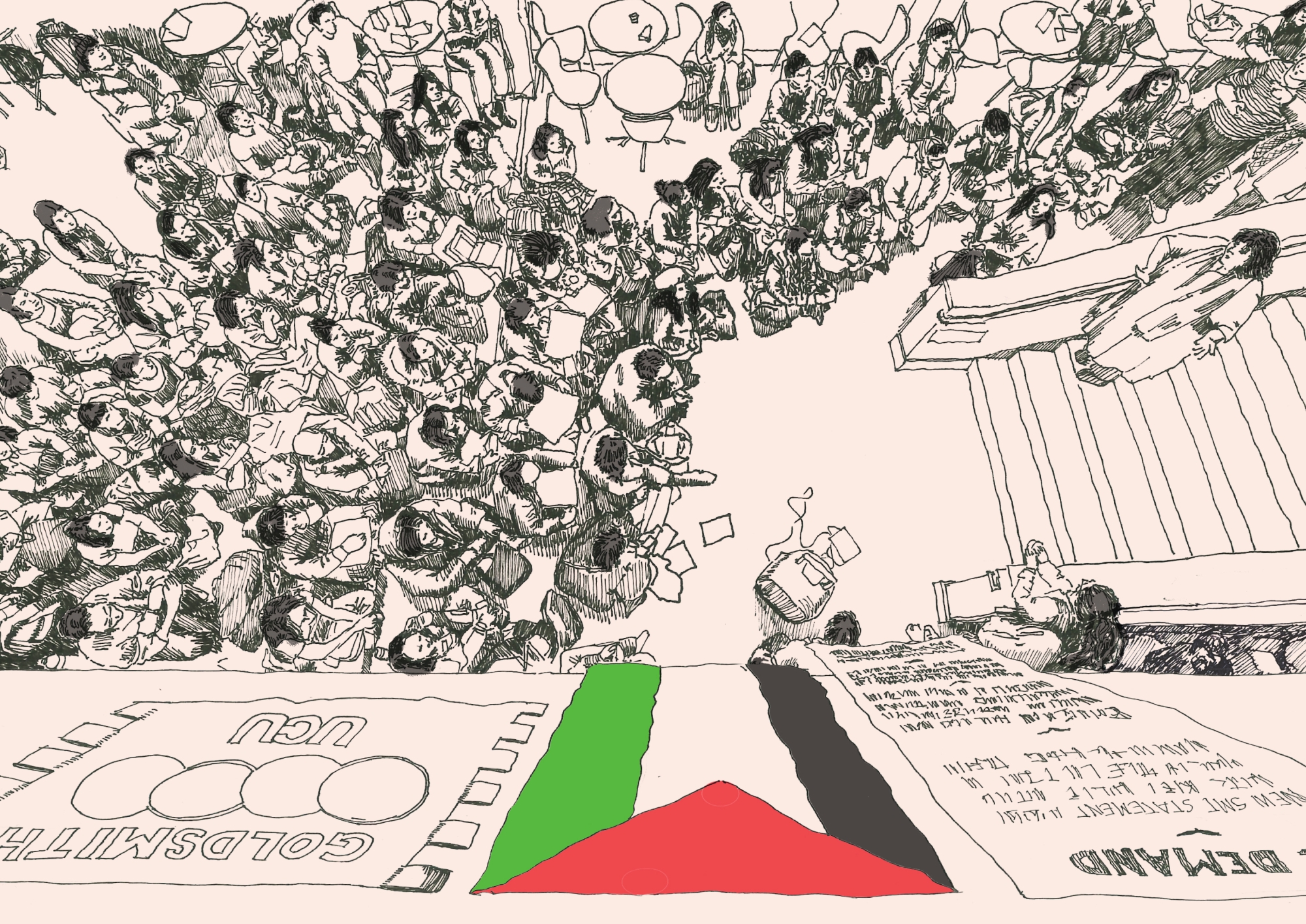
Incredibly grateful to the artist, Aparna Konat, for this sketch of the Goldsmiths For Palestine occupation. Follow Aparna’s incredible work on Instagram: https://www.instagram.com/aparnakonat
This is a slightly edited text of a speech I delivered at a rally on 8 March 2024 (International Women’s Day), organized by Goldsmiths for Palestine (G4P), a student-led group campaigning for an end to institutional complicity and in solidarity with the Palestinian struggle for justice and liberation. I have attempted to preserve the speech-like tone and format in this written version. However, my words here are likely insufficient in capturing the strength, emotions, and collectivity of this rally. I do not use citations with every claim I make in this speech; instead, I offer (a non-exhaustive list of) resources at the end of the piece for reading, learning, and mobilising.1
----
We are here today, as we collectivise in anger and rage, and sadness and grief – and even more rage and grief with every passing second and minute – as we bear witness to a genocide that continues. A genocide that is rooted in Zionism, settler colonialism, and dispossession. A genocide that is built on decades of colonial violence, occupation, murder and plunder, incarceration, theft of land, resources, labor, and the lives of Palestinians. A genocide that did not begin on or after October 7, 2023. A genocide – not a conflict or war or whatever else people might want to call it to erase the histories and realities of Zionism and the Israeli regime – a genocide that has made starkly visible the emptiness of the promises of liberalism, of institutions, of human rights, of international law, of our political leaders. A genocide that millions of people, around the world, are speaking up against, despite being silenced, surveilled, and suppressed, and yet, so many others around us go on with their lives with a sense of inhuman normalcy. A genocide and its long history of Zionist violence that Palestinians in Gaza and beyond have been narrating, have been living, have been surviving, and have always been resisting (see note 1).
We are here today, in this university, this academic institution, that takes great pride in its commitment to social justice, to decolonising this and that, to anti-racism, to ensuring the well-being and safety of its students, to community and global engagement. And yet, this university, like most others, stays silent in the face of ongoing destruction of universities, libraries, archives, and schools in Gaza – turns away into deflections and the obfuscating language of “nuance” and “complexity,” in front of an abhorrent and clear epistemicide and scholasticide (see note 2). A university filled with academic staff who claim to write about the world and even claim to indeed care about the world and about liberation. I don’t have to tell you how hollow and untruthful these commitments and claims are – you all know that; you have lived it and experienced it.
But I do have to point out that, in this university, time and again, year after year, it is students and student- and worker-led campaigns that have been the spaces of learning and education, of fighting, of community, of building, of survival. It was the five-months long 2019 occupation by GARA (Goldsmiths Anti-Racist Action) and this ongoing one by G4P (Goldsmiths for Palestine); it has been countless picket lines and strikes and teach-outs with students and workers when we shut down this university and truly began to learn; it has been the rallies, strategies, and resilience of the Justice for Workers campaigns led by cleaning and security staff and the anti-casualization organizing on this campus; it, sometimes, has been some of our classrooms and every teaching space we make beyond them; it has been the solidarity and strength of union comrades and students who stand with us as we fight the brutality of the institution – these are the spaces, the times, the campaigns, the actions that have shown me and so many others, including so many of you here today at this rally, what a university can be, what education can mean, what a workplace should be.2 A university that is not rooted in neoliberal capitalist white supremacist systems, but an open, un-gated, free space for collective education that is rooted in community, radical politics and access to all, fair working conditions, justice, and indeed, liberation. We ask again – why do we only end up learning together, finding each other, building things when the university is disrupted from its normal rhythms? We, of course, know the answers to this question and being here together at this protest has, yet again, shown us what matters.
We demand from this university – stand in absolute material solidarity against the demolition of universities and educational spaces in Gaza – do something and now; speak up against the murders of academics, students, researchers, teachers in Gaza. It is the very least you can do.
akanksha_1.jpg
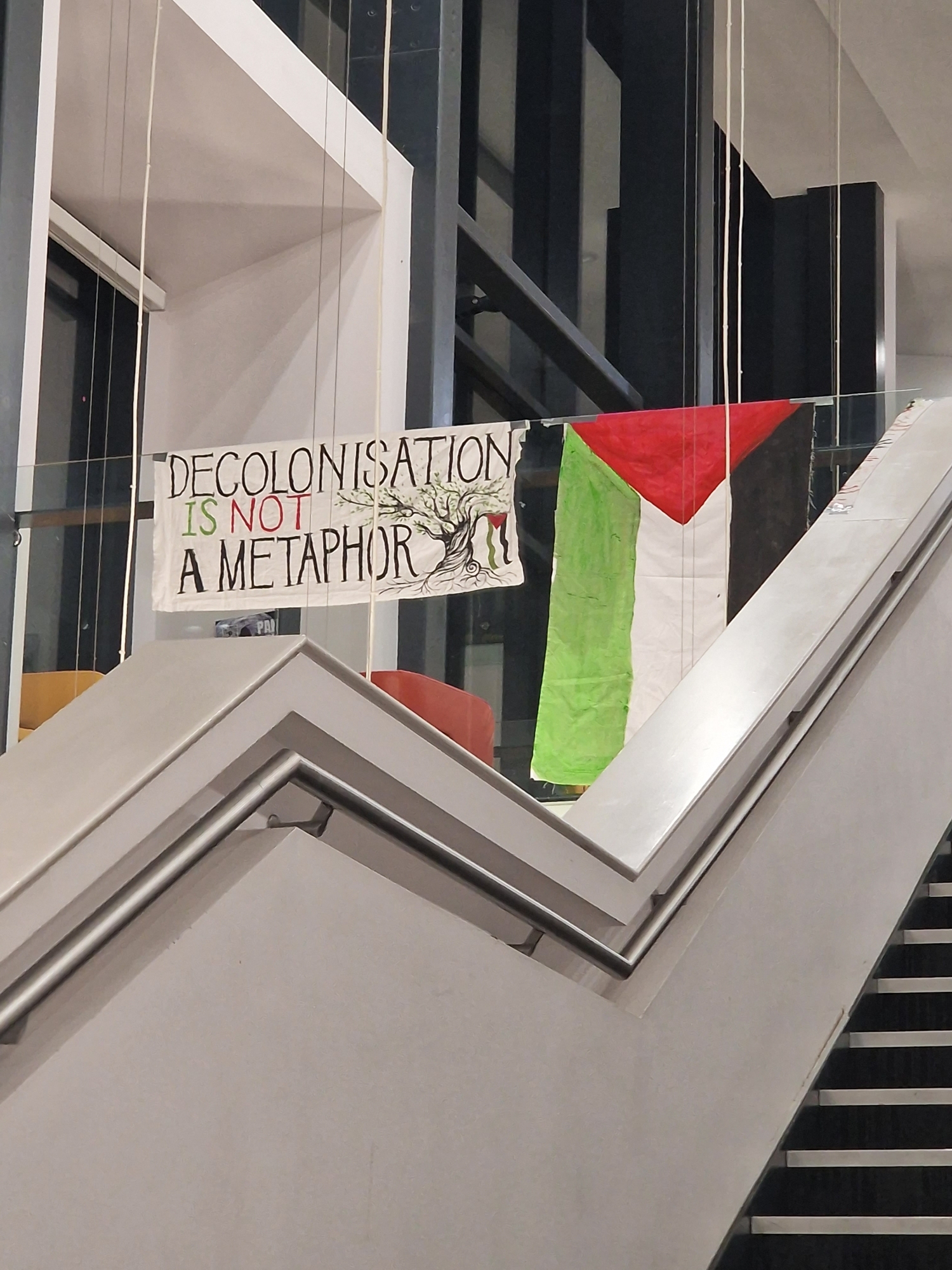
Personal photograph. Goldsmiths For Palestine Occupation of Professor Stuart Hall Building, 2024.
----
Today, in this speech, I want to speak about three things.
The first thing I want to mention in this speech is the importance of this day – today – International Women’s Day. Given what this day has been reduced to by neoliberal feminism, capitalism, and even a post-feminism, every year, we see calls to remember the socialist roots of this day – to connect this day to women’s labour struggle and women’s work – including the unwaged work of social reproduction. And yet, here we are, in a genocide, and we encounter feminisms – not just fascist, imperial, and liberal feminisms – but even Marxist postcolonial and progressive what-not feminisms and feminists, who stay silent in an ongoing genocide, who erase Palestinian resistance and Palestinian feminisms, who enable Zionism and colonialism.3
So, I say this out loud, and I know you all agree with me:
WE REJECT A COLONIAL IMPERIAL LIBERAL FEMINISM that weaponizes “women’s rights” and sees Palestinian women as victims that need to be saved or killed – what do you oppressors know of decades of anti-colonial and anti-patriarchal struggle that has been led by Palestinian women? What do you know of the reality of gendered colonial violence you inflict and how women in Gaza and in all of Palestine contest it, survive it, fight it, resist it? What do you know of Palestinian women who have been fighting your brutality, leading and shaping resistance movements and protests and union struggles and intifadas and holding homes and friendships and families and loves? What do you lot – with your womenandchildren human rights savior discourses – know of survival and of dreams of liberation that women facing oppression have and realize every single day?
WE REJECT A COLONIAL IMPERIAL LIBERAL FEMINISM that refuses to see how the settler colony exploits the labour of the people it colonizes. What do you colonizers know of dignity and work and survival under occupation? What do you, who publish your heavily-worded theories of social reproduction, feminist Marxism, and what not while erasing genocide, race, resistance, and colonialism, know of how worlds come into being every single day? What do you know of how struggles are material and connected, from Sudan to Congo to Balochistan to Kashmir to Palestine – you, who do not even know what humanity is – how dare you dehumanise?
WE REJECT A COLONIAL IMPERIAL LIBERAL FEMINISM that champions the demonization and dehumanization of Palestinian men, Arab men, Muslim men, Black men, migrant men and weaponizes struggles against sexual violence for its murderous carceral colonial purposes – what do you violent ones know of the tenderness of a grandfather from Gaza losing the soul of his soul?
WE REJECT A COLONIAL IMPERIAL LIBERAL FEMINISM that sees queer liberation as Israeli occupation soldiers, standing on ground they destroyed, and life they devastated, with their rainbow flags, shouting, love is finally here. Fuck your rainbow flags; and fuck your love. What do you know of love that was always here and is still here, love that you tried to destroy but that lives on and breathes? What do you know of a queer politics rooted in anti-capitalist decolonial struggle? What do you know of our queer love that is at once filled with queer grief and queer hope, and joys so beyond your limited perverse Zionist and imperial imaginations?
akanksha_2.jpg
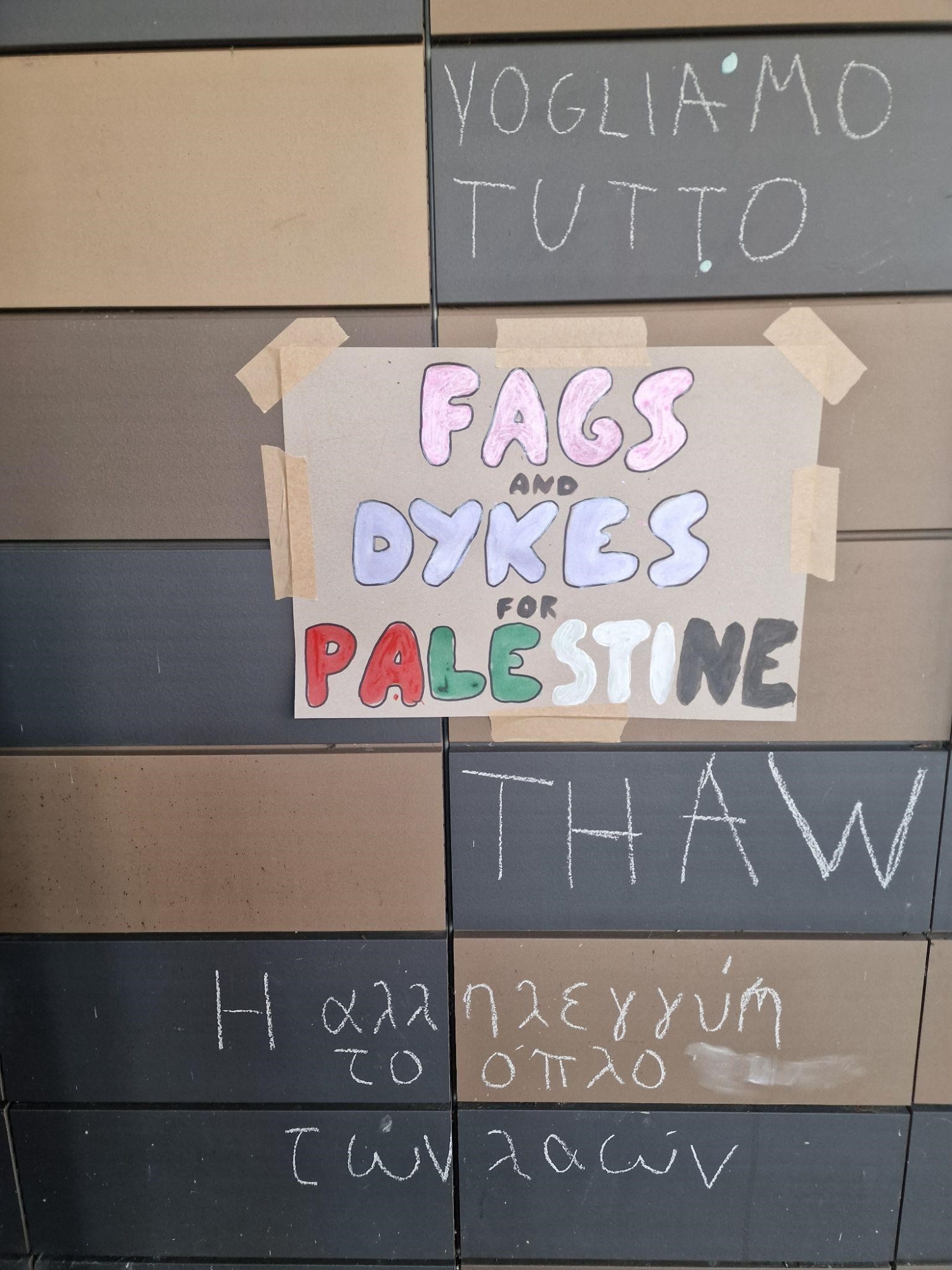
Personal photograph. Goldsmiths For Palestine Occupation of Professor Stuart Hall Building, 2024.
----
The second thing I want to speak about is the willful entanglement of academia in this ongoing genocide and the larger project of settler colonialism. British universities – or rather universities in most of the world really – have always been close to military and state power and remain complicit in imperialism. In settler colonial states, universities flourish on stolen land acquired through dispossession of indigenous communities, and in so many places, academic institutions continually enable the privatization of commons, gentrification, and housing crises, often functioning as landlords. Universities and academia are sites of ableist, racialized, gendered, and classed structural exclusion and discrimination – Who gets to be there and in what capacity? How are certain students and workers treated? How is labour exploited? How are staff casualized and a managerial class with inflated salaries protected and expanded? In India, where I am from, universities remain sites of caste-based exclusion and violence – by design and not exception – and increasingly suppress dissent and struggles against injustice, inequality, and authoritarianism. A host of academic disciplines – from anthropology to area studies, from psychology to physics, from international relations to fields of medicine – were and are formed and reformed through the imperatives of Empire and colonialism, through and for the perpetuation of gendered and racialized hierarchies, through and in service of militaries, state power, and imperialism. In the UK, universities have long helped train and develop military resources and technology. Many of these institutions were built through the plunder and profits of colonialism and slavery and are getting more marketized and securitized with each passing year. They remain invested in the arms industries, weapons trade, fossil fuel ventures, and much more. Some, like SOAS, have tried to hush their links with the UK Ministry of Defense that paid 400,000£ to academics at the institution in exchange for their expertise to the Defense Cultural Specialist Unit. Others, like UCL, continue to host conferences on eugenics. Here, at Goldsmiths, our university proudly bears statues of slave-traders on Deptford Town Hall – a building that belonged to the community but was bought by the university, privatized and securitized, and closed to the local neighborhood (see note 2 and 4). Student-led campaigns to remove these statues and to restore community access were carefully crushed, repeatedly.
The willful turning away of UK institutions as they witness Zionist destruction of universities and targeted killings of academics and teachers in Gaza is predictable, disgusting, shameful, unacceptable. The silence of universities and academic and art institutions on an ongoing genocide and on – wait, not silence, actually, they are not bloody silent, are they? They tell us we cannot protest – they tell us they will tell us how we can protest; they surveil us and suspend students – Palestinian students, Arab students, Muslim students, so many more – they tell us we are hurting the feelings of others, we are making other students and staff uncomfortable and scared; they weaponise antisemitism – which is not anti-Zionism – and tell us, over and over, that we are wrong for speaking out against genocide, for wanting a different university, for fighting for a better world rather than this fucked up mess where people are being actively dispossessed and killed and genocided and bombed and maimed and starved by "Israel" and some people out there applaud and celebrate this and others stand by with their humanitarian pauses, conflict language, and both-sides debates; they tell us that we are wrong for demanding more than what they throw at us – the crumbs of liberal bullshit – that we need to be balanced and respectful and behave ourselves. Well, I say, fuck your crumbs and your Zionist liberal bullshit. We are here; our students are here; young people are here, older people are here, they will not leave till you meet their demands; we will not rest till the genocide ends, till colonialism crumbles, till resistance brings the liberation and freedom of Palestine and all oppressed communities around this world.
Here, I ask again, there are hundreds of academic staff in this university, and yet we see a handful of them in this student-led occupation, and today, as in all rallies, we hardly see them. Dearest colleagues, where are you all with your professorships and permanent contract jobs? What are you busy doing? Writing papers on genocide and settler colonialism? Organizing performative funerals for human rights? Signing book contracts on justice and violence? On Gaza? Hosting yet another conference in a fancy room on global issues? Show up! Learn a thing or two about the university, about learning, about this world. Speak up! Fight! We see you and we will not forget!
akanksha_3.jpg
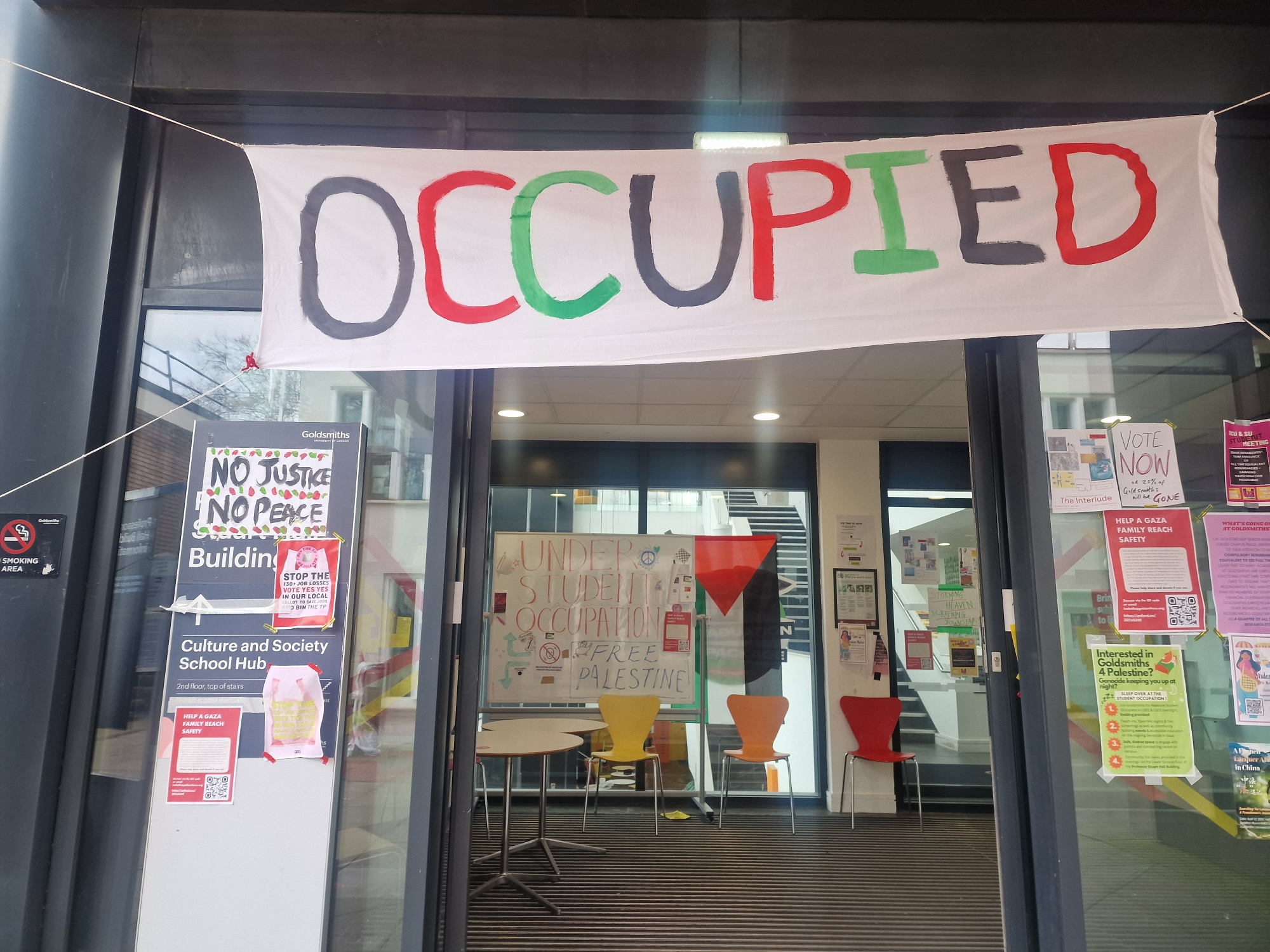
Personal photograph. Goldsmiths For Palestine Occupation of Professor Stuart Hall Building, 2024.
----
The third and final thing I want to talk about is transnational solidarity. We have been making all the connections between murderous capitalist settler colonial, nationalist, fascist, liberal regimes across the world. I was born and raised in India – a state that is deeply mired in its complicity with this genocide and with the Israeli regime and Zionist settler colonialism in Palestine. A Hindutva authoritarian state that continues to incarcerate so many activists and educators, particularly those from marginalized communities. A postcolonial state that ruthlessly pursues its own colonial project in Kashmir and unleashes militarized extractive dispossessing violence in Kashmir and in so many other places – from resource and land grabbing in the Andaman Islands to mining and privatization of forests for profit in Central India. A state where caste-based and anti-Muslim violence is structural and pervasive. The transnational sketches of violence are bloody and rotten; they are everywhere. But so are resistance and transnational solidarity. I think today of the Kashmiris in Srinagar who have been barred from holding prayers by the occupying Indian state but continue to speak for Palestine and against the genocide in Gaza. I stand in awe of the Indian port workers who refused to load shipments of Israeli arms and weapons. I think of the major trade unions in India that demand that Modi’s agreement with Netanyahu to export Indian workers to "Israel" be scrapped immediately and that the genocide and occupation end. I stand with so many comrades across movements, who, despite arrests and threats, continue to protest for Palestine and call for BDS and unconditional solidarity (see note 5). I even think of the trade unions on our little university campus and in our local neighbourhood that fully stand with the student and community actions for Palestine. These solidarities are hopeful in their despair, and yet, they fall very short. We need to urgently ask – what do we need to do right now? What do we need to do right now differently, more urgently, more intensely to put an end to this genocide and to Zionism and to stop the haunting normalcy of this world as it continues to kill and maim and justify this violence? There is no time for despair – only for rage and fighting in every way.
laiba_raja.jpg
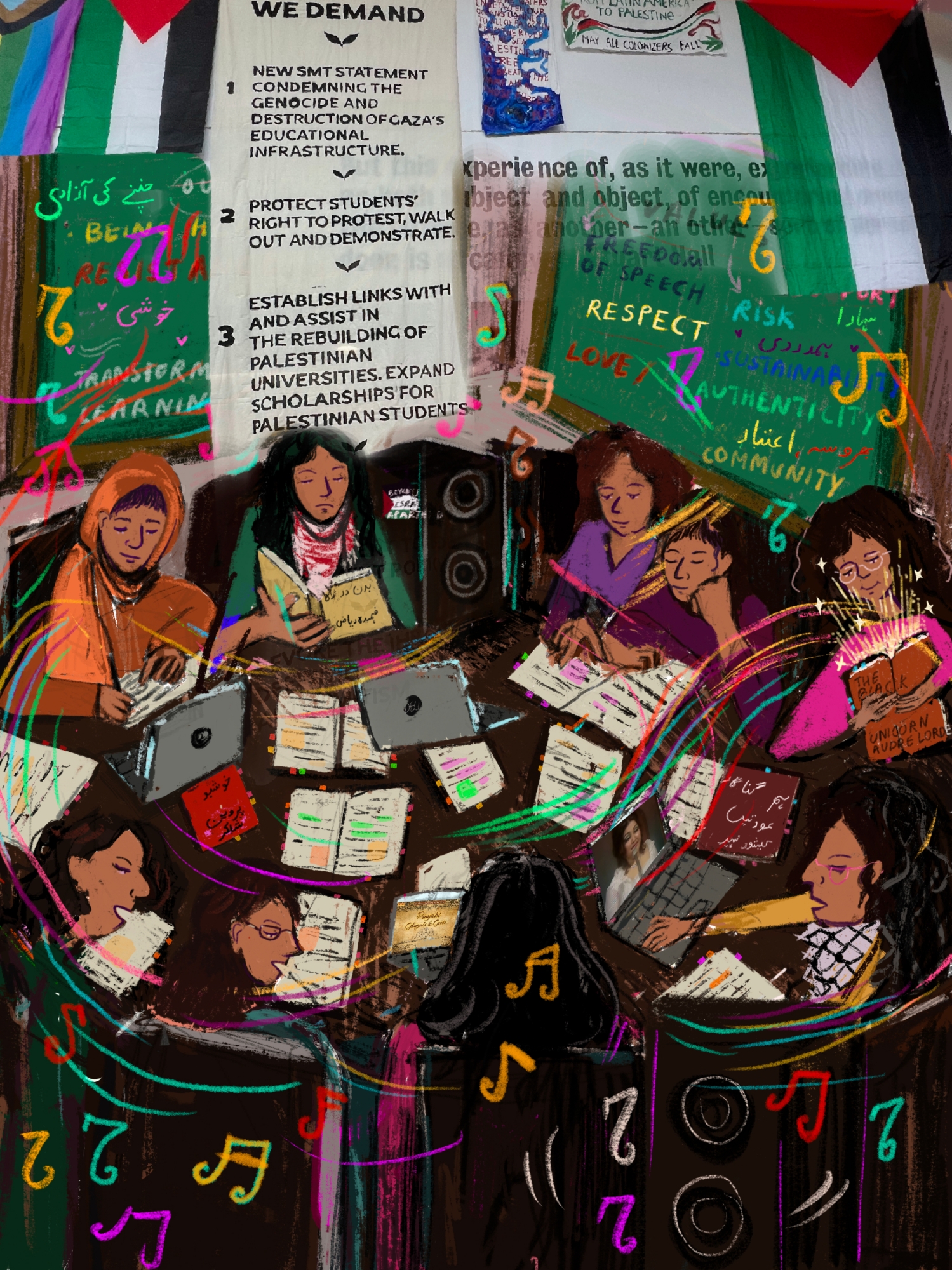
Incredibly grateful to the artist Laiba Raja for this beautiful collage work on the Goldsmiths for Palestine occupation. You can follow Laiba on Instagram here: https://www.instagram.com/laibaverse/
----
My friend, comrade, sister Sabiha Allouche – in conversation with whom, all my academic and activist work emerges and in company of whom, my rage, grief, laughter, and joy at/in this world takes shape – always asks us to look for connections. In our feminist queer crip anti-capitalist love for each other and in transnational solidarities, violence, and resistance, she says to us – we make links, we make links, we make links! So, I end this speech on International Women’s Day with something that speaks to her words through poetry and literature.
Several South Asian writers – writing in multiple languages – have penned poetry for Palestine through the decades. Many of those who are often recited and remembered for this, and for their anti-imperial internationalist solidarities and activism are men – Faiz, Iqbal, Jalib, Kazimi, Ishqi, and more.4 Women poets, translators, writers, editors, and indeed, internationalist anti-imperial activists of struggle, solidarity, and resistance from South Asia’s literary spaces of that time are always forgotten and erased. Urdu writer and feminist Kishwar Naheed translated Palestinian revolutionary Leila Khaled’s autobiography – My People Shall Live, while also writing many poems about Palestinian resistance. Fahmida Riaz – novelist, poet, editor – founded the political magazine Awaz [Voice] in the late 1970s, speaking against military dictatorship in Pakistan as well as about third world solidarities. In an editorial in June 1980, she wrote of Zionism as a force shaped by the ghosts of imperialism; she translated Mahmoud Darwish’s poetry into Urdu; she wrote poems about Palestinian resistance; she put visuals of women resistance fighters on the covers of Awaz. In the early 1980s, the magazine was banned in Pakistan, and she was forced into exile after multiple charges of sedition.5
I end with a poem by her, which wasn’t written for Palestine or for Palestinian women, but is, right now, speaking to them and their resistance and to anyone in this world who dares erase it, undermine it, seek to discipline it, silence it.
Inqilaab ke raaj singhaasan par biraajte gunvaano!
Tum kya do ge gyaan mujhe!
Mujhko seedhi raah dikhaane waalo!
Itna pehchaano
Tum kursi par baithe hue ho
Aur maiñ dharti par khadi hui hooñ
Those of you who sit on the royal throne of what you are calling a revolution!
Who are you to lecture me?
Those of you who claim to show me the right path [to resistance]!
You must realize
While you are seated on a [powerful] chair,
it is me, a woman, standing [and fighting] on this ground.
From the river to the sea, Palestine will be free.
From the sea to the river, Palestine will live forever.
Notes
Note 1:
For more on the histories and presents of Zionist violence and Palestinian resistance, see:
- Nahla Abdo-Zubi and Nur Masalha (2018)
- Rashid Khalidi (2020)
- The Fall 2025 (Vol. 11 No. 2) Issue of Kohl, titled “No Compromise under Genocide:” https://kohljournal.press/issue-11-2
- The incredible political education work of Makan: https://www.makan.org.uk/
- The critical research and policy analyses from Al-Shabaka: The Palestinian Policy Network: https://al-shabaka.org/
Note 2:
For more on scholasticide in Gaza and reflections on universities and academia during genocide, see:
- Basma Hajir and Mezna Qato (2025)
- Walaa Alqaisiya and Nicola Perugini (2025)
- Mezna Qato (2024)
- Rafeef Ziadah (2025)
Note 3:
On Goldsmiths Anti-Racist Action (GARA), see:
- GARA’s Facebook page: https://www.facebook.com/goldsmithsanti/
- GARA’s Twitter Page: https://x.com/GoldAntiRacism
- Media coverage on The Guardian: https://www.theguardian.com/education/2019/mar/20/students-occupy-goldsmiths-in-protest-at-institutional-racism
- Media coverage on People’s Dispatch: https://peoplesdispatch.org/2019/08/09/our-universities-must-be-survivable-for-students-and-staff-of-color/
- Media coverage on Times Higher Education: https://www.timeshighereducation.com/news/goldsmiths-occupation-just-start-tackling-inequality
- Akanksha Mehta (2020)
- Ethiraj Gabriel Dattatreyan and Akanksha Mehta (2020)
On Justice for Workers and anti-casualisation organising, see:
- J4W Facebook page: https://www.facebook.com/J4WGoldsmiths/
- The website Precarious@Gold: https://precariousatgold.wordpress.com/
- This article in Ebb Magazine: https://www.ebb-magazine.com/essays/justice-for-workers-at-goldsmiths-in-the-fight-against-casualisation
- This media coverage in Hyperallergic: https://hyperallergic.com/459305/protesters-at-goldsmiths-university-in-london-demand-answers-for-who-keeps-the-cube-white/
- The Precarious Workers Bulletins/Notes From Below of Goldsmiths’ Workers’ Actions: https://notesfrombelow.org/author/goldsmiths-workers-action
- Statements (and motions) by Goldsmiths branch of UCU: https://goldsmithsucu.org/justice-for-cleaners/
On other Goldsmiths campus industrial actions, picket lines, and strikes, see:
- Akanksha Mehta and Grace Tillyard (2023)
- Roberto Mozzachiodi and Joe Newman (2023)
- Uddin Majumdar (2020)
- Podcast on wildcat action by precarious workers in 2020: https://soundcloud.com/scourti-studio/goldsmiths-wildcats-in-conversation
- Podcast on strike action, political education, and care in 2021-22 (featuring Akanksha Mehta, Grace Tillyard, Islam Al Khatib, Hafsa Haji, and Julia Sauma) https://soundcloud.com/thesociologicalreview/behind-the-scenes-at-a-london-university-strike
Note 4:
For more on student campaigns against militarisation and university complicity in genocide, see:
- Demilitarise SOAS campaign: https://demilitarisesoas.blogspot.com/
- Palestine Solidarity Campaign’s University Complicity Database: https://palestinecampaign.org/university-complicity-database/
- BDS movement page on Academic Boycott: https://bdsmovement.net/academic-boycott
Note 5:
For the connections between India and "Israel," see:
- Azad Essa (2023)
On Kashmir-Palestine solidarity, see:
- Ather Zia (2025)
- The website Stand With Kashmir: https://standwithkashmir.org/kashmir-palestine-solidarity/
For more on Indian workers’ unions (and other) actions against genocide, see:
- This reportage in Middle East Eye: https://www.middleeasteye.net/news/israel-palestine-war-india-trade-unions-call-government-cancel-labourer-deal
- This reportage in Maktoob Media: https://maktoobmedia.com/world/gaza-genocide-port-workers-union-in-india-refuses-to-load-unload-israel-linked-military-goods/
- This post by Workers for Palestine: https://www.workersinpalestine.org/news/the-water-transport-workers-federation-of-india
- Indians with Palestine’s Instagram page: https://www.instagram.com/indians_with_palestine/
BDS India’s Instagram page: https://www.instagram.com/bdsinindia/
- 1. In late February 2024, students from Goldsmiths for Palestine (G4P) occupied the Professor Stuart Hall Building on the campus of Goldsmiths (University of London) in Southeast London, UK. They demanded that the institution end its links and complicity with Israel and support Palestinian students with funding and explicit solidarity. This occupation – perhaps, the first student encampment in the UK in 2024, subsequently part of the global student intifada – was then followed by student-led occupations of the library and the CCA (Goldsmiths’ Centre for Contemporary Art). In all of these, alongside direct actions, rallies, protests, and disruptions to achieve demands, students, staff, and community members also created spaces of learning, community, and organising. https://www.instagram.com/goldsmithsforpalestine
- 2. Students and workers at Goldsmiths, University of London have been attempting to archive these struggles for many years, and it remains an ongoing exhausting project. I have listed a few things out in the world that will tell you more about our campaigns and actions in the last few years. See note 3.
- 3. See and join the work of the Palestinian Youth Movement (PYM) (https://www.palestinianyouthmovement.com/) and the Palestinian Feminist Collective (https://palestinianfeministcollective.org/).
- 4. For more, see Ahmed (1998).
- 5. For more, see Anonymous (2024); and Mahmood (2023).
Abdo-Zubi, Nahla, and Nur Masalha (Eds). 2018. An Oral History of the Palestinian Nakba. London: Zed Books, 2018.
Ahmed, Shahab. 1998. “The Poetics of Solidarity: Palestine in Modern Urdu Poetry.” Alif: Journal of Comparative Poetics, 18:29–64.
Alqaisiya, Walaa, and Nicola Perugini (Eds.). 2025. Palestine and the Western Academe: Fighting the Exception, Defending Epistemic Justice (1st ed.). London: Routledge.
Anonymous. 2024, Apr 19. “For Palestinian Martyrs: Urdu Literature and Palestinian Resistance.” Jamhoor. https://www.jamhoor.org/read/for-palestinian-martyrs-urdu-literature-and-palestinian-resistance
Dattatreyan, Gabriel Ethiraj, and Akanksha Mehta. 2020. “Problem and solution: Occupation and collective complaint.” Radical Philosophy, 208:66–72. https://www.radicalphilosophy.com/commentary/problem-and-solution
Essa, Azad. 2023. Hostile Homelands: The New Alliance Between India and Israel. London: Pluto Press.
Hajir, Basma, and Mezna Qato. 2025. “Academia in a Time of Genocide: Scholasticidal Tendencies and Continuities.” Globalisation, Societies and Education, 23(5): 1163–71.
Khalidi, Rashid. 2020. The Hundred Years' War on Palestine: A History of Settler Colonialism and Resistance, 1917-2017. New York: Metropolitan Books.
Mahmood, Saif. 2023, Nov 27. “Remembering Pakistani poet Fahmida Riaz, who feared fanaticism everywhere.” Scroll. https://scroll.in/article/1059539/remembering-pakistani-poet-fahmida-riaz-who-feared-fanaticism-everywhere
Majumdar, Uddin. 2020, Jun 27. “The Goldsmiths Wildcat Strike.” Tribune Mag. https://tribunemag.co.uk/2020/06/the-goldsmiths-wildcat-strike
Mehta, Akanksha. 2020. “Embodied Archives of Institutional Violence and Anti-Racist Occupation – Reading Julietta Singh’s ‘No Archive Will Restore You’ in the University.” Feminist Review. https://femrev.wordpress.com/2020/08/28/embodied-archives-of-institutional-violence-and-anti-racist-occupation-reading-julietta-singhs-no-archive-will-restore-you-in-the-university/
Mehta, Akanksha, and Grace Tillyard. 2023, Aug. “Behind the scenes at a London university strike.” The Sociological Review: Strikes and Care. https://thesociologicalreview.org/magazine/august-2023/strikes-and-care/behind-the-scenes-at-a-london-university-strike/
Mozzachiodi, Roberto, and Joe Newman. 2023, Jan 20. “Notes on a Marking and Assessment Boycott.” Notes from Below. https://notesfrombelow.org/article/notes-marking-and-assessment-boycott
Qato, Mezna. 2024, Aug 10. “Mezna Qat: ‘Without our libraries and universities, how will we tell the story of Gaza?’” The New Statesman. https://www.newstatesman.com/world/middle-east/2024/08/mezna-qato-without-our-libraries-and-universities-how-will-we-tell-the-story-of-gaza
Zia, Ather. 2025, Feb 27. “Intifada: From Palestine to Kashmir.” Social Text. https://socialtextjournal.org/periscope_article/intifada-from-palestine-to-kashmir/
Ziadah, Rafeef. 2025. “Genocide, neutrality and the university sector.” The Sociological Review, 73(2):241–248.