
Instrumentalized to Consolidate Hegemony: International Law and the Zionist Case after October 7
gaza_under_siege.png
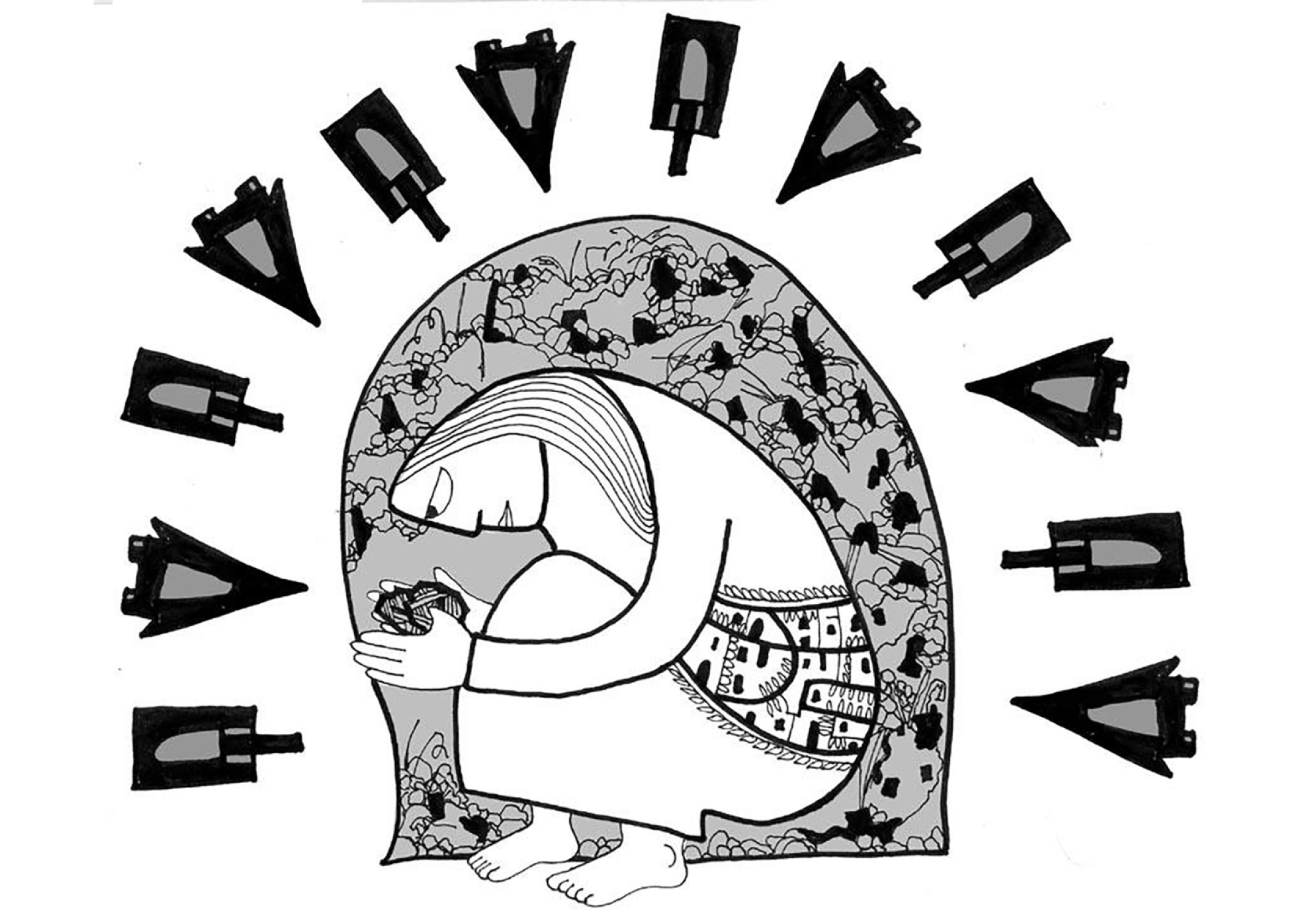
"Gaza Under Siege" by Lena Merhej. Assafir, 2007.
Today’s wars are not only fought on the ground; much of what is decided in battle is reproduced in the realm of language, through legal reports, court proceedings, and official statements. International law has lost its claims of neutrality as a post-conflict arbiter, becoming an active participant in the conflict itself. It rewrites facts, tests the limits of legality, and constructs new political narratives. When the law is used selectively, or for purposes other than those for which it was intended, it produces silent victims and immune perpetrators by redefining crime, redistributing responsibility, or controlling accountability’s timeline.
International law’s response to the Zionist settler genocide following October 7 clearly embodies this shift: the official discourse did not merely deny the accusations or reject human rights interpretations, but reconstructed the very foundations of who the victim is, how crime is defined, and who has the right to resort to the law. When in the hands of Israel, the law is invoked to claim a “reverse genocide” and present legal battles before the International Court of Justice (ICJ) and the International Criminal Court (ICC) as an extension of “self-defense,” thus shifting from a framework of accountability to a tool for controlling or undermining that same accountability. Here, the question of the law becomes a political one par excellence: it is not about whether the law was violated, but about how the law itself is used to reproduce inequality. The research in this paper goes beyond describing violations; instead, it analyzes the legal structure of international law as part of a system of control within the context of long-term settler-colonialism.
The paper begins with the premise that international law does not always function as a mechanism for regulating power. Rather, it can become a tool for reproducing inequality in colonial contexts through discourse, practice, and institutions. In the case of the Zionist settler-colonial entity, the problem lies not in the absence of law, but in its excessive invocation as the primary language for justifying and managing genocide, while maintaining the appearance of formal compliance with its rules.
The study therefore explores the ways in which the occupying power has exploited international law after October 7, through what I describe as the “weaponization of law,” with the aim of redefining the victim and the crime, and neutralizing accountability mechanisms before the ICJ and the ICC. It will additionally address how concepts such as “proportionality,” “military necessity,” and “complementarity” are used to legitimize violence rather than restrict it, and how international courts themselves are transformed into arenas that don’t administer justice, but manage power relations.
Methodologically speaking,1 this paper critically analyzes legal and institutional discourse, drawing on documents from the ICJ, trial briefs, the Zionist entity’s official responses to the charges of genocide, and publicly available human rights reports. The study is limited to publicly available Arabic and English materials and covers the period from October 7, 2023, until the ICJ’s orders for the indication of provisional measures issued in January 2024. The paper also adopts a critical stance that acknowledges the structural inequality behind the Palestinian situation, with deliberate precision in the use of concepts such as “genocide” or “military necessity.”
The text does not seek to instrumentalize suffering or reproduce the victim/perpetrator narrative in a reductive manner. Rather, it aims to hold the international legal framework accountable to its own tools by analyzing its conceptual structure.
As for the author’s position, this paper adopts a critical stance that is explicitly and morally aligned with Palestine – not out of emotion or affiliation, but based on the recognition that an analysis of injustice cannot be complete without acknowledging the structural inequality that underlies it. This conscious bias does not negate analytical rigor; on the contrary, it frees it from the illusions of false neutrality, which are often used in the literature to reconcile positions instead of analyzing them.
The Military Origins of Lawfare
The concept of “lawfare” began to emerge in the American military and security literature in the 21st century. Major General Charles Dunlap coined the term to describe the use of law as a weapon of war – that is, as a strategy employed to achieve political or military objectives without resorting to physical force (2001, 1). Dunlap viewed the law as a tool through which adversaries can disrupt the maneuverability of modern armies by exaggerating the image of violations or invoking international tribunals at critical moments. This concept was not initially presented as a critique of the behavior of major powers, but rather as a threat these powers face from weaker adversaries capable of exploiting the rules of international law to constrain their actions (ibid., 2-4).
In this sense, “lawfare” was initially viewed as a resort for less powerful actors against major military powers. Orde Kittrie (2016, 2) defines this phenomenon as the use of law – whether through courts, legislation, or public legal discourse – as a substitute to ground force in traditional conflicts. According to Kittrie, this use may include, for example, persuading international bodies to impose sanctions or legally discrediting an adversary to deprive it of alliances and support. These mechanisms are generally used in what is known as “pressure through compliance” – that is, leveraging international law to weaken or deter an adversary.
This approach gained prominence because it established “lawfare” as a parallel arena of conflict in which contemporary disputes are managed, and in which legal tools are deployed as if they were military ones. However, at the same time, its implicit assumption alarmed the major powers, as they sought to use the law not as a tool for accountability, but as a rhetorical shield for their practices, thus rejecting criticism or litigation. It is the reason why the theory was later subjected to widespread criticism from more radical circles, which argued that framing “lawfare” as a tool for the weak obscures how the major powers themselves have mastered the art of weaponizing the law by controlling its institutions, interpreting its concepts, and regulating its procedures (ibid., 5-10). Whilst the concept of lawfare appears to be straightforward, notably in its usage for instilling justice and neutrality, its reality is more complex: the law itself can become an unequal arena, in which the most powerful states reproduce their superiority through tools of formal compliance, and not solely through force. This paves the way for a shift from conceiving lawfare as a mediatory tool in the hands of weaker actors to understanding it as a tool in the hands of the colonial states themselves. This, this paper shows, has been the case of the Israeli settler-colonial entity after October 7, 2023.
Law as a Tool of Hegemony: Colonialism and Formal Legitimacy
Critics of classical approaches to “lawfare” have exposed its structural biases. In his works on colonialism, John Comaroff (2001) challenged the view that the law is a weapon of the weak, noting that the law has always been a central tool for subjugating indigenous peoples, and that it represents a form of symbolic and procedural violence that is seen as legitimate despite being part of a system of control. From this perspective, the law itself becomes part of the colonial structure rather than a framework for holding it accountable. This analysis intersects with what Noura Erakat (2019) proposes regarding the failure of international law to protect Palestinians: while there aren’t any shortcomings in its rules, it is politically activated in a way that reinforces power imbalance and entrenches exceptionalism. Legal exceptions invoked in the name of security or military necessity become the norm, and the law is transformed from a tool for curbing violence into a tool for managing and perpetuating it.
Ozan Varol (2015) introduced the concept of “stealth authoritarianism” to explain how democratic legal instruments, such as elections, courts, or legislation, are used to entrench undemocratic power. Although Varol does not write specifically in the context of international law, his framework informs our understanding of how states can maintain the appearance of law and legitimacy while undermining their actual meaning. The law becomes a cover for continued oppression, not a means of resisting it. This analysis intersects with the concept of “medical lawfare” proposed by Neve Gordon and Nicola Perugini (2020, 132-138), whereby legal arguments such as the presence of combatants hiding in hospitals are used to justify strikes on health infrastructure in Gaza, while holding Palestinians responsible for their own plight. This indicates that legal concepts such as “military target” or “human shield” are not neutral; they are subject to political interpretation in a colonial framework that is already security-driven towards a besieged population. Therefore, the weaponization of the law is not limited to violating it; it primarily consists of formal compliance in a manner that strips away protections and justifies control. In this approach, the law is not considered the antithesis of violence. When it comes to hegemony, it can produce legalized violence that subjugates those who lack the capacity for interpretation or institutional defense.
Judicial Maneuvering and the Politicization of Proceedings: Courts as Arenas of Power
In addition to concepts and discourses, the law is weaponized through control over litigation venues, trials’ timings, and their procedural conditioning. As a result, a wave of contemporary legal and political literature has focused on what is known as “judicial strategic maneuvering.” It describes the ways in which the relationship between the state and international justice institutions, such as the ICJ and the ICC, is managed with the aim of steering accountability or obstructing it, without publicly denying or rejecting the law. States, particularly the most powerful ones or those protected by strong political alliances, often use the very tools of the law to undermine its efficacy: they challenge a court’s jurisdiction, object to its membership, file lengthy briefs to delay proceedings, or even establish superficial domestic accountability mechanisms that are used as a sufficient local alternative to prevent the exercise of international jurisdiction (Schabas 2008). This behavior relies on what is known as complementarity, which is supposed to afford states the opportunity to prosecute suspects domestically before resorting to international courts. However, this principle is often exploited tactically, as states conduct internal investigations that are either not independent or are lacking in rigour, solely to delay the Court’s intervention (Heller 2006).
In the case of Israel, this tactic is employed in various ways: it explicitly rejects the jurisdiction of the ICC on the grounds that the Zionist entity is not a member, and relies on the support of political allies to dissuade the Court from moving forward. Additionally, it resorts to its military or civil courts to conduct investigations that are presented to the international community as evidence of domestic accountability, although Human Rights Watch (2016) reported a persistent lack of meaningful accountability and serious procedural, structural, and substantive shortcomings in Israel’s investigative mechanisms. In this context, accountability does not necessarily mean achieving justice; it merely becomes a tool to redistribute responsibility, postpone resolution, or strip the law of its deterrent effect. Thus, the courtroom becomes yet another arena of conflict, where the state does not necessarily seek to exonerate itself, but to control the timing of accountability and turn it into a matter open to debate.
Legitimizing Violence from within the Law: Proportionality, Necessity, and the Legal Architecture
That international law, which was designed to regulate the deployment of violence in “armed conflicts,” may be used to legitimize the very violence it purports to counter, constitutes one of the most pressing legal paradoxes in modern struggles. The issue here is not a violation or disregard of the law, but rather its use as a tool for legitimacy. Carrying out lethal acts under the guise of legal compliance grants aggressors symbolic immunity and undermines the ability to hold them politically and morally accountable. In Of War and Law, U.S. scholar David Kennedy (2006, 37-42) asserts that the law does not always act as a guardian of justice; it may be part of the arsenal of war, providing aggressors with formal legitimacy and giving moral justifications to their operations. Kennedy argues that humanitarian law does not necessarily deter war, but rather frames it within a logic of management. The question is not “Should we kill?;” it becomes “Is the killing proportionate?” In other words, proportionality, as a criterion in and of itself, permits killing to occur, as long as it does not exceed acceptable limits.
In his legal-architectural analysis of the assault on Gaza, Eyal Weizman (2011, 11-14) points to what he calls the “architecture of proportionality:” quantitative data, maps, and equations are used to justify the targeting of residential areas, under the pretext that the military threat associated with the target justifies the harm inflicted on civilians. In this model, concepts such as “military necessity” and “legitimate target” become tools for manipulative interpretation, expanding the parameters of who constitutes a target and reclassifying victims according to probability or statistics. Rules of protection become mechanisms for regulating not the war itself, but its legal narrative: hospitals become targets when combatants are said to be present inside them; humanitarian relief is suspended if it is deemed unsafe; and safe corridors are granted a limited timeframe, all of which were observed in Gaza, after which legal bombardment casually resumes. This is the heart of the paradox: the law is used not to curb crime, but to legalize it and define its temporal and spatial coordinates (ibid., 93-97).
In the case of Palestine, this tactic is not confined to closed rooms; it is also employed in the Israeli legal discourse before the international community. Presenting military operations as legally constrained does not necessarily mean they are less deadly. What they are, however, is legally shielded from accountability, because killings are now accompanied by official statements, precise maps, or debatable justifications of proportionality. When the legal system itself can be used to manufacture legitimate violence rather than to deter it, then parties to asymmetrical “conflicts” are not equal in their ability to produce legal meaning or control its institutional mechanisms.
Critiques of lawfare demonstrate, to varying degrees, that the weaponization of the law is not an exceptional or marginal phenomenon. It is a recurring pattern of legal and political production by powerful states: from the interpretation of concepts, to the control of public forums, to the use of legal procedures themselves, justice is hollowed out from its substance. Traditionally, law is viewed as a tool in the hands of the weak to restrain the powerful. Critical perspectives consider that the law itself can entrench hegemony, as demonstrated by studies of strategic maneuvering and analyses of humanitarian law as a framework for managing violence rather than preventing it. However, these schools of thought agree, albeit from different perspectives, that the law is not merely a neutral tool. It is a space where meaning, legitimacy, and timing are constantly negotiated.
Yet, most of these critiques either focus on past cases (such as Iraq, Afghanistan, and the “war on terror”) or address Palestine as one example among others, without an in-depth analysis of how the Zionist entity has redefined its relationship with the ICJ and the ICC after October 7, 2023, as that of a colonial power that uses the very language of international law to grant itself immunity. Writings in the Arabic language on the weaponization of law in this context remain scattered; they often separate criticizing the performance of international courts from an analysis of the colonial dimension of the structure of the law itself. This article seeks to bridge this gap by centering Palestine, linking the legal discourse of the Zionist settler-colonial entity to its military practices on the ground, and deconstructing how the concepts of responsibility, victimhood, and crime are reshaped within the logic of the weaponization of international law after October 7, 2023.
Critical Discussion
In the wake of the October 7 operation, the Zionist entity’s response was not limited to military or security measures. It extended to what might be called a counter-legal offensive, or the exploitation of the international legal framework to create a parallel narrative and subject the legal account to its own standards, rather than to the standards of international law. In this context, the entity portrayed the events of October 7 as genocide against it (Becker 2024; Shalev 2025), transforming the fundamental accusation leveled against it into a counter-allegation. The false legal balance redistributed responsibility and undermined the Palestinian narrative at the level of legal and institutional discourse.
As Avraham Russell Shalev (2025) argues, this strategy represents an advanced form of lawfare; its concern is not so much about defense as it is about confusion: which accusation is legitimate, who has the right to seek justice, and who is presented as the perpetrator or the victim. In this model, international conventions such as the 1948 Genocide Convention, whose aim was and remains the prevention and punishment of genocidal crimes, are used instead to deliver a symbolic counterblow. The Zionist settler-colonial entity did not merely seek to convince the ICC or the ICJ that genocide did not occur in Gaza; it deliberately presented itself as a victim of genocide, claiming the concept in the international legal system against an adversary who was, in the first place, resorting to court to protect itself from genocide.
This logic is evident in the proceedings of the case of South Africa v. the Zionist entity before the ICJ. In its provisional measures issued on January 26, 2024, the Court acknowledged the plausible rights of Palestinians in Gaza to protection from genocide, and ordered the entity to take immediate measures to prevent the acts listed in Article II of the Convention on the Prevention and Punishment of the Crime of Genocide.2 These acts include the killing of members of the group, causing them serious bodily or mental harm, and deliberately subjecting them to living conditions intended to destroy the group in whole or in part. In its written and oral arguments, the Zionist entity focused on the element of “specific intent” to destroy a protected group in whole or in part, as the decisive threshold for proving the crime. It presented the military operations in Gaza as an exercise in its right to self-defense under Article 51 of the United Nations Charter in the face of an “existential” threat, rather than as the implementation of an extermination policy targeting Palestinians as a group.
The debate is thus reduced to a question of intentions, while the material structures of violence, such as the long-term blockade, the widespread destruction, and the lack of basic livable conditions, are excluded despite their significance in assessing the context of genocide (ICJ 2024; Convention on the Prevention and Punishment of the Crime of Genocide 1948). This framing not only serves to deny the crime itself, but also to strip it of its moral significance, transforming it into an unfortunate yet justifiable outcome within the legal balance of proportionality. What might be called the “legal whitewashing of genocide,” then, is the repackaging of the material facts of violence in technical legal language that makes them appear to be an unfortunate consequence of operational management, rather than a policy directed against a protected group. In maneuvering this logic, Palestinians are no longer seen as victims of structural and ongoing violence, but rather as part of a reciprocal equation in which both sides are supposedly held accountable to the same degree, despite differences in context, capabilities, and colonial rule (Reynolds 2017, 165-170).
The legal framework does not stop at presenting a case before the ICJ, but extends to the structural relationship between the Zionist settler-colonial entity and the Court. At the institutional level, and for years, the entity has relied on a network of internal investigations before military courts and disciplinary bodies to create the appearance of accountability. The principle of complementarity in the Rome Statute assumes that these national mechanisms should prove their efficacy prior to the ICC’s intervention. However, critical literature on complementarity demonstrate how this principle can be exploited tactically: superficial, non-independent, or selective investigations are used to demonstrate that the state is “able and willing” to ensure accountability, while in reality it obstructs access to effective justice (Heller 2006; Schabas 2008).
In the case of Israel, and as per numerous human rights reports, most complaints against soldiers and officials accused of grave violations against Palestinians lead nowhere: cases are closed or no indictments are filed. The likelihood of an Israeli soldier being held accountable for the killing of a Palestinian civilian is extremely slim. Yet, these same investigations are used before the ICC as evidence of the existence of an “effective domestic system,” thereby transforming complementarity from its presumed role in safeguarding against impunity into a tool for reproducing it (Human Rights Watch 2016; Yesh Din 2024). Alongside this procedural maneuver, the Zionist settler-colonial entity and its allies have developed a parallel narrative aimed at delegitimizing the accountability bodies themselves. Whenever the ICC takes action or the ICJ issues a ruling, “politicization,” “bias,” and “anti-Semitism” are invoked to frame the activation of international law’s mechanisms as an attack on “the entity’s right to self-defense,” rather than as an effort to protect civilians in Gaza. Thus, the focus shifts from the substance of the allegations to the legitimacy of the court itself; the demand for accountability is framed as bias, and solidarity with the victims is redefined as hate speech.
This combination of procedure and rhetoric is a dual strategy that shows that the weaponization of the law after October 7 goes beyond the bounds of traditional “legal defense.” The Zionist entity is not merely exploiting loopholes in the international legal system; it is rather working to reengineer it from within. It redefines what constitutes a crime by focusing on narrow elements such as specific intent. It reverses the positions of victim and perpetrator by weaponizing the rhetoric of genocide. It empties the principle of complementarity of its substance through perfunctory investigations, and it besieges institutions of justice through accusations of politicization and anti-Semitism. In this context, the law ceases to be a tool for curbing or holding violence accountable, and instead becomes an infrastructure for managing, distributing, and protecting it under the guise of compliance, legitimacy, and human rights rhetoric, We view this to be one of the most intense manifestations of legal colonialism in the contemporary Palestinian context.
Conclusion
Caught between the rhetoric of compliance and the practice of hegemony, the weaponization of international law is inseparable from the political landscape of asymmetrical “conflicts,” particularly in the case of the Zionist settler-colonial entity after October 7, 2023. The struggle is not only about the facts, but also about who holds the authority to name, interpret, and classify them as a crime vs. legitimate self-defense in legal terms. This paper has demonstrated that when the law is transformed into a tool of legitimization rather than accountability, the notions of crime, victimhood, and justice are redefined according to the logic of the more powerful rather than legal rules.
By reversing accusations, the Zionist settler-colonial entity uses its domestic institutions to invoke the principle of complementarity: it frames the ICC as hostile, does not engage in legitimate defense within the rules of law, and produces an offensive legal reality that usurps Palestinians’ right to narrative, accountability, and recognition. When violence is reproduced from within the law, not from outside it, it reveals the fragility of the moral structure of international law when it is left to the interpretation of the powerful. It also raises a critical question about the meaning of legal neutrality in the context of ongoing colonial domination. By openly siding with Palestine, this article does not claim to reveal an absolute truth. Instead, it offers a critical reading that acknowledges that the law is not morally equal, but a reproducer of inequality through ostensibly legitimate means.
This article raises broader research and political questions regarding the potential for Arab and Palestinian actors to utilize international law without falling into the trap of having it weaponized by hegemonic powers. It also highlights the need for comparative studies linking Palestine to other contexts in the region, such as Syria, Yemen, and Sudan, in order to understand how the architecture of the law affects the possibilities for transitional justice and accountability. It also points to the need to develop an Arab human rights discourse that does not merely diagnose the failings of international institutions, but rather rethinks strategies for documentation, litigation, and cross-border alliances in a way that limits the ability of colonial states to monopolize the language of the law and to claim superior knowledge about it.
- 1. Editorial note: Kohl does not cite "Israeli" sources. We made an exception in this article, as it is concerned with exposing the rhetoric and arguments used by the Zionist entity to exploit and circumvent international laws.
- 2. Article II of the “Convention on the Prevention and Punishment of the Crime of Genocide” (1948) stipulates that: “genocide means any of the following acts committed with intent to destroy, in whole or in part, a national, ethnical, racial or religious group, as such: (a) Killing members of the group; (b) Causing serious bodily or mental harm to members of the group; (c) Deliberately inflicting on the group conditions of life calculated to bring about its physical destruction in whole or in part; (d) Imposing measures intended to prevent births within the group; (e) Forcibly transferring children of the group to another group.”
Becker, Tal. “Opening Statement of MFA Legal Advisor Dr. Tal Becker at ICJ Proceedings.” Ministry of Foreign Affairs. Israel: 12 January 2024. https://www.gov.il/en/pages/opening-statement-of-mfa-legal-advisor-tal-becker-at-icj-proceedings-12-jan-2024
Comaroff, John L. “Colonialism, Culture, and the Law: A Foreword.” Law & Social Inquiry 26, no. 2 (2001): 305–314.
Convention on the Prevention and Punishment of the Crime of Genocide. The Office of the High Commissioner for Human Rights. United Nations: 9 December 1948. https://www.ohchr.org/en/instruments-mechanisms/instruments/convention-prevention-and-punishment-crime-genocide
Dunlap, Charles J., Jr. “Law and Military Interventions: Preserving Humanitarian Values in 21st Century Conflicts.” Humanitarian Challenges in Military Intervention Conference. Carr Center for Human Rights Policy and Harvard Kennedy School: 29 November 2001. https://people.duke.edu/~pfeaver/dunlap.pdf
Erakat, Noura. Justice for Some: Law and the Question of Palestine. Stanford: Stanford University Press, 2019.
Gordon, Neve, and Nicola Perugini. Human Shields: A History of People in the Line of Fire. Oakland: University of California Press, 2020.
Heller, Kevin Jon. “The Shadow Side of Complementarity: The Effect of Article 17 of the Rome Statute on National Due Process.” Criminal Law Forum 17, no. 3 (2006): 255–280.
Human Rights Watch. “Palestine: ICC Should Open Formal Probe.” Human Rights Watch, 5 June 2016. https://www.hrw.org/news/2016/06/05/palestine-icc-should-open-formal-probe
International Court of Justice. Application of the Convention on the Prevention and Punishment of the Crime of Genocide in the Gaza Strip (South Africa v. Israel). The Hague: 26 January 2024. https://www.icj-cij.org/sites/default/files/case-related/192/192-20240126-ord-01-00-en.pdf
Kennedy, David. Of War and Law. Princeton: Princeton University Press, 2006.
Kittrie, Orde F. Lawfare: Law as a Weapon of War. New York: Oxford University Press, 2016.
Reynolds, John. Empire, Emergency and International Law. Cambridge: Cambridge University Press, 2017.
Schabas, William. “Complementarity in Practice: Some Uncomplimentary Thoughts.” Criminal Law Forum 19, no. 1 (2008): 5–33.
Shalev, Avraham Russell. “Hamas’ October 7th Genocide: Legal Analysis and the Weaponisation of Reverse Accusations - A Study in Modern Genocide Recognition and Denial.” Israel Law Review 58, nos. 2-3 (2025): 343–382. https://doi.org/10.1017/S0021223725100009
Varol, Ozan O. “Stealth Authoritarianism.” Iowa Law Review 100, no. 4 (2015): 1673–1766.
Weizman, Eyal. The Least of All Possible Evils: Humanitarian Violence from Arendt to Gaza. London: Verso, 2011.
Yesh Din. “Data Sheet: Law Enforcement on Israeli Soldiers Suspected of Harming Palestinians and their Property in the West Bank.” Yesh Din Volunteers for Human Rights, 2024. https://www.yesh-din.org/en/data-sheet-law-enforcement-against-israeli-soldiers-suspected-of-harming-palestinians-and-their-property-figures-for-2018-2022