
War Threshold: The Psychological Landscape of Israeli Violence
lamia_grandparents_house.png
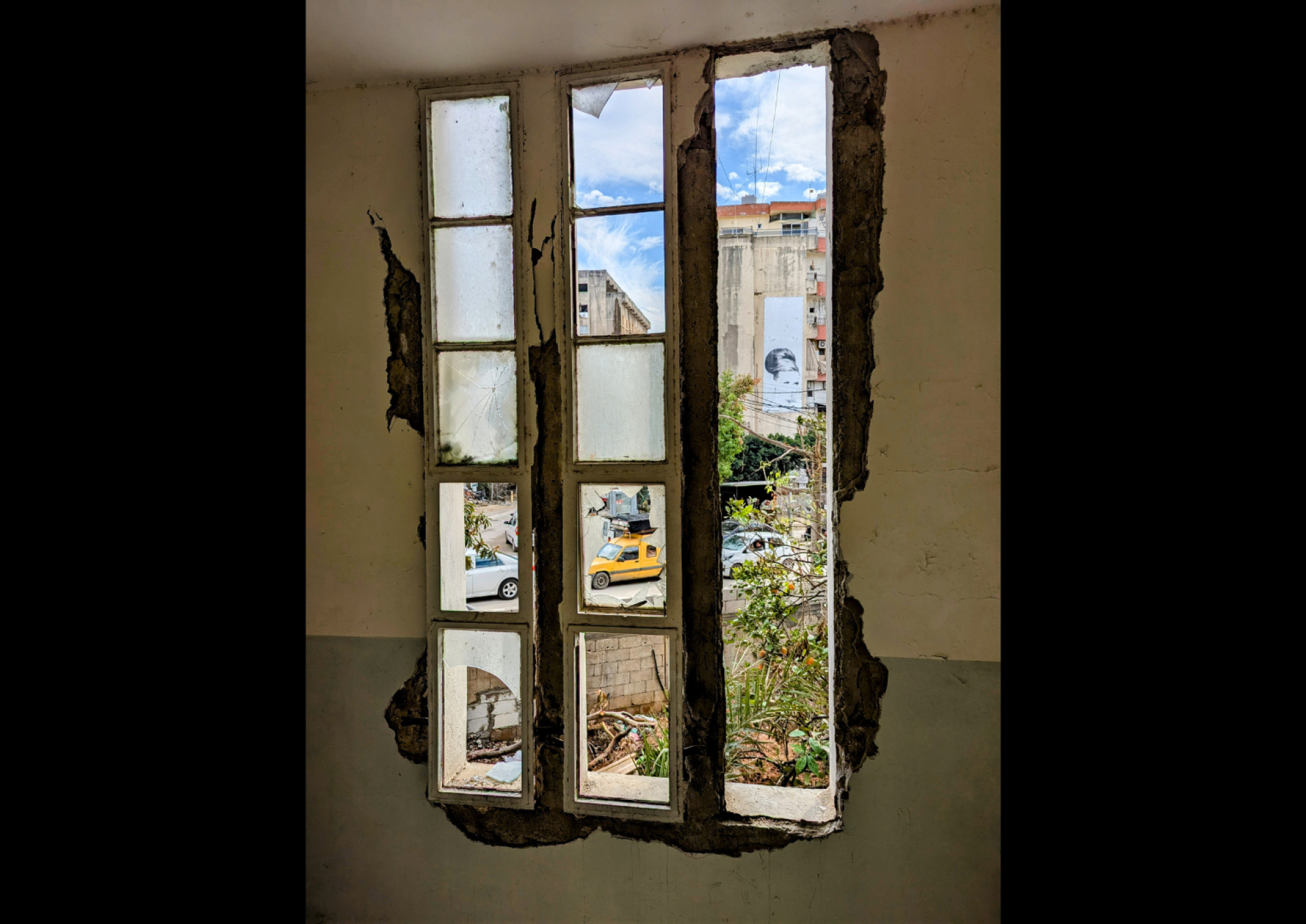
Lamia’s grandparents’ house in Nabatieh, December 2024. Personal photograph.
After the ceasefire in the Israeli war on Lebanon went into effect in 2024, I had an entrenched desire to write from the place where perpetual wars end. Something in me urged an exploration of this convoluted edge, where bombing abruptly stops and staggering massacre recedes, until war resumes. Anxieties and terror come to a baffling end, as a new reality is imposed onto our lives, while we keep anticipating the imminent return of Israeli violence. We experience this liminal ending of war in a haze, as we stagger back to what is left of our homes, piece together our fragmented selves, bury and mourn loved ones and grieve a little, before the war continues.
As I stumbled out of the 2024 war, I imagined writing an essay on three endings of ongoing war that have in many ways constituted my life in Israeli violence. I would title the essay, نهايات الحروب المستمرة [the endings of continuous wars].
The first ending was the last day of the Lebanese Civil War, when I was eight years old. In the essay, I would write about how, on that last day of the war, I went down to an open field next to our family home in Tyre with my cousin Khalil. We needed to commemorate the end of the war with a cheerful photo. I would write about how I tried to strike a dancing pose in the middle of the field, while wearing a light green dress.
From this ambivalent time, all I am left with is Khalil’s photo that I still carry with me everywhere I go. It is my visual access to my childhood in war, dancing in an open field, standing at the threshold of the war/postwar binary, in a city that sheltered our family from the civil war and exposed us to the Israeli violence of the 1980s.
Looking at the photo today, a feeling of pretend happiness mixed with a carefully concealed worry overcomes me.
In the essay, I would write about our family’s return to Beirut the first day of the postwar; how we all woke up at 3am and set off to avoid traffic; how my mother stuffed all our belongings into the back of our small car where she sat; my father drove, and my brother and I shared the passenger seat. I remember the lights flickering in the empty streets, the unavoidable Traffic of Return, my silent and overwhelming terror about resuming school in a couple of days. After a year of absence, our home smelled of dread, old dust, and cooking oil; for the first and last time in our lives, my mother made a lunch that consisted only of fried potatoes.
lamia_dancing.jpg
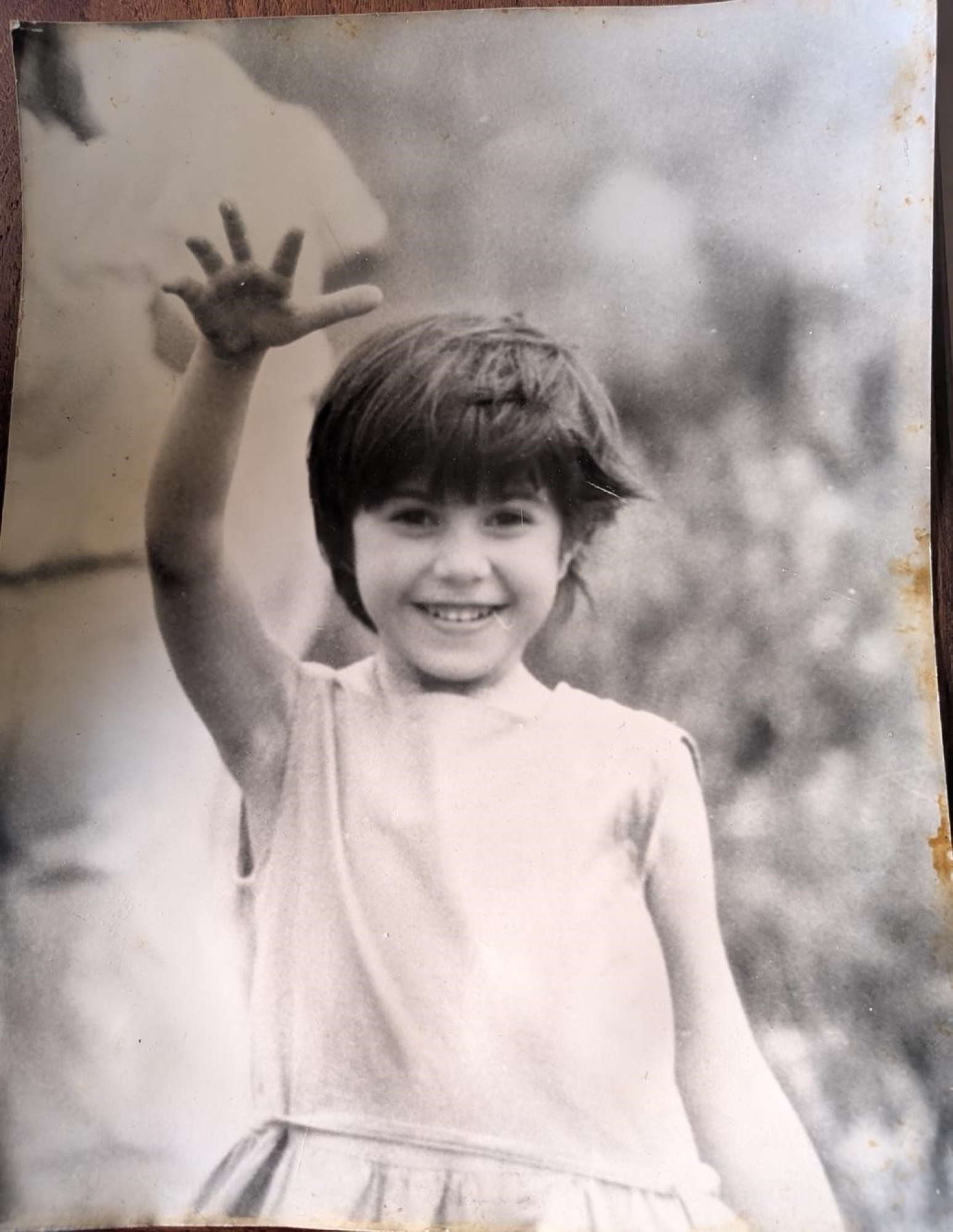
Lamia dancing in Tyre, 1990. Photo by Khalil Taher.
The second ending began with the ceasefire of the July War on August 14, 2006, at 8am. On that morning, Israeli forces intensified their bombing in the long minutes leading to the deadline. I would write about how I could still hear the bombs go off from our home in Beirut that day; how my mother and I drove to the South a few hours later; how we stayed on the road for 11 hours. Another Traffic of Return. I would write about the faces of the people who had stayed in the South, the bombed roads and bridges, the man smoking shisha outside his house in Tyre, the old bags of chips left behind in empty grocery stores, dust and rubble everywhere.
The memories of these two war endings kept resurfacing in vivid ways. They offered me a more reliable structure for remembering the unbearable ending of the 2024 war: a third threshold that I could not cross easily, and one that left me broken, silent, and kind of deranged.
In my mind, I could narrate the first two endings in snapshots, inhabiting one memory narrative and then moving to the next. Yet, the third ending kept coming back in a spiral form, much like a Hitchcock movie’s special effects. As if I was spiraling while narrating it, or as if the ending could not possibly be told in a linear and sensical form. It reminded me of the spiral symbols that I loved drawing in my textbooks, when I returned to school after the ongoing Civil War ended. With my math compass, I would draw one spiral after another, sketching small spirals across homework and notes. Sometimes, I would draw a large spiral that would cover the page and even swallow the entire classroom, until the teacher asked me to stop.
Similarly, the last day of the 2024 Israeli war endlessly spiraled in my mind, as if that day never ended – as if it continues to encircle me today:
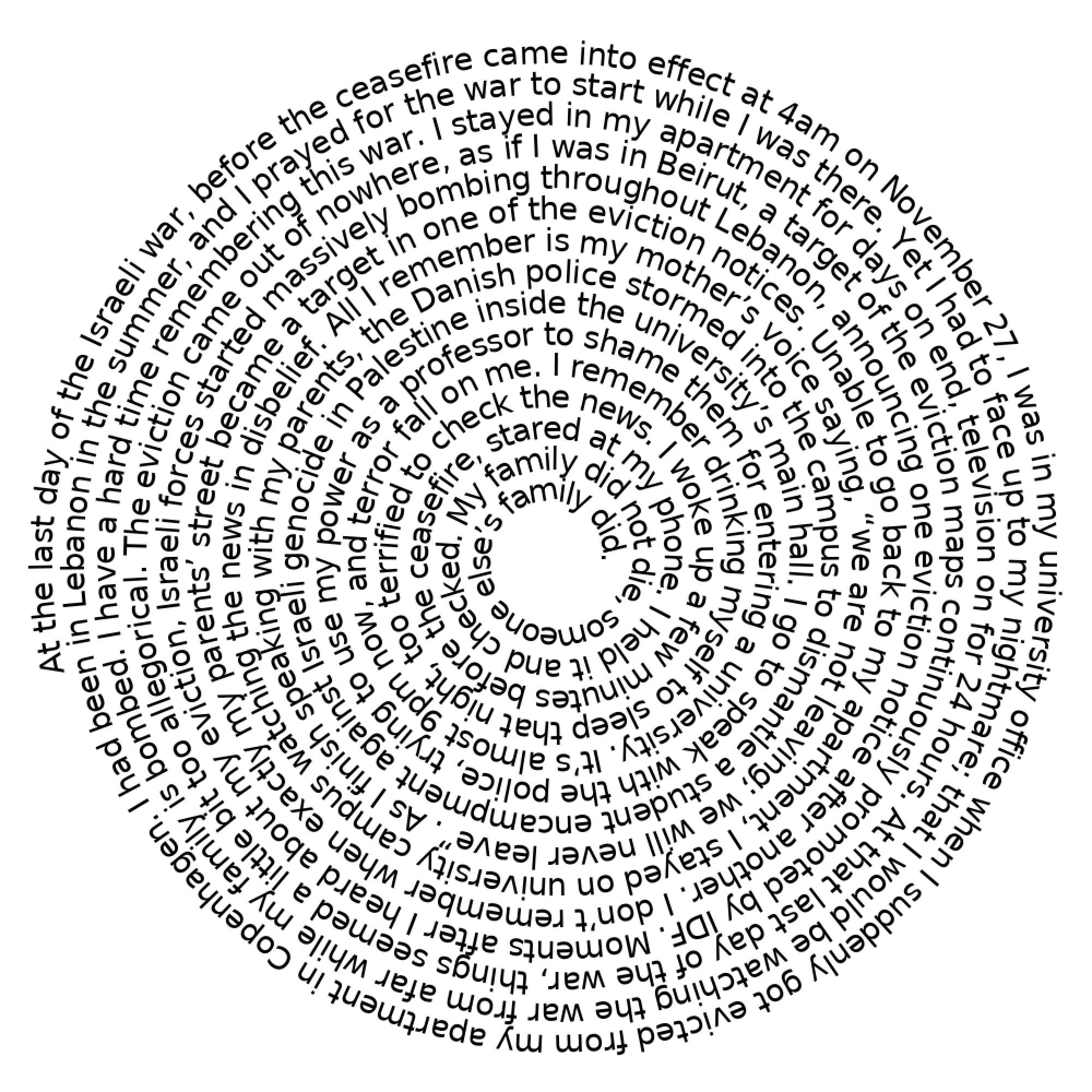
I experienced this last day of the war in a phantasmagoric reality, with all the parts (my home eviction, my parents’ street targeted, police entering university campus) coming together in one parodic realization of all of Israeli violence’s possibilities at the edge of war. Unlike the other two endings, that last day comes back blurry, with no stabilizing memories to stand on, as if all of this couldn’t possibly have happened. Multiple realities collapsed together that day, where my home in Copenhagen and my home in Beirut became one, and Israeli violence could reach me everywhere.
*****
To write from the endings of ongoing Israeli violence is to pay close attention to the accumulative nature of that violence and its dubious temporalities. It is also about having time to occupy that ending, before war erupts again. I never had that time to write my end-of-war essay, as the 2026 war broke out. When I was finally able to write this text, writing in Arabic proved to be too painful, too close.
The ending of the 2024 war made me realize that I have been inhabiting Israeli violence from its liminal threshold, and I, like many children of war, have learned to suppress memories of this violence to live in its suspended aftermath. When the 2026 war erupted, all the accumulative wars that were halted from memory and reality – like the Israeli invasion of Lebanon (when I was 6 months), the Israeli violence in the Civil War, the 1996 war, the July War, and the 2024 war – returned together in full force.
This “return” occurred vividly and painfully. Flashbacks of Israeli violence resurfaced with overwhelming force, leaching onto new war events. Time collapsed, and it was difficult to keep track of which Israeli violence I was experiencing. Perhaps what was most painful was that I was experiencing the war as a child again, still stuck in the reality of never-ending violence since 1982. The fliers dropped by Israeli planes in 2026 were the ones dropped over my head in August 2006. The soundscapes of the bombing felt incredibly familiar, an almost historical experience that my body quickly recognized.
Objects and places, once mundane and familiar, now became alive, bursting with their own memories of violence.
Basement/Parking lot/ملجأ
I go to a research center in Beirut in the first week of the 2026 war. The bombing intensifies and we are asked to evacuate to the nearest underground parking lot. As I step into the parking lot, I become the child stepping into the basement of my school as rockets struck near us, hitting a school bus. It is March 9, 1989, on Teacher’s Day. I was carrying a plant, and I had made sure to stand at the beginning of the student line to be the first to give my teacher her gift. The moment I stretched out the hand holding the plant towards my teacher, the strike hit, and we were rushed to the underground gym, where we waited for our parents to pick us up. I freeze looking at the long stairs leading to the parking lot. I cannot bear being that child-in-war again, stuck in the school basement. I run away into the war, preferring to walk home.
انذار/ Staircase/Running
My mother asks me to deliver keys of my old home to relatives who arrived from the South. I walk towards my street – the same street that was threatened on the last day of the 2024 war, the playground for my childhood. I see people anxiously standing outside. A neighbor tells me that someone got a call that threatened the building right next to my old home with an evacuation order and that the building will be bombed. Another neighbor screams at me to stay away from the building. Except, my relatives are waiting for me inside. I decide that letting my family down is worse than being afraid. I go inside the building, take the elevator, meet my relatives, open the door for them, and decide that it is quicker to take the stairs down. Running down the stairs, I am suddenly face to face with a much older Israeli violence. My body is running like I did as a child, for all the times it had to escape Israeli air raids.
Family/ فرشة
I am home, now full of loved family members who escaped from the South: family settling in, making food, discussing the news, organizing the space. We hear bombing, no one shows fear, so I dismiss mine. I try to be “useful” but fail. Everyone seems to know their role so well, and I always fall short. The living room becomes my sleeping space. We prepare the mattress every night after everyone falls asleep. I wake up to the sound of bombing at night but I still sleep peacefully. From my new sleeping space, in close proximity to my parents, I recognize an old and unexplainable feeling of complete safety and calm. It is the sense of becoming one with your family during war, when we used to spread our mattresses and sleep closely together in the 1980s; when we became one body, organizing, eating, talking, strategizing our collective movement inside the house; when we either live together or die together. I do not believe that I have felt this safe in any other situation than when facing Israeli violence with my family.
****
The endings of the Israeli war arrive without a denouement, while its beginnings unleash a rooted and transgenerational terror (and sometimes surprising warmth and safety) that has been lurking beneath the surface. Together, they constitute the psychic contour of Israeli violence, where living in settler colonial violence is always a historical experience.
Erupting and receding, the cycles of Israeli violence leave behind massive massacre, destruction, and terror. To make sense of them and endure their aftermath, all the while anticipating the next cycle, is enormous labor. These cycles’ practices of remembrance, storytelling, and iterations sometimes struggle to form. In other times, they are solidified into collective stories of suffering and endurance.
Today, these stories overwhelm us with emotions, and teach us the ways of surviving and mourning in genocidal times. Some of them will undoubtedly mark me for the rest of my life. A man was saved by his cat from under the rubble of his house; a Sudanese family was killed by occupation forces and mourned in a mass funeral in the Palestinian camp; an old man died sleeping on the rubble of his house; a Syrian child and her father were tracked and killed by the drone; a wounded fighter chose to surrender himself to protect the village that hosted him; another wounded fighter sat under a tree and closed his eyes as the drone approached him and exploded. Many more daily stories sketch incredible human and posthuman heroism and survival in unfathomable times.
Yet, if I write from the register of the biographical, it is not to display an act of witnessing, suffering, and endurance from Israeli violence, but to reconstruct its psychological landscape at the threshold of war. This landscape contains the multi-layered histories of Israeli violence that repeats itself again and again, where what cannot be uttered or remembered can emerge in its repetition.
As such, I (re)experience Israeli violence from its threshold, perhaps from the time when I first came face to face with it. I have, like many others, built an entire lifeworld on that threshold. I have familiarised myself with its corners, have fallen in and out of love, in and out of collectives and friendships by its edges. I have read books, drank whiskey, laughed and danced and written essays. But only at the ends and beginnings of war, am I able to fully grasp the incredibly dizzying, suffocating, and confined space that I inhabit, when I live in Israeli violence.