
The Imperial War of Attrition Against Futurity
artworksamara.jpg
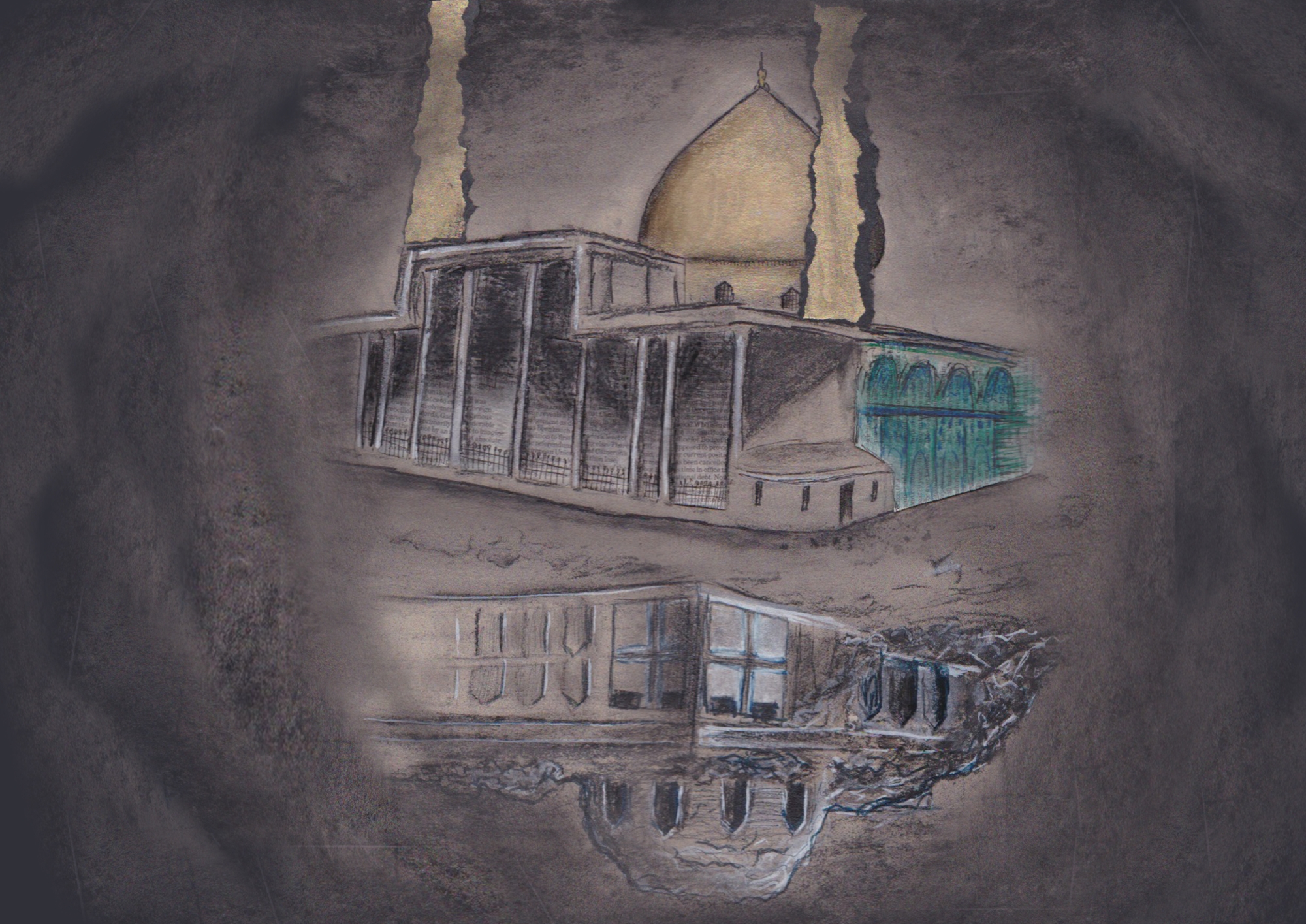
Al-Askari Mosque before and after the occupation of Iraq. Gabby Samara, 2020.
“I am still trying to grasp reality. I can only say that I am truly afraid of the future.”
- A 30-year-old Palestinian woman displaced in Rafah, the besieged Gaza Strip concentration camp (Cavazzoni et. al 2025: 1382).
On the night of March 7, 2026, US-Israeli airstrikes targeted oil storage facilities and refineries in Tehran, igniting oil infernos that choked the city’s skies in black smoke filled with hydrocarbons, heavy metals, and sulphur dioxide, so dense it blocked out the next morning’s sunrise. Over the next 48 hours, toxic acid rain fell over the surrounding areas, poisoning waterways, killing vulnerable plants and animals, and leaching carcinogens into the soil. The visual spectacle was apocalyptic, and the environmental damage catastrophic. Yet, strategically, the material advantage gained by the imperial coalition was insignificant. Iran continued to resist efforts at regime change and refused to capitulate to US demands. What, then, is the purpose of attacks inflicted at such huge economic cost to imperial powers, which change little in the balance of power?
Materialist analyses often reduce the impetus for these strikes to attacking Iranian oil production or the financial incentives of the military-industrial complex. While valid, they risk obscuring the more intangible and diffuse objects that a more comparative analysis of imperial warfare reveals. Across the region, imperial violence appears to follow a common pattern of spectacular and attritional destruction irrespective of economic cost: US airstrikes on Baghdad in 2003 were largely a visual spectacle, conducted at great cost but with exaggerated strategic value; Israel’s genocide in Gaza has been deliberately protracted and employed the most perverse methods of slaughter possible; and Israel’s sonic booms over Lebanon costs tens of thousands of dollars per flight without tangible gains. Considered collectively, this violence prioritises calculated spectacle, attrition, and sadism over efficiency.
The strikes on Tehran exemplify an attritional logic that attacks the material, ecological, affective, and political conditions necessary for imagining alternative futures. In this sense, imperial attrition attempts to render the present exhausting and reduce the future to an anticipation of further violence, uncertainty, and collapse. The purpose is to attack radical imagination itself, obfuscating the sense of the future as a horizon of open and transformative political possibility, and instead induce a transnational and transtemporal state of despair.
This attritional psychological conditioning also seeks to collapse space and time – regurgitating memories of past attacks on the region, and simultaneously, projecting current devastation as the inevitable future. Scenes of Tehran’s blackened skies revive fractured memories of the bombing of Baghdad, through which we envision Baghdad’s destruction as Tehran’s future. Likewise, scenes of Israeli attacks on Lebanon remind us of Gaza’s annihilation and prophesies this annihilation into Lebanon’s future. This violence therefore operates not only through what it destroys, but through the temporal relations it produces: the past is reactivated in the present, while the present is projected forward as a model of what will come. Attritional warfare thus attempts to exert a cyclical temporality that disciplines the political imagination of an entire region, targeting the very lens through which the future is conceived.
Attrition as a Mode of Imperial Warfare
Conventional approaches to attritional warfare – which understand attrition as the gradual exhaustion of an opponent’s capabilities through the progressive depletion of weapons, resources, and operational capacity – are insufficient for analysing imperial warfare across West Asia. Here, attrition can be understood more expansively, as a mode of warfare that increasingly exhausts the material, ecological, embodied, affective, and political conditions through which resistance to imperial domination becomes possible. The interlocking combination of environmental devastation, infrastructural degradation, psychological warfare, and spectacle dynamically undermines the capacity to imagine, organise, and sustain alternate futures. Attrition thus becomes a method of imperial warfare targeting futurity rather than existing resistance groups.
Futurity provides the language with which to explore this broader terrain of imperial warfare. Here, futurity refers to the ways in which “the future is rendered knowable through specific practices (i.e. calculation, imagination, and performance)” and “intervenes upon the present through three anticipatory logics (i.e. precaution, pre-emption and preparedness)” (Baldwin 2011: 173). Our relationship to the future is therefore always in flux, continually (re)shaped by our embodied experiences, material circumstances, affective anticipation, and imagination. Consequently, violence that obscures the capability to anticipate, imagine, or organise alternative futures directly assaults futurity.
Attrition must therefore be conceptualised beyond a singular, violent event limited to the present. Attending to the longue durée, Rob Nixon’s concept of “slow violence” reframes violence “politically, imaginatively, and theoretically,” by centring violence which “occurs gradually and out of sight, a violence of delayed destruction that is dispersed across time and space” (2011: 2). Although imperial warfare is also immediate and explosive, Nixon’s framework reveals how environmental violence compounds with damaged infrastructures, ecosystems, and populations, so that these “delayed effects” become “not just attritional but also exponential” (2011: 3). Future repercussions are thus not merely collateral afterlives, but a primary temporal terrain of warfare.
Scholarship on environmental and chemical warfare builds upon this framing by demonstrating that long-term ecological destruction is a primary technology of imperial domination. Scholars like Molavi (2024) and Hamouchene emphasise how Israel’s environmental warfare in the Gaza Strip functions as a key method of annihilating the conditions for Palestinian existence in Gaza. Beyond these tangible consequences, toxicity also functions as a political condition by producing uncertainty about the environments that sustain life and anxiety within the communities that inhabit them (Buell 1998; Logan 2018). Imperialists’ environmental attrition thus combines material degradation with affective temporal anxiety.
Environmental devastation alone, however, is insufficient in explaining how attrition is lived and felt. Lauren Berlant illustrates how attritional violence is inhabited through her conceptualisation of an “impasse:” “a stretch of time in which one moves around with a sense that the world is at once intensely present and enigmatic” (2011: 4). The impasse occurs when repeated exposure to precariousness reorganises everyday experience, so that surviving the “overwhelming” present is all-consuming (Berlant 2011: 3-10). Berlant terms this cumulative process “slow death,” or “the physical wearing out of a population and the deterioration of people in that population that is very nearly a defining condition of their experience and historical existence,” producing circumstances “where life building and the attrition of human life are indistinguishable” (2007: 754). This embodied exhaustion narrows political imagination by consuming the affective space required for future-making.
In West Asia, attritional psychological warfare drives this affective oversaturation. Literature on Israeli psychological warfare highlights how sensory overload, drones, and leaflets have long been central to Israeli assaults on Lebanon, and how Israel’s sadistic violence in Gaza has caused profound emotional exhaustion and psychological disorientation, even among distant witnesses (Cavazzoni et al. 2025: 1372-1393). This psychological attrition transforms anticipation of the future into a continual expectation of crisis, violence, and uncertainty for direct victims and spectators alike. To this extent, psychological warfare compounds with environmental warfare: environmental devastation intensifies exhaustion, while psychological terror makes this destruction feel enduring and exponential. Together, they co-constitute a direct temporal attack on the material and affective foundations of the future.
Diana Allan’s work on Palestinian oral histories further elaborates upon how imperial violence influences temporal experience. In her work on storytelling about the Nakba, Allan suggests that the Nakba produced a “complex temporality” in which “the exigencies of the present are experienced both as the continuation of a traumatic past and the past of some diminishing future,” such that “past, present and future tenses overlap” (2018: 82). She also describes a “sense of proleptic nostalgia” based on the anticipation of future loss, that “lends a predictable intensity” to present experience (Allan 2018: 78). Violence already experienced can therefore be projected into an anticipated future, which becomes a template for what is expected to occur; the future increasingly feels cyclical and constrictive rather than transformative and open.
Collectively, this literature traces attritional warfare as an overarching strategy to destroy the infrastructures, environments, bodies, and affects that shape temporal horizons. The empirical cases that follow foreground different emphases within the same attritional logic: Iraq emphasises the infrastructural and environmental dimensions, Gaza the spectacular, embodied, and ecological dimensions, and Lebanon the sensory and temporal dimensions. Against this backdrop, imperial violence across the region demonstrates a common logic through which imperialists seek to scorch the future, waging war not only against land and bodies, but against the conditions for future world-making.
The Attritional War on Iraq
The historical development of attritional warfare in West Asia can be traced through the US-led destruction of Iraq, where years of environmental devastation, infrastructural collapse, and psychological warfare acted as mutually reinforcing mechanisms of domination. This attritional warfare was initiated by the imposition of sanctions in 1990, which – beyond the hundreds of thousands of direct casualties – systematically degraded the material and psychological foundations of Iraqi society. The devastating impact of the sanctions on Iraqis’ nutrition, access to healthcare, education, and overall quality of life inflicted prolonged psychological anxiety and hypervigilance around managing scarcity, particularly amongst children.
The exhaustion caused by sanctions was not confined to Iraqi bodies but also extended to Iraq’s environment. The banning of water treatment chemicals such as chlorine and parts for water pumps under “dual use” restrictions caused the degradation of water treatment facilities and the dumping of raw sewage into the Tigris and Euphrates. The contamination of these waterways was simultaneously ecological, infrastructural, and temporal, attacking present-day resources and the conditions for sustaining future life. The psychological impact of their devastation was intensified by the rivers’ cultural significance, expanding environmental destruction into an affective attack on the future conditions for existence. Iraq’s environmental destruction was intensified through the US military’s use of depleted uranium in the 1991 Gulf War, scarring the landscape with radioactive contamination that the sanctions prevented Iraq from detecting and mitigating (Logan 2018: 270-271). Successive US bombardments of Iraqi oil infrastructure and chemical plants in 1991 and 2003 compounded this toxicity, causing extensive cancer rates and birth defects for generations, alongside a political climate of prolonged health uncertainty (Logan 2018: 257-271).
The 2003 invasion escalated this attritional violence through intentional spectacle. The doctrine of “shock and awe” strikes deployed psychological warfare designed to intensify the immediacy of fear about the future and enforce subordination to the occupation. The ensuing bombardment intersected with previous experiences of attritional violence to mutually constitute an affective environment of exhaustion, despair, and defeatism. The occupation heightened this psychological warfare through torture and ritual humiliation, immortalised by the infamous Abu Ghraib torture photographs (Puar 2007: 81). Their continued circulation meant this violence was repeatedly felt and normalised, functioning as an enduring, affective encounter.
The imperial restructuring of Iraq’s political system also reveals how attrition serves to constrain future political possibility alongside physical destruction. The occupation’s imposition of the identitarian muhasasa system structured political representation through sectarian allocation, employing a colonial “divide and conquer” model to fragment collective political imagination. The destruction and restructuring of Iraq therefore extended its temporality beyond the initial occupation by dictating the institutional conditions within which Iraq’s future could be politically imagined.
Baghdad’s destruction and political subjugation transcended the geographic boundaries of Iraq. The Pentagon’s intentional leaking of the timing of the attack to international media outlets ensured their visibility in a revolutionised Arab media landscape pioneered by the rise of Al Jazeera. Furthermore, Baghdad’s historic intellectual and cultural importance within the region meant its destruction carried significant symbolic weight as a regional spectacle of imperial power. This mediated destruction thus transformed the experience of war into a wider regional encounter with the vulnerability of political imagination to imperial power.
Iraq therefore establishes the foundational logic of imperial attrition. Its mechanisms transformed the conditions under which futurity could be produced, making survival increasingly urgent, recovery uncertain, and political alternatives difficult to organise. These techniques of attritional warfare would be intensified exponentially in Israel’s genocide in the besieged Gaza Strip.
The Genocide of Attrition in the Gaza Strip Concentration Camp
Israel’s genocide in the Gaza Strip marks an intensification of this imperial logic, precipitated by years of siege, cyclical bombardment, infrastructural degradation, and environmental destruction. Since 2007, Israel’s siege has dominated everyday existence with restrictions on freedom of movement, electricity, water, healthcare, construction materials, and other fundamental goods – extending beyond present deprivation to the degradation of the infrastructures reproducing collective life. The temporal consequences of this degradation are profound, eroding the institutions that educate children, provide healthcare, and sustain communities, making the future increasingly difficult to encounter as an open political horizon. Reports warning that Gaza would be “uninhabitable” by 2020, and that over half of Gaza’s children had suicidal thoughts in 2022, reflect the temporal destruction of siege across material, psychological, and affective landscapes.
Nevertheless, the continued emergence and adaptation of Palestinian resistance to siege and bombardment contests the occupation’s attempts to assert a “settler futurity” (Hickey 2019: 4). Indeed, the persistence of resistance reveals why futurity is such a central target of imperial attrition, as resistance is itself a practice of future-making that insists the future is not bound by present imperial conditions. The persistence of resistance demonstrated the limits of settler strategy, prompting Israel’s escalation from the attritional degradation of life to its systematic destruction through genocide. To this extent, Israel’s destruction of homes, schools, universities, hospitals, archives, and cultural centres attacks their role as infrastructures of future-making – spaces where memory, education, aspirations, life and history are reproduced – which beget resistance and radical hope for the future.
Since the genocide began, the environmental devastation of Gaza’s agricultural land, water systems, and ecological infrastructures has projected Israel’s attritional violence into the future on a far more extreme scale. As Hamouchene describes, Israel’s ecological destruction amounts to “ecocide: the deliberate destruction of an entire social and ecological fabric,” which can sustain Israel’s genocide even in the absence of military onslaught. Uncertainty therefore pervades in the anticipation of these ongoing consequences and doubts regarding whether ecological revival is possible. This environmental loss also carries significant affective weight due to Palestinians’ intimate attachment to the land. For example, damage to 97 percent of Gaza’s trees is not only a loss of agricultural produce but also a loss of generations of memories and of ecological continuity between present and future.
This temporal violence is further concretised in Israel’s systematic targeting of Palestinian children, who embody the most immediate representation of future possibility because their lives contain endless unrealised potential. Since October 2023 alone, Israel has slaughtered over 20,000 Palestinian children and disabled thousands more, destroying not only lives but the futures they would have built. Similarly, the psychological conditioning of thousands of Palestinian children in Gaza to feel “death is imminent” and “a wish to die,” exterminates their belief in a future at all. Attrition therefore extends temporally through both the killing of future political subjects and the psychological conditioning of others to transform the future into a site of fear.
The psychological toll of this attritional genocide also extends across the region through the spectacular circulation of digital media livestreaming, on a scale never before witnessed in history, Israel’s destruction and systematic sadism in Gaza. This sustained psychological warfare has had profound consequences for West Asia as a whole; by January 2024 alone, a survey of 8,000 people from across 16 Arab countries found that 97 percent experienced psychological stress due to the genocide, with 84 percent describing the stress as very great. This mediated spectacle creates a regional affective environment where Gaza is not only a present catastrophe but also a possible future of the entire region; it communicates not only what is happening in Palestine but also what may happen to those who resist imperial domination.
Attritional Warfare in Lebanon
The latest Israeli assault on Lebanon takes place within an already oversaturated affective landscape, where remnants of past Israeli violence have already shaped the conditions in which the future is encountered. The expansion of Israel’s genocidal campaign into Lebanon therefore encompasses not only an interconnected attack on bodies, land, and infrastructure, but also the weaponisation of sensory experience and insecurity.
The sonic warfare of Israel’s assault has heightened temporal disorientation. Collectively, sonic booms, drone buzzing, audio threats, and telephone calls that displace residents all transform familiar environments into spaces necessitating permanent hypervigilance. Sonic booms are especially potent because they evoke memories of the 2020 Beirut port explosion, collapsing distinct events into a continuous psychological onslaught. This sonic warfare also collapses the space between Gaza and Lebanon, reproducing the sounds of Israeli attacks on Gaza as an “acoustic reminder that [Israel] can turn Lebanon into Gaza at any point.” Sonic warfare therefore reactivates the past in the present while producing a cyclical experience of temporality, whereby anticipation of the future is marked by recurrent violence.
This collapsing of temporal and spatial boundaries has been made explicit through Israeli rhetoric, which repeatedly projects Gaza’s destruction as Lebanon’s future. War criminal Benjamin Netanyahu suggested Lebanon faces “destruction and suffering like we see in Gaza;” Israel Katz announced the application of the “Rafah model” and the “Beit Hanoun model” to Lebanon; and Bezalel Smotrich suggested “Dahiyeh will look like Khan Younis.” This rhetorical assault constructs Gaza’s annihilation as a template for Lebanon’s anticipated destruction. A similar logic was also evident in Israeli leaflets dropped over Lebanon. Leaflets dropped over Beirut on 13th March 2026, titled “The New Reality,” featured the headline “Where is our country heading?,” and the incredulous suggestion that the occupation forces are working to “ensure Lebanon’s future.” Making authoritative claims over Lebanon’s future is an attempt to make imperial expansion feel inevitable.
The projection of future destruction is compounded materially through forced displacement and the destruction of homes and environments. Forced displacement produces a cyclical temporality marked by insecurity, which – alongside the destruction of homes and civilian infrastructure – degrades the material anchors for imagining continuity. Displacement therefore destabilises the possibility of return, reconstruction, and permanence, leaving displaced people “disoriented and emotionally exhausted.” Additionally, Israel’s use of white phosphorous and agricultural destruction in many displacement zones casts further doubt on the viability of future regeneration.
Cumulatively, the sensory and temporal dimensions of imperial attrition compound with mechanisms of environmental destruction, displacement, psychological warfare, and political rhetoric to intensify their temporal reach. This attrition weaponises anticipation itself to demarcate the future as a site of pre-emptive fear and exhaustion, making resistance increasingly difficult to imagine, organise, and sustain.
The War on Futurity: Exhaustion, Imagination, and Resistance
Considered in tandem, Iraq, Gaza, and Lebanon reveal that contemporary imperial warfare operates not as distinct campaigns but interlocking manifestations of a common attritional assault against futurity. Across these contexts, regional infrastructures, environments, bodies, affects, memory, and political organisation are repeatedly subjected to imperial violence that far exceeds their immediate material effects, progressively exhausting and oversaturating the present, and redefining the region’s relationship to the future. The destruction of infrastructure strips away the social foundations upon which the future is built; environmental destruction makes the ecology of the future uncertain; psychological warfare shifts anticipation of the future towards an expectation of exhaustion and fear; displacement disrupts continuity between the present and the future; and horrific spectacle psychologically connects the violence of past, present, and future imperial campaigns across the region. These mutually reinforcing forms of attrition cumulatively manufacture environmental, embodied, and psychological exhaustion. In this sense, imperial power seeks to replace liberatory political imaginaries that stake a claim to a decolonised future with a futurity that normalises permanent crisis, governed by an anticipation of further destruction, domination, and collapse. The future becomes increasingly apprehended through scarcity, cyclical repetition, and inevitability, making imperial domination feel materially and affectively entrenched.
The extraordinary resources that imperialists devote to devastating environments, infrastructures, affects, and everyday life testify to the centrality of futurity within anti-imperial struggle. Empire continues to wage war on the future on an ever more unsustainable scale because the future remains the principal terrain upon which anti-imperial politics is organised. While imperial attrition attempts to narrow the field of future possibility by exhausting the conditions through which futures can be produced, resistance continually expands that field by producing practices that insist upon alternative possibilities. The struggle over futurity is therefore dialectical, with alternative futures continuing to be imagined and politically enacted even as the material and affective capacities required to realise them are progressively degraded. The persistence of resistance does not negate the exhaustion produced by imperial attrition, but demonstrates that such exhaustion cannot determine the limits of political imagination.
The political stakes of this struggle are emphasised in scholarship on decolonial futurity, which demonstrates that contestations over the future are intrinsic to the struggle for liberation. As Amber Hickey suggests, decolonisation is “perhaps not only about the return of land, but equally and importantly the return of time” (2019: 15). Similarly, Sophia Azeb insists on the importance of asking “Who will we be when we are free?,” so that “our future-selves are always in sight, that our freedom is always in sight.” As such, futurity is not an abstract temporal category; it is a political terrain through which imperial and anti-imperial projects confront one another. The imagination of a decolonised future under conditions designed to make that future materially and psychologically opaque is itself a refusal of imperial permanence.
Conclusion: Imperialists Scorch the Future
“The settler’s work is to make even dreams of liberty impossible for the native. The native's work is to imagine all possible methods for destroying the settler.”
- Frantz Fanon, The Wretched of the Earth.
It is no surprise that the imperial war against West Asia escalated so drastically after Al-Aqsa Flood resistance operation, which embodied Fanon’s call to “imagine all possible methods for destroying the settler” (1963: 93). Al-Aqsa Flood amounted to the most radical resistance operation witnessed in decades, enacted from within the most concentrated site of colonial violence and surveillance in the entire region. From the symbolism of bulldozers breaking the occupier’s prison fences, paragliders soaring over concentration camp walls, and footage of imprisoned Palestinians returning to their land, the Flood captured the political imagination of a region, obliterating not just physical barriers but psycho-political ones. As Egyptian researcher Nihal El Aasar notes, these visions of a liberatory future transcended Palestinian geographies, forcing a “complete rupture of the political landscape of the Arab world” that has been “felt across all Arab capitals – from Cairo to Amman to Damascus to Baghdad,” shattering the defeatism of the post-Arab Uprisings period. As news of the operation spread, paragliders, red triangles, and bulldozed fences featured on placards in demonstrations around the region, in the largest wave of transnational protests since 2019. The power of the Flood as a transformative, Fanonian “cleansing force” (1963: 94) was clear in chants such as: “A flood, a flood, to wash away the coward,” “Open the borders,” and “The people demand the fall of Israel.”
It was these liberatory imaginaries of regional futurity that threatened imperialists’ control over the region to such an extent that it necessitated the escalation of their attritional warfare thereafter, to crush the radical hope that had invigorated the Arab street. As such, it is this liberatory futurity that is both the primary threat and central target of the current imperial regional war. In genociding the Gaza Strip, imperialists are decimating the focal point of these liberatory imaginations. To a great extent, therefore, the regional war is not simply a battle over bodies, land, or governance: it is a battle over hope for the future.
Through reconceptualising imperial warfare as attritional violence against the environmental, infrastructural, psychological, affective, and temporal conditions through which future world-making is produced, imperial war becomes a struggle over time. The significance of this reframing is not to displace the immediate violence of bombardment, occupation, displacement, or genocide, but to reveal how these forms of violence manifest across time and space in ways that bombardments alone cannot.
The illumination of the future as a central target of imperial warfare should embolden our commitment to the future as a central terrain for anti-imperial politics. In the words of a Palestinian youth: “The future is life, it is hope, and hope allows us to pursue, to persist. If there is no future, there are no aspirations, no purpose. Yes, [the future] gives reason to continue … hope” (Rizeq 2026: 11). Imperial power wages war upon the future precisely because emancipatory futures confront the structures that manufacture exhaustion. The persistence of such futures – imagined, organised, and enacted under conditions designed to make them impossible – is therefore critical to the anti-imperial struggle.
Allan, Diana. 2018. “What bodies remember: sensory experience as historical counterpoint in the Nakba Archive.” In N. Abdo and N. Masalha (eds.), An Oral History of the Palestinian Nakba. London: Zed Books, 67–86.
Baldwin, Andrew. 2011. “Whiteness and futurity: Towards a research agenda.” Progress in Human Geography 36(2): 172–187.
Berlant, Lauren. 2007. “Slow death (sovereignty, obesity, lateral agency).” Critical Inquiry 33(4): 754–780.
Berlant, Lauren. 2011. Cruel Optimism. Durham, NC: Duke University Press.
Buell, Lawrence. 1998. “Toxic Discourse.” Critical Inquiry 24(3): 639–665.
Cavazzoni, Frederica, Ala’ Mustafa, Cindy Sousa, Ola H Abuward, Mona Ameen Nofa, and Guido Veronese. 2025. “‘Anyone Else Struggling with Work‑Genocide Balance?’ Exploring the Psychological and Social Impact of Collective Annihilation in Gaza.” Culture, Medicine, and Psychiatry 49: 1372–1393.
Fanon, Frantz. 1963. The Wretched of the Earth. Translated by Constance Farrington. New York: Grove Press.
Hickey, Amber. 2019. “Rupturing settler time: visual culture and geographies of Indigenous futurity.” World Art 9(2): 163–180.
Logan, Drake. 2018. “Toxic violence: The politics of militarized toxicity in Iraq and Afghanistan.” Cultural Dynamics 30(4): 253–283.
Molavi, Shourideh C. 2024. Environmental Warfare in Gaza. London: Pluto Press.
Nixon, Rob. 2011. Slow Violence and the Environmentalism of the Poor. London: Harvard University Press.
Puar, Jasbir. 2007. “Abu Ghraib and US Exceptionalism.” In Terrorist Assemblages: Homonationalism in Queer Times. Durham: Duke University Press, 79–113.
Rizeq, Jala. 2026. “Palestinian youth’s future thinking in context.” Journal of Youth Studies: 1-18.