31
the_land_s_ghandour.jpg
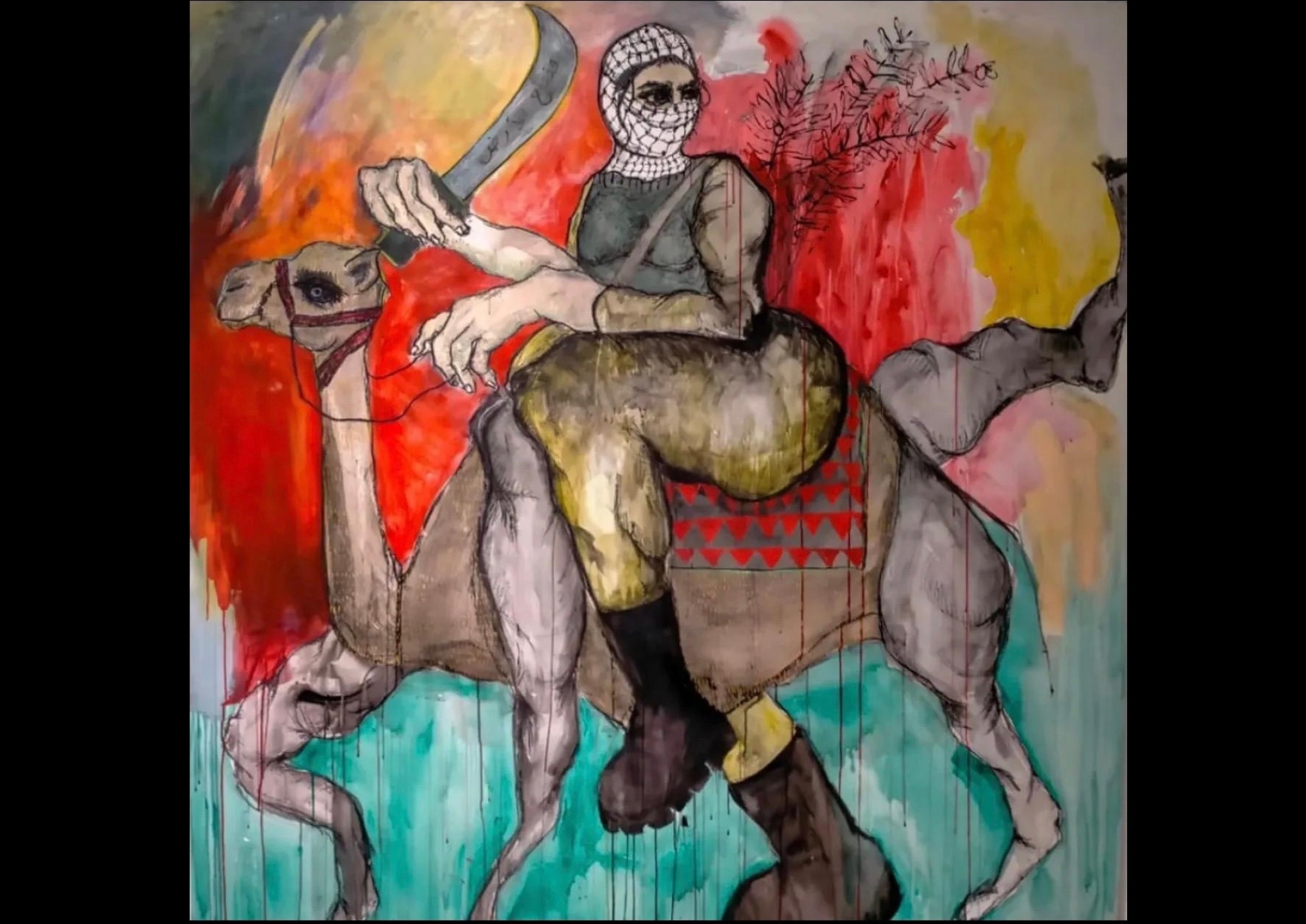
Serene Ghandour, "The Land" 2024. Mixed media on canvas, 200x200 cm.
I remember loving my birthday.
I remember feeling giddy on my birthday.
I remember being woken up by my mother, this great big smile on her face. Every year, she’d tell me the story of how I was born. She’d say it was 12 am when I started having contractions, two hours later, I was at the hospital
it happened so naturally, you were a breeze. I was out by 8 am the next day with you in my arms.
I remember feeling like a child.
I remember hating growing older.
I remember turning fifteen and thinking, “this is it,” a quarter of my life, gone.
I remember feeling too old at twelve, but I’ve never felt as old as I do now.
I turned 31 forty-two minutes ago.
And that giddy feeling in my stomach is missing. September was always my season, until it wasn’t. Poof. Just like that, thirty years of birthdays, and it only took just one to escape the birthday propaganda.
Birthdays were a serious thing growing up. They were immensely important milestones for my mother, and it wasn’t just specific birthdays. It wasn’t that she’d go big for 13 or 15 or 16 or 21, the ages that demarcated some turning point. No, it was each and every birthday.
Once, sat on my living room floor with a few friends, drinking cheap gin and complaining entirely too much about the industry jobs we all had, I asked someone I’d met that evening when her birthday was. Knowing someone’s birth chart is my shameless attempt at trying to know people.
I remember being vaguely surprised by her saying she wasn’t sure. She knew her birthday month, and generally that it was in the latter half, but Koreans often celebrated their collective birthdays on January 1st, she explained. Everyone turns one year older on January 1st, so if you happened to be born on December 30th, you were considered 1 year old on December 31st, and 2-years old on January 1st.
She went on to say there’d been a law change about that recently. Maybe mothers like my mother had rallied behind the change in legislation.
Why are birthdays even celebrated?
I used to roll my eyes when people asked that, but now I find myself thinking it.
“Do they not understand the joys being alive?” I’d think to myself. “Do they not understand that each year I continue to live is one more than I thought I’d get? Living is worth celebrating, isn’t it?”
There is a cyclical beauty to life. Maybe beauty is too optimistic. Magic. The magic of the cycle, the circle, the on and on of it all. And magic is awesome and terrifying.
We don’t understand it, and we can’t control it, so it scares us. But only at first. When you are laid bare to the whims of powerful structures and powerful people and powerful magic, it’s meant to make you think there is no rhyme or reason. To mystify the world is what magic does, and magic uses time to retrace and erase us.
We do not know that we have been here before, afraid of the same things we have always been afraid of. We have always been at the crossroads. We are there and here and there over.
My mother is Palestinian. She was born with a Jordanian passport. When she married, she was given a Lebanese one. Her birthplace on her Lebanese passport still says Haifa, Palestine.
I remember being afraid of exactly this as we neared the army checkpoint in Awkar, the one next to the American embassy, late one night. Do you think they’ll ask for my passport? she asks my dad who’s sitting in the passenger seat.
Bi kouno 3am bi nabcho 3a shi 7arame he replies. They’re probably looking for some criminal – a lazy attempt at reassurance.
My breath hitches in my throat as my mother rolls her window down.
Ya3tik el 3afye watan she greets the man in the camo uniform.
She refers to him as “the nation.”
The man says nothing in return, and instead shines a light at her, at my father, and then at me in the backseat, attempting to look as innocent and scared as possible. I knew how to weaponize fear, even then. I knew how to play and act and smile in order to survive. I knew the only way to stay safe was through making myself smaller – it is, after all, what I was taught.
A beat.
Tfaddalo he says as he gestures us forward with his head, allowing us to pass.
Ya3tik el 3afye, she thanks him.
My mother rolls the window up, and something in my chest unclenches. This is how I was taught to erase us.
The kindest thing I ever read was written by a partner on a wall. I remember she wrote, “in community with the erased, and those self-erasing to survive, and the magic of the process.”
She wrote it after a friend of ours presented her research paper to a room full of some successful, some famous, nepo-academics and intellectuals.
Our friend had just finished speaking to us about the act of archiving. She had challenged the audience to think of the photographs in our homes, the ones in desk drawers or crates, as an archive of family history. For her, this archive traced her family’s roots back to the south of Iran, her father pictured in the army, and the rest of the family enforcing smoke and mirrors around this fact.
For them, they were and are Emirati, nothing else, and nothing more. But this picture spoke to their otherness, an otherness that the family was too afraid to admit, let alone look at.
You see, my friend had manipulated this picture of her father. She cut a cloth to the contours of his body, in which he became a mere silhouette of velcro. She treated this intervention as permission. Her father was happy to show the picture to her friends when she asked. Other times, he came up with excuses not to. But this way, his consent remained reversible, and people still got to see the picture.
I think there’s more to it.
I think she found a way to be seen, to be witnessed, within the violent effacement games of her family. She was saying, here is a way to know where we are from, even in fear, even hidden. Here is how I can declare what I know to be true, and we can do it scared if we are too scared, and bravely on the days fear loosens its slight grip.
Is this what was meant by the magic of the process? The being in and of itself? The circle? The push and pull? The schlikh and schlakh of a velcro silhouette? The rolling of a window up and down? The rolling of tires? The process. The process. The cycles. The seasons. The genocidal turn-taking. On and on. The awesome and terrifying magic of the process.
It’s been two hours since I turned 31.
I received a surprise birthday wish a moment ago, in between the cold of my room and the ruffling of my duvet, and something stirred in my stomach. A glimpse of the feeling of those earlier mornings. Maybe, September is still my season. Maybe, having our seasons also means there are seasons not meant for us.